Dope vs Pope: Power in God’s Image
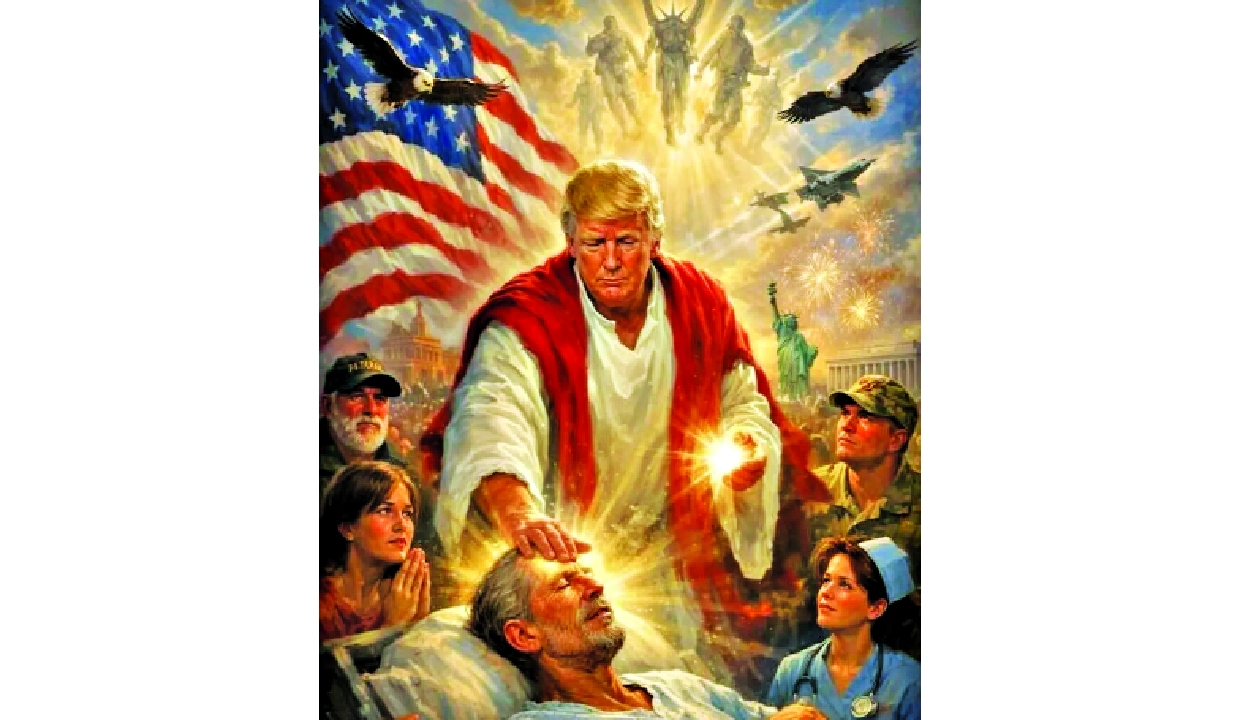
Hell must be calm and beautiful, as all monsters on the planet are, performing what hell itself was meant to perform. Jimmy Kimmel got it right when he reduced the moment to a satirical shorthand: “Dope vs. Pope.” Soon after President Donald Trump posted an AI-generated image of himself in a Jesus-like role, appearing to heal a sick man-widely interpreted by critics as resembling Jeffrey Epstein-in a hospital bed, the reaction did not merely ripple through Washington or the Vatican, but spread across the wider political orbit that surrounds him. The image-later deleted from his social media account-showed Trump in a white robe, his hand glowing as it touched the forehead of a patient, framed by a staged backdrop of the American flag, the Statue of Liberty, fighter jets, an eagle, a praying nurse, and a uniformed soldier. Across political lines, it was read as self-exaltation, a deliberate borrowing of sacred imagery for personal elevation. The episode was not an ordinary online controversy. It worked as a break in meaning: political identity, religious symbolism, and artificial intelligence fused into a single manufactured claim of authority. To treat it as a passing provocation would miss the point. Political history is full of rulers who have clashed with religious power or bent it to their own needs. From emperors bargaining with the papacy to modern regimes trying to absorb religious institutions into the state machine, the Church has long stood as a rival source of legitimacy.
In the twentieth century, ideological systems often defined themselves against religious authority. Adolf Hitler, in the private fragments recorded in Table Talk, described Christianity as hostile to the logic of struggle and survival, treating it as a moral system that weakened his worldview. Joseph Stalin reduced the Vatican to irrelevance with the blunt question: “How many divisions has the Pope?” Benito Mussolini treated religion as something to be contained and managed under state supremacy.
Across these systems, the Church was either dismissed, controlled, or stripped of independent authority.
Authority is no longer carried only through law, policy, or institutional negotiation. It is constructed through images that circulate quickly and provoke reaction. Political power now often appears first as visual impact before it becomes anything else. This matters because earlier conflicts between Church and state were built on jurisdiction, belief, and sovereignty. Today, the conflict is not structured in that way. The AI image of Trump as a Christ-like healer is not an argument. It is an act of symbolic appropriation that unsettles the boundary between sacred representation and political display. Religious imagery becomes material for personal projection, while political leadership borrows the visual language once reserved for spiritual authority.
Against this backdrop, Pope Leo XIV presents a sharply different form of authority. His statements repeatedly insist that the Church does not function as a party-political actor, yet he refuses silence on moral questions. He has stated that he does not intend to enter partisan politics, but also insists he will speak where he believes Gospel principles are at stake. In one of his most quoted interventions, he directly counters contemporary political reasoning by stating that “JD Vance is wrong: Jesus does not ask us to rank our love for others,” rejecting any attempt to organise Christian ethics into hierarchies of human value. This position avoids easy classification. It is neither aligned with ideological conservatism nor with progressive political agendas. Instead, it rests on a claim that moral truth cannot be reduced to political identity. Ethical teaching, in this view, is not meant to serve a faction, nor disappear into neutrality. It remains active in public life without becoming owned by it. He is equally direct about internal weaknesses within the Church. His criticism of “indoctrination” is not decorative language. It is a warning that religious teaching loses integrity when it suppresses independent moral judgement. He argues that indoctrination damages conscience by removing the possibility of genuine reflection, even when that reflection leads to disagreement. This places him in the middle of ongoing internal disputes over doctrine, authority, and pastoral direction. It is within this context that his African apostolic journey gains weight. Covering roughly 18,000 kilometres across several countries, and including a visit to the Great Mosque of Algiers, the journey is more than ceremonial travel. It signals a shift in where Catholic growth and influence now sit. Africa is no longer peripheral to global Christianity; it is one of its strongest centres. Beginning a major journey there is a deliberate acknowledgment of that reality.
The contrast with Trump is direct. The papal journey is physical, slow, and rooted in encounter. It depends on presence, dialogue, and institutional continuity. Trump’s communication style operates in a different register entirely. It is instant, visual, and designed for rapid circulation. One approach builds meaning through continuity in time; the other creates impact through immediate display and repetition. One draws authority from tradition; the other reshapes tradition into material for ongoing public reaction.
This difference also reflects a wider shift in how authority is understood. The idea of an American pope was once considered unlikely, largely because of concerns about how closely American political culture sits with global religious authority. Yet Leo XIV’s election complicates that assumption. He has been described as “the least American of Americans”, a phrase pointing to someone who carries national origin but does not appear confined by it. His Augustinian grounding, centred on shared life, unity, and moral order, frames authority as something held in common rather than performed for effect.
Trump’s use of religious imagery should not be reduced to simple disrespect. It reflects a wider condition in which institutions no longer hold exclusive control over meaning. Symbolic language now moves freely across digital platforms, detached from its original setting. Religious images can be lifted into political communication without mediation by religious authority. Despite all this, what if Trump genuinely believes he is the chosen one-the ‘son of God’-and that every action he takes is divinely instructed? Then who, in the end, is the real ‘dope’?
The writer is a columnist based in Colombo; Views presented are personal.