Rulers of the Deep: India’s forgotten Maritime Legacy
A nation with oceanic flanks, seaborne trade, and an inextricably maritime civilisational history cannot afford to remain continental in its imagination. The Indian Ocean has been, across four millennia, India’s ocean. The nectar is there, in the depths. The churning must not stop
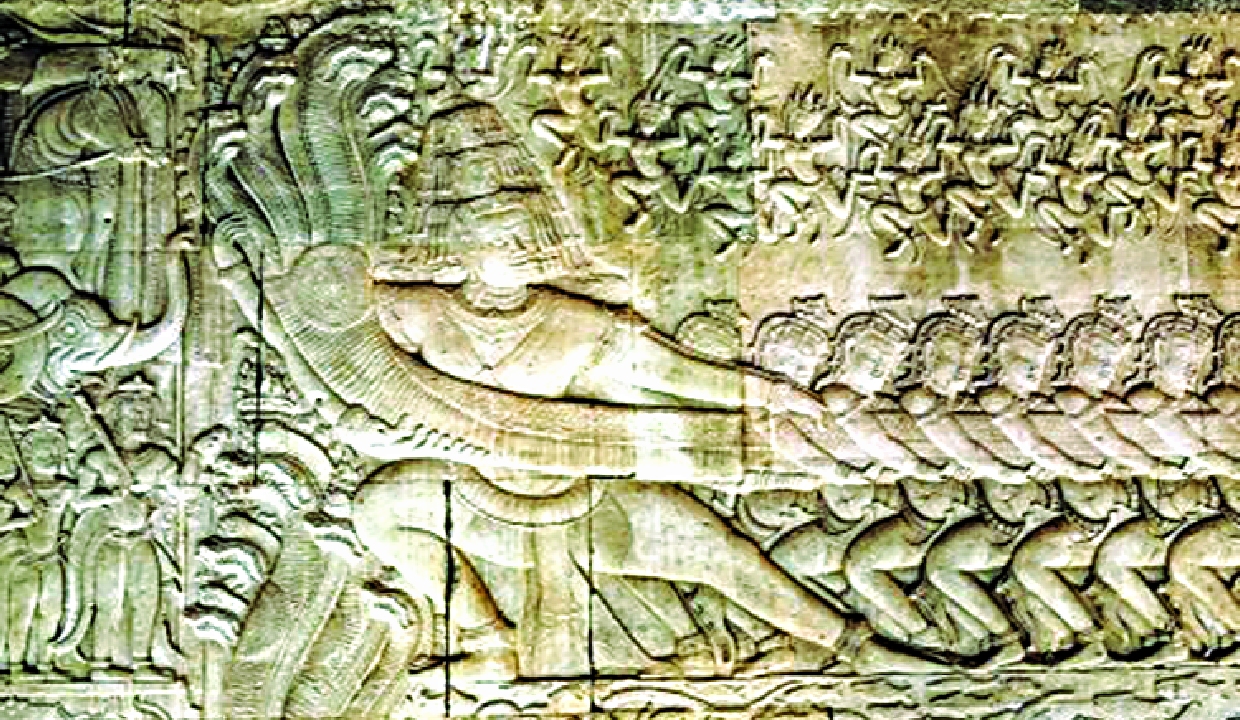
The ancient story of Samudra Manthan, the Churning of the Cosmic Ocean, is among the most enduring in India’s civilisational memory. The Devas and Asuras, rivals bound by necessity, churned the primordial sea using Mount Mandara as the rod and the serpent Vasuki as their rope, with Lord Vishnu steadying the mountain in his tortoise form. From the depths emerged wonders — but first came Halahala, a poison of annihilating potency. Lord Shiva consumed it, turning blue and saving the universe. Only then did amrita, the nectar of immortality, finally surface. The meaning is eternal: great rewards come only through great struggle. Poison and nectar must both be faced. India’s maritime history is its own Samudra Manthan — four millennia of churning the seas, enduring subjugation, and now reaching once again for the nectar. This is that story.
The prehistoric Mariners: Before history had a name
India’s relationship with the sea predates recorded history. Archaeological evidence from the Gujarat and Konkan coastlines suggests that prehistoric communities were sailing watercraft as far back as 3000 BCE, reading stars, mapping currents, and making deliberate open-water crossings. The sea was not an obstacle to these people; it was a highway — a foundation upon which all subsequent Indian maritime achievement would rest.
The Indus Valley Civilisation: Commerce across open waters
The Harappan civilisation (circa 3300-1300 BCE) provides the earliest concrete evidence of India’s maritime enterprise. The port city of Lothal in Gujarat revealed a sophisticated dockyard — arguably one of the world’s first planned port facilities. Harappan seals and artefacts found across Mesopotamia and the Persian Gulf confirm structured, organised trade routes over four millennia ago. India was, in this earliest chapter, already an Indian Ocean power.
The Maurya empire: Naval power at the service of empire
The Maurya dynasty (322-185 BCE) is celebrated as a land empire, but its naval dimension is underappreciated. Kautilya’s Arthashastra describes a dedicated admiralty — the Navadhyaksha — that classified and maintained naval vessels as instruments of commerce and strategic power. Maurya ports on both coasts sustained trade extending to Sri Lanka, Southeast Asia, and the Mediterranean. The empire grasped, intuitively, what Mahan would articulate two millennia later: that seaborne commerce was foundational to imperial power.
The Kalinga legacy: A Maritime nation with a soul
Kalinga, occupying the eastern seaboard (modern Odisha), produced celebrated navigators — the Sadhabas — whose transoceanic voyages are still commemorated in the Boita Bandana festival. Kalinga’s maritime reach shaped the culture, religion, and governance of coastal Southeast Asia. Hindu and Buddhist philosophy, architectural traditions, and legal concepts spread to Myanmar, Thailand, Cambodia, and Indonesia not by conquest alone, but through sustained maritime commerce. This was soft power wielded through the sea, centuries before the concept had a name.
The Chola empire: India’s greatest naval power
No dynasty better exemplifies India’s maritime zenith than the Cholas (9th-13th centuries CE). Under Rajendra Chola I, the navy launched a transoceanic campaign that defeated the Srivijaya empire of Sumatra, establishing dominance over the Strait of Malacca — the chokepoint that carries roughly 40 per cent of global trade today. This was blue-water capability: purpose-built warships, professional naval command, and logistics sustaining operations thousands of kilometres from home. The Cholas came closest to what Mahan called the command of the sea — using maritime routes for their own purposes while denying them to adversaries.
The Vijayanagara empire: The last great Maritime patron
Vijayanagara (1336-1646 CE), though primarily a land power, understood coastal control. Its rulers fostered trade through the ports of Calicut and Cochin, and their prosperity depended on seaborne imports of horses and exports of spices and gems. Their reign coincided with the first arrival of Portuguese caravels - and the empire’s inability to mount a coordinated naval response to European power would prove decisive for the centuries that followed.
Chhatrapati Shivaji Maharaj: The father of the Indian Navy
In India’s long narrative of maritime decline, one figure blazes as an exception — Chhatrapati Shivaji Maharaj (1630-1680). He grasped what eluded almost every ruler of his era: without command of the sea, no Deccan power could be truly sovereign. Against the entrenched Portuguese, the consolidating British, and the Mughal Siddi admirals, Shivaji built a navy from scratch — agile gurabs and gallivats suited to the Konkan coast, and a chain of sea forts including the formidable Sindhudurg, completed in 1667, a declaration that the sea belonged to the Marathas.
His admiral Kanhoji Angre went on to resist the combined fleets of Portugal, Britain, and the Dutch for decades. Shivaji understood that a navy was not auxiliary but primary - that the same waters bringing European power to India’s shores could be used to deny and contest that power. It was a lonely, prescient act of strategic imagination. The Indian Navy’s premier shore establishment, INS Shivaji, fittingly honours his legacy.
The unravelling: How India lost the sea
The decline was neither sudden nor simple. The 1509 Battle of Diu, in which a Portuguese fleet defeated a combined Ottoman-Indian force, marked the turning point after which European powers progressively dominated the Indian Ocean. Even Shivaji’s naval renaissance remained regionally confined and was dismantled after his death as the Marathas turned inland.
Social forces deepened the erosion. Hardening caste restrictions stigmatised maritime occupations. The Kala Pani taboo - the belief that crossing the ocean caused ritual pollution - discouraged seafaring among the upper strata. Successive Mughal emperors, brilliant administrators but continental in orientation, showed scant interest in sea power. By the time the British East India Company consolidated its grip, a civilisation that had launched transoceanic naval campaigns was reduced to crewing British merchant vessels.
Post-Independence India: Reclaiming the Maritime identity
Independent India inherited a modest navy and, preoccupied with land borders, remained a continental power in outlook for its first decades. The transformation has been gradual but real. The Maritime Security Strategy of 2015 formally claimed primacy in the Indian Ocean Region. The SAGAR doctrine — Security and Growth for All in the Region — positioned India as a net security provider across the ocean.
Today India operates two aircraft carriers: INS Vikramaditya and the indigenously built INS Vikrant, commissioned in 2022 — the first carrier designed and built in India, a milestone of deep symbolic weight. Nuclear submarines, surface combatants, and the Information Fusion Centre for the Indian Ocean Region reflect expanding reach. Yet gaps remain: procurement delays, budget constraints, and China’s rapid naval build-up and port investments across the littoral present challenges India has not yet fully resourced itself to meet.
Conclusion: The nectar rises
The Devas and Asuras did not abandon the churning when the poison emerged. They endured it — because they knew the nectar lay deeper still. From Lothal’s dockyard to Rajendra Chola’s transoceanic fleet, from the Kalingan traders who carried civilisation across the Bay of Bengal to Shivaji’s sovereign navy on the Konkan coast, India’s relationship with the sea was foundational to its power and identity.
Colonial conquest, social taboo, and strategic neglect broke that relationship. India swallowed its Halahala across two centuries of diminishment. But the churning has resumed. INS Vikrant, the SAGAR doctrine, and new naval and coast guard bases on both coastlines are signs of a civilisation remembering what it once knew.
A nation with oceanic flanks, seaborne trade, and an inextricably maritime civilisational history cannot afford to remain continental in its imagination. The Indian Ocean has been, across four millennia, India’s ocean. The nectar is there, in the depths. The churning must not stop.
The writer is a retired Additional Director General of the Indian Coast Guard; Views presented are personal.
Leave a Comment
Comments (1)
Well researched article on our maritime legacy sir. It has enhanced our knowledge about our maritime legacy.