Mamata: Rise, rebellion and the reckoning of Bengal’s stormy petrel
Defeated by the very saffron force she once allied with, Mamata now faces the most searching moment of her career — one marked by questions over strategy, opposition unity, political miscalculations and the changing mood of Bengal. Her fall is a larger commentary on the volatile nature of power and personality-driven politics
The “stormy petrel of Indian politics”! She truly fits the bill of this adage. A fighter to the core who refused to accept the “injustice” done to her by her parent party, the Congress. She walked out to set up a political party of her own, squarely based on her street-fighting skills and enormous capacity to lead from the front.
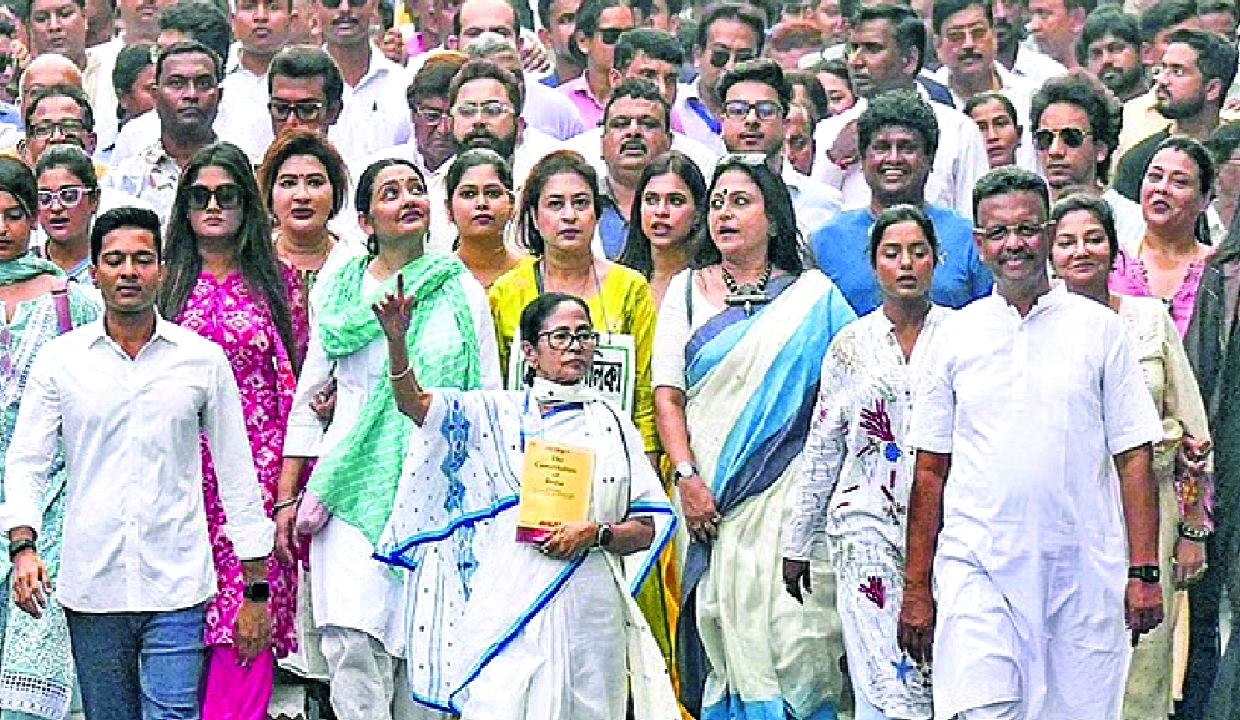
Rising from scratch after remaining a Union Minister and president of the West Bengal Youth Congress, Mamata Banerjee, a maverick to the core, was and is a rule unto herself who never accepts any hegemony but has a strong tendency to dominate. The white cotton-saree-clad, simpleton-looking, diminutive woman briskly walking in her trademark white hawai chappals led the newly founded Trinamool Congress to new heights before the fall with a thud.
Who could have even dreamt of plotting the downfall of the Left citadel anchored by the indomitable comrade Jyoti Basu, who remained Chief Minister of West Bengal for a record period? There was none to challenge it, with Congress having fallen by the wayside after being further weakened with the quitting of Banerjee and her supporters.
She did literally achieve what was perceived to be an impossible task. The Left’s fortress had fallen and Banerjee rose like a colossus and dominated West Bengal politics for over a decade till the debacle of the 2026 Assembly election came.
Keeping aside the controversies surrounding the poll process for the time being, she was beaten at her own game — defeating the Left — by the new emerging power in the state, the Bharatiya Janata Party. The latter fully trudged on the communal contours, rising on the controversial bogey of Special Intensive Revision (SIR) of voter lists by the Election Commission of India. Ordered in a huff, which resulted in the deletion of lakhs of voters within no time, it put a question mark on the entire process.
The once stormy petrel of yore was defanged by none other than a political party, BJP, with which she had once been in alliance and became the Railway Minister in the Atal Bihari Vajpayee dispensation. There is no doubt that her aligning with the saffron party at that juncture opened a window for the BJP in West Bengal for the first time, despite the founder of the party’s former formation, Bharatiya Jana Sangh, Shyama Prasad Mukherjee, being a native of the state.
Was it Banerjee’s miscalculation to have sided with the BJP squarely out of her hatred for the Congress on the lines of the socialist brigade led by former Defence Minister George Fernandes?
The cases, though, are not comparable. Strong dislike for Congress was a common thread. After all, both of them, born mavericks, were Cabinet colleagues in the Vajpayee government. Both of them overshot their respective ideologies based on secularism to make a common cause with the “Hindutva agenda” to checkmate the Congress and at the same time keep politically afloat.
While Fernandes had somewhere meekly surrendered, as during the twilight of his political career the once firebrand leader had lost his sting before the towering Vajpayee-Advani duo, Banerjee stood her ground and refused to budge before the same BJP, now helmed by yet another duo from the same formation, Prime Minister Narendra Modi and Home Minister Amit Shah.
So far so good. All this while, till she lost the election and the Chief Minister’s chair, Banerjee abhorred the rickety INDIA bloc of the opposition parties, at times ridiculing it, particularly Rahul Gandhi. Not only did she play hide and seek at crucial junctures, but at times her tantrums weakened the opposition unity even before it could take shape.
Was it to still indirectly help her erstwhile ally-turned-enemy, who has ultimately consumed her? Or was it to force her fellow opposition party leaders to accept her supremacy and leadership unconditionally?
She might not have liked to help BJP (read Modi-Shah), but her unpredictability and her mercurial ways of functioning did aid the saffron party by jeopardising, knowingly or unknowingly, the cause of opposition unity. In the end, it added to Modi’s strength.
Well, true to her nature, she suddenly discovered her long-lost love for the INDIA bloc minutes after her defeat. A sullen and crestfallen Banerjee, in her first press conference after a massive BJP “wave”, talked of her next goal to strengthen the alliance. “Not as a leader but as a commoner (read worker)” was the catchphrase of her presentation.
Except for Gandhi (read Congress), most of the opposition leaders and their outfits seem to have ignored the “might” of Modi despite the BJP failing to muster a simple majority on its own in the 2024 Lok Sabha elections. The three glaring examples are those of Shiv Sena (UBT) chief Uddhav Thackeray, Nationalist Congress Party supremo Sharad Pawar —both the parties are now split and the leaders nursing their wounds — and now Mamata Banerjee lording over the defeat of Trinamool Congress. But for marginal splits in her ranks, here and there, she withstood the Modi-Shah combine’s onslaught at engineering a major split, as has happened in the other two parties.
Who can forget the unceremonious transition of Nitish Kumar from Bihar’s Chief Minister, vacating the chair for BJP, to Rajya Sabha MP? And Biju Janata Dal chief Naveen Patnaik is licking his wounds after being waylaid by an “old and trusted ally”, the BJP.
However, the duo seemed to have other plans up their sleeves, which an overconfident and arrogant Banerjee either ignored to see through or inimitably decided to take head-on. Was she ignorant about the ground realities and changing electoral map and people’s mindset? Did she fail to counter the polarising agenda of the BJP and fall into their trap by trying to match it with a similar counter, though of a different shade?
These and many more questions will haunt her in the time to come. What baffles one the most is why she did not plan to unitedly enter the poll arena to face the BJP’s growing influence, armed with statecraft.
It is ironic for the opposition unity that most of its leaders remember INDIA only either after electoral defeat or during times of crisis. A sturdy framework for opposition unity has to be cemented during normal times, with the leaders keeping their egos and hypothetical ambitions aside.
No one is sure as to how Banerjee’s defeat in her native state will strengthen the INDIA bloc. She has weakened her case to spearhead the combine en route to becoming a prime ministerial candidate. Instead, leaders such as her and DMK chief M K Stalin, both of whom lost their Assembly seats, should restart the effort at opposition unity on a very humble note.
Was it Banerjee’s miscalculation to have sided with the BJP squarely out of her hatred for the Congress on the lines of the socialist brigade led by former Defence Minister George Fernandes?
The writer is a political and national affairs analyst; Views presented are personal.