The Indian Navy’s quiet war for energy security
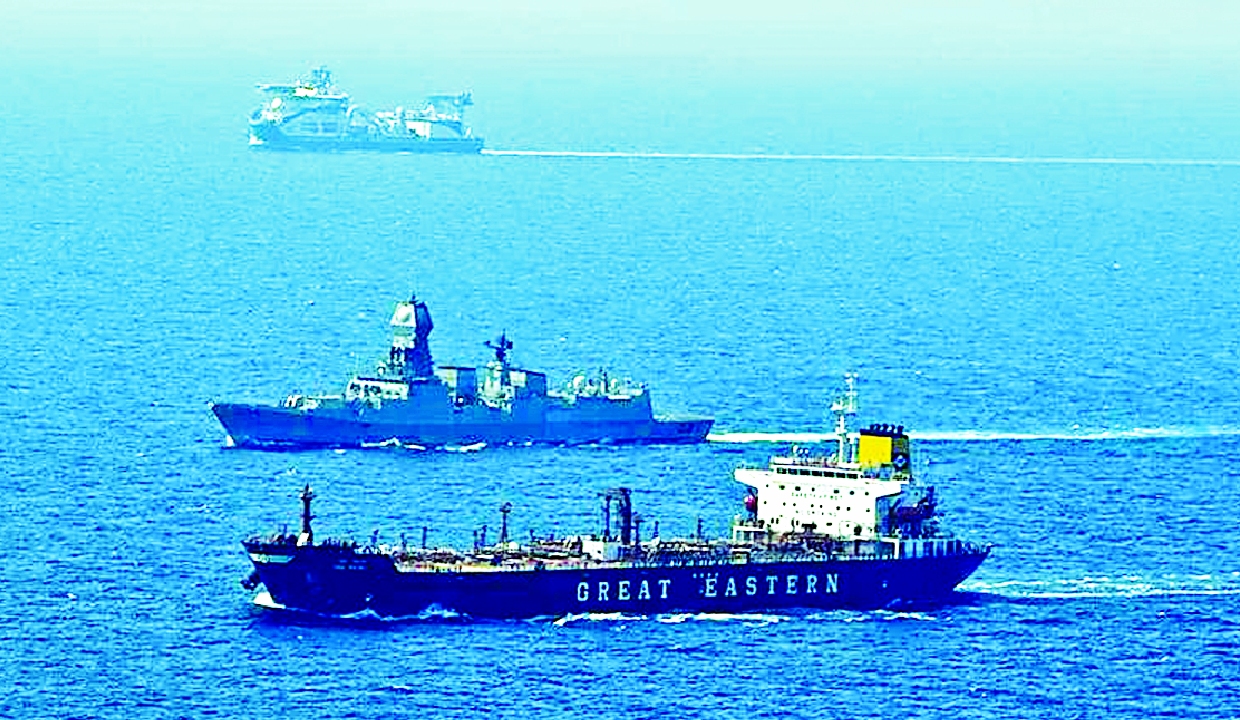
The recent tensions around the Strait of Hormuz have once again reminded us how delicate the global energy system really is. For India, this is not a distant geopolitical headline - it shows up much closer to home. Nearly 20 per cent of the world’s oil trade passes through this narrow corridor, and India imports over 80 per cent of its crude requirements, with a significant share coming from the Gulf. Even brief disruptions here tend to be reflected quickly in domestic fuel prices, freight costs, and inflation.
What does not get talked about enough is this: even if every tanker were escorted safely, things could still go wrong. It is easy to assume that naval escorts solve the problem, but they do not. In high-threat environments, convoy operations reduce speed and throughput - meaning fewer ships can pass through in a given time. So the real issue is not just safety; it is whether enough oil can keep moving on time. That is where the role of the Indian Navy becomes far more layered than it appears.
Over the past few months, as tensions in West Asia have risen, we have already seen early signs of strain. Tanker insurance premiums for the Gulf reportedly spiked by 30-50 per cent during peak-risk periods, while several shipping operators either delayed voyages or rerouted cargo. Alternative pipelines - such as Saudi Arabia’s East-West pipeline and the UAE’s Fujairah corridor - together can bypass only a fraction (roughly 6-7 million barrels per day) compared to Hormuz’s normal flow of over 20 million barrels per day. In simple terms, there is no real substitute for Hormuz at scale. In such a situation, the Navy’s job goes well beyond merely being present or providing protection. It is about keeping routes viable. Its mission-based deployments across the Arabian Sea and the wider Indian Ocean Region are designed to maintain a continuous presence in key shipping lanes. This presence does something important: it builds confidence. Shipping companies and insurers react as much to perceived risk as to actual threats. A credible naval footprint helps ensure that commercial traffic continues, even in uncertain conditions.
There is also another side to this story that receives far less attention: India’s dependence on liquefied natural gas (LNG). India imports roughly 45-50 per cent of its natural gas needs, much of it from Qatar via Hormuz. Unlike crude oil, LNG cargoes operate on tighter schedules and with limited storage flexibility. Even short delays can disrupt power generation and city gas supply chains. During recent tensions, several LNG carriers reportedly slowed or paused transit, underlining just how exposed this segment is. Here too, the Navy’s role is indirect but crucial; it helps maintain predictability in movement.
Then there is the digital layer, almost invisible but critical. The waters around Hormuz also carry major subsea communication cables that support global financial systems, shipping logistics, and energy trading platforms. Any disruption here would not just affect communication — it could interfere with how energy markets function in real time. In the years ahead, maritime security will increasingly include safeguarding both physical cargo and the data systems that support it.
At the same time, India has been quietly adapting. In response to recent disruptions, Indian refiners increased sourcing from alternative suppliers, including Russia and the United States, to cushion supply risks. This reflects a broader shift - energy security today is no longer about a single source or route. It is a mix of diversification, market flexibility, and maritime security. The Navy plays a central role in enabling this system to hold under pressure.
Another key lesson from the current situation is that chokepoints are interconnected. When stress builds in Hormuz, it inevitably shifts towards other critical routes like the Strait of Malacca, which carries nearly one-third of global maritime oil trade. For India, this creates a dual-front challenge — securing energy flows from both the west and the east.
The Navy’s distributed deployments across the Indian Ocean are built precisely to manage this kind of scenario. All of this points to a quiet but important shift. The Indian Navy is no longer just guarding sea lanes — it is helping keep a complex, high-volume system running. It manages risk, supports flow, and buys time when uncertainty rises. Because, in the end, energy security is not just about where oil or gas comes from. It is about whether it can keep moving at scale, without interruption, and at the desired scale. And often, that answer is decided at sea. Hence, fair winds and Sham No Varuna to all our men and women on the open waters.
The writer is a Delhi-based independent contributor to print and online publications; Views presented are personal.