Dashavatar to Darwin: Tracing Life’s Evolution
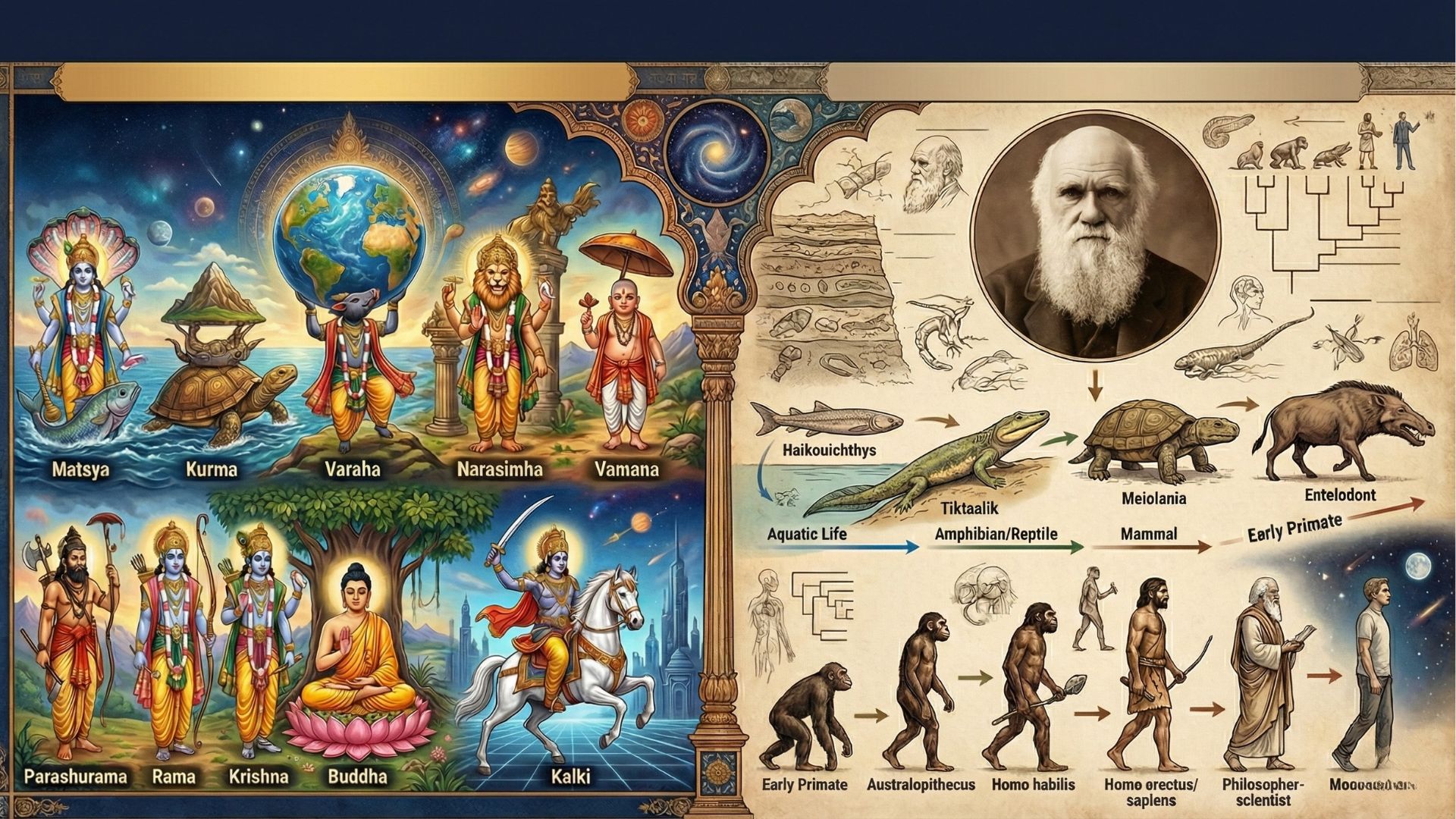
On 12th February 1809 in Shrewsbury, England, a boy was born who would later be responsible for how humans thought about their existence. That boy was Charles Darwin, a name that echoes around the world, specifically when ‘evolution’ is spoken of. Scientific institutions, universities, humanist groups, and educational organisations commemorate his birthday by celebrating “Darwin Day” for his immense contribution to the field of science and for developing the Theory of Evolution by Natural Selection and authoring Origin of Species. His theory is metaphorically referred to as the "Theory of Everything" for Biology, as it provided the first unified explanation for the incredible diversity of life on Earth.
Simplifying Darwin’s theory, he mainly talked about variation, where individuals within the same species have different traits and inheritance. These traits can be passed down to the next generation, and natural selection, where, due to limited resources in nature, individuals having traits better suited to their environment are more likely to survive and reproduce. Further explaining that more offspring are produced than can survive, leading to a struggle for existence, and that over generations, this process can result in gradual change and the formation of new species. However, Darwin did not know about genes or modern genetics, so he could not fully explain the biological mechanism behind how traits are inherited. However, his theory was acknowledged across the scientific community.
Edward Blyth - The Indian connection to Darwin
A year younger than Darwin, Edward Blyth, a British zoologist and one of the early contributors to evolutionary thought, is one of the lesser-known but key links between India and Darwin’s work. Blyth served as the curator of the Asiatic Society in Calcutta (now Kolkata) from 1841 to 1862, where he sent specimens, which included detailed observations from India, to Darwin. Blyth specimens included data on Indian cattle breeds, the wild ass of Kutch, and cross-bred Indian geese, amongst others. Both corresponded with mutual admiration for each other, with Darwin acknowledging and citing Blyth’s work in Origin of Species with nearly 40 references.
Dashavatar & Darwin
Edward Blyth wasn’t the only connection with Darwin and India. A striking similarity to Darwin's theory — the Dashavatar of Lord Vishnu.
Like many other Hindu philosophies, where symbolism and deeper aspects are often rooted in scientific truths. The Dashavatar of Lord Vishnu appears to narrate how life on Earth evolved. Darwin's idea of life's aquatic origins resonates perfectly with the Matsya Avatar (fish). It then parallels the Kurma Avatar (tortoise), marking the amphibious transition. Living organisms gradually adapt to land, fully transforming into terrestrial animals with the Varaha Avatar (boar). Finally, the Narasimha Avatar (half-man, half-lion) represents the early stages of human evolution. However, from there, it takes a more philosophical and spiritual path: Rama symbolises the ideal human qualities we need, Shri Krishna achieves perfection in various arts and aspects of life that humans aspire to, Buddha represents the path to Nirvana(enlightenment), and finally, Kalki stands for cyclical or progressive evolution.
That being said, there are differences in approach: Dashavatar is more philosophical and spiritual, attributing the beginning of life to divine intervention. Darwin, on the other hand, focuses on natural selection, genetic variation, and random processes, with the sole aim of explaining biological diversity. The comparison is retrospective and symbolic, with no historical evidence of the influence of Hinduism on an agnostic Darwin.
While Darwin explains his work through science, Hinduism reminds us that humans have always sought to understand mysteries through religion. However, one can introspect on whether the Indian myths, philosophies, art, literature, and studies do actually have answers to life — its beginning and end; a decision open to the readers.
AK Sharma & Anshuman Sharma
Designation - Independent Consultants.