Cheap Drones, Costly Wars
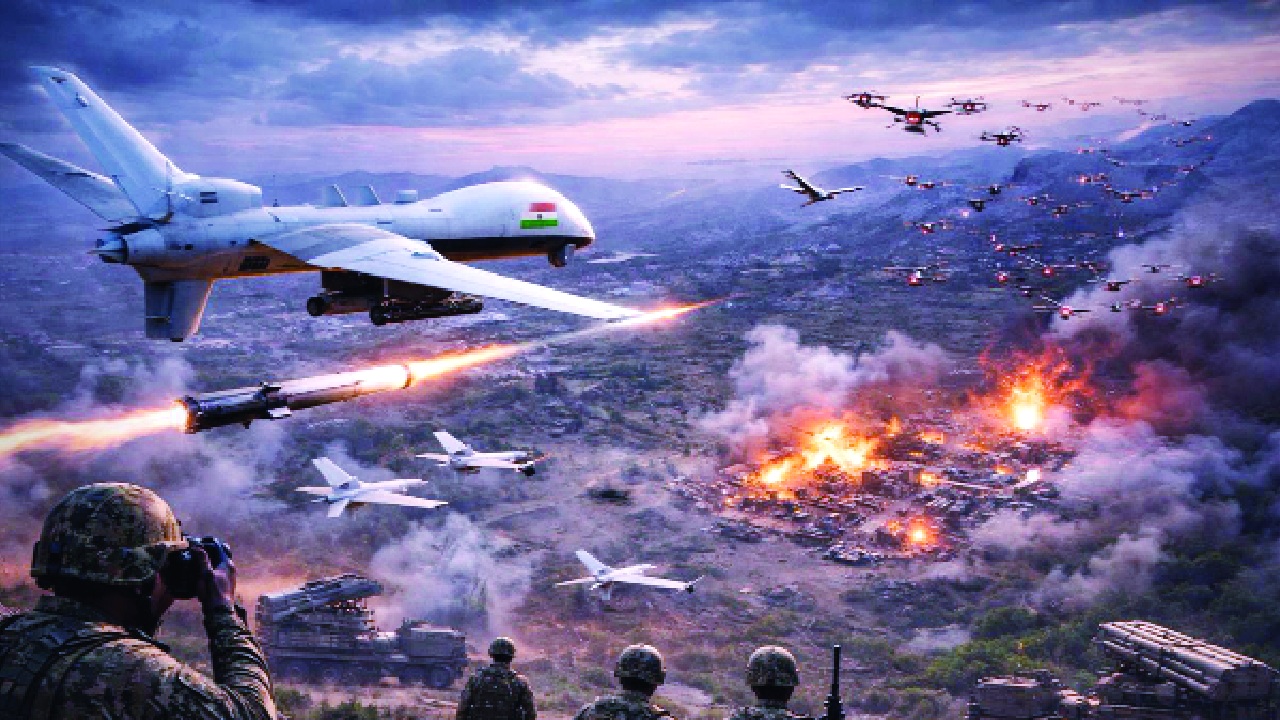
Drones have captured global military imagination, dominating conflicts from Eastern Europe to the Middle East and creating the impression that mass and saturation now determine victory. Yet how wars actually end tells a different story. Some conflicts have de-escalated swiftly after decisive air campaigns, while others have dragged on despite extensive drone use. For India, this distinction is critical, shaping how future sub-continental conflicts may be fought and how swiftly they can be decisively concluded. At the heart of this debate is the distinction between Tier-1 and Tier-2 airpower.
Tier-1 airpower represents the pinnacle of military aviation: modern fighters, fused sensors, AI-enabled planning, and - crucially - doctrine, training, integration, and intent. It is designed to conduct air campaigns that target an adversary’s decision making capacity, with precision, intelligence fusion, command and control, and escalation management as core attributes. Tier-2 airpower, by contrast, relies on mass - especially drones - for steady attrition. Despite its technological sheen, it mirrors World War-1 trench warfare in the air, producing prolonged conflicts, marked by rising costs rather than decisive outcomes.
Recent experience indicates that Tier-1 airpower is far more effective at compressing conflict timelines. Operation Sindoor illustrates this clearly. The campaign relied on precision air strikes, tight command and control, and careful escalation management. IAF fighters, employing precision stand-off weapons and electronic warfare, penetrated Chinese-origin Pakistani air defence systems to conduct deep strikes against terror camps and PAF bases. Instead of seeking marginal effects through low-impact drone attrition, Indian planners delivered a swift and sharp demonstration of capability that constrained the adversary’s choices. Pakistan’s drone and missile responses were neutralised by India’s layered and integrated air defence network. Within four days, the conflict ended, with the regional military balance decisively signalled through airpower.
This logic echoes the Tier-1 airpower masterstroke of Israel’s Operation Rising Lion against Iran. In a volatile region prone to escalation, Israel prioritised rapid air superiority through pre-emptive SEAD (Suppression of Enemy Air Defences), using AI-sifted intelligence for hyper-precise strikes. Follow-on attacks targeted key nuclear facilities at Natanz and Fordow, while Iran’s retaliatory drones and missiles were intercepted with a very high success rate. The outcome was a short and intense confrontation that conveyed strategic resolve without sliding into prolonged war. For India, facing nuclear-armed adversaries, the lesson is clear: speed, clarity, and control are strategic necessities, not optional advantages.
The contrast with the Russia-Ukraine war is stark. Despite ubiquitous drone use for reconnaissance, strikes, and harassment, neither side has achieved decisive advantage. Instead, the conflict has degenerated into a grinding contest of endurance, exposing Tier-2 airpower’s fatal flaws as incremental gains are purchased at immense human and economic cost.
Global think tanks quantify Tier-1’s edge with hard data. A 2025 CSIS study comparing Israel-Iran and Russia-Ukraine shows that Tier-1 forces like Israel achieved air dominance in four days with about 200 sorties, at an estimated cost of roughly $2 billion. By contrast, Russia has spent around $500 million per day for years with limited gains. SIPRI data further shows that prolonged wars drive exponentially rising military expenditure across entire regions, not just the belligerents.
The verdict is clear. Tier-1 airpower - precision and doctrine over drone deluges - doesn’t merely prevail; it ends conflicts faster and at lower overall cost. Attrition-based, drone-heavy warfare may appear affordable per unit, but it becomes ruinously expensive over time. Prolonged conflicts drain national attention, slow economic growth, and heighten risks of horizontal or vertical escalation. World Bank and SIPRI studies show that long wars impose costs far beyond the battlefield - lost GDP, deferred development and reconstruction burdens. By contrast, short, decisive campaigns, even with high upfront investments, are typically cheaper across their lifecycle.
India’s strategic calculus is clear. As a rising power seeking sustained growth and regional stability, it must not fall into the trap of a war of endurance. Its geography and threat environment already raise the prospect of a two-front contingency, where time matters as much as terrain. Tier-1 airpower addresses this challenge by shaping outcomes rapidly, limiting conflict duration, and preserving strategic flexibility. This does not render drones irrelevant.
They remain valuable, versatile and complementary enablers in modern warfare. However, drones alone do not deliver a strategic advantage; they lock adversaries in cycles of retaliation rather than compel resolution. Recent conflicts show that technology without doctrine prolongs war. India’s evolving airpower posture, emphasising precision strike, integrated air defence, intelligence fusion and integrated planning reflects a clear understanding of this reality. The real choice is not between manned aircraft and drones, but between decisive outcomes and protracted conflict.
In an era captivated by FPV drone footage, India’s experience offers a more enduring lesson: wars end faster when airpower targets an adversary’s ability to decide, not merely its capacity to endure. That is the true advantage of Tier-1 airpower and why India’s bet on it matters.
Wing Commander Ankit Abbott, VSM is a flying branch officer with operational experience on fighter aircraft. He also commanded a Surface-to-Air Guided Weapon Squadron; views are personal