Breaking Maharashtra’s patriarchal order
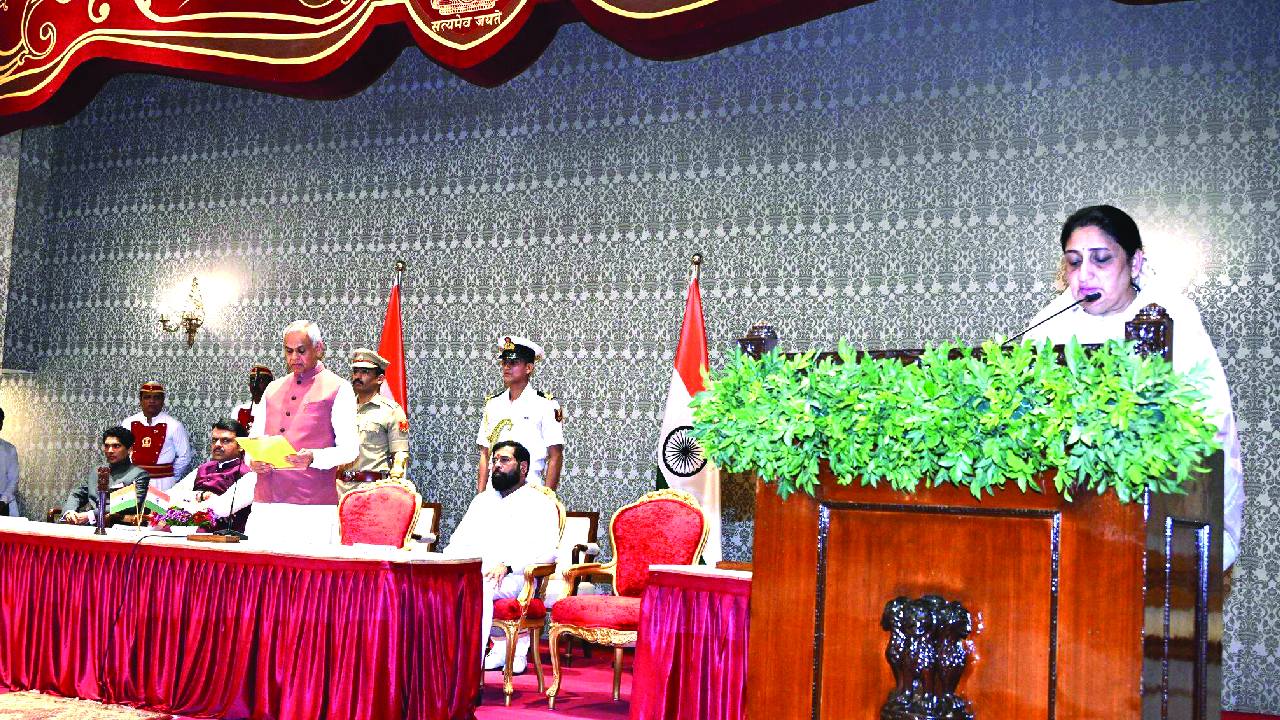
In Maharashtra's deeply ritualised political culture, the emergence of Sunetra Pawar marks a quiet but consequential departure from convention. Transitioning from personal bereavement to public responsibility, she entered office without invoking ritualised sympathy or seeking patriarchal endorsement-an approach that itself carries political significance.
Close observation shows a public demeanour marked by composure, restraint, and self-assurance. While Lady Pawar's rise has been facilitated by the ruling dispensation and networks associated with her late husband, she has not projected herself as a ceremonial placeholder or proxy. Instead, her actions indicate an intention to define her role independently within existing power structures. A commerce graduate with long-standing interests in agriculture, the arts, and social work, she remained outside active politics for much of her life despite coming from a political family. After marriage, she took up farming and later built a profile as a social entrepreneur and environmental advocate through initiatives in rural sustainability. She chairs the Baramati hi-tech textile park, employs large numbers of rural women, and serves as a trustee of her family's Vidya Pratishthan. Entering electoral politics in 2024 from Baramati and subsequently moving to the Rajya Sabha, she has moved from relative political obscurity to a role of independent public consequence.
Ignoring Family Patriarch
Her composure under sustained media attention reflected long familiarity with professional, social, and institutional engagement rather than political improvisation. This was visible during the period of bereavement, when she appeared publicly alongside Supriya Sule, and later in her interactions with her late husband's established associates, including Praful Patel and Sunil Tatkare. Her move into executive authority as Maharashtra's first woman Deputy Chief Minister was swift, understated, and politically bold, not accidental; it was a calculated political step.
In taking this route, she bypassed the traditional authority of the family patriarch, Sharad Pawar, under whose leadership her late husband had operated for most of his political career. This was not a routine tactical disagreement but a structural break. Given Sharad Pawar's long-standing role as a central power broker in Maharashtra and national politics, her refusal to function under his command marked a decisive rupture, signaling the end of his uncontested hold over the Pawar political legacy.
Immediate Outcomes
She now faces a set of immediate tests that will determine the durability of her leadership. The forthcoming local body elections will serve as the first indicator of her control over the NCP organisation, with a sympathy factor likely to benefit candidates contesting on the party symbol, including those aligned with Sharad Pawar. The results will influence whether authority within the party consolidates under a single leadership and could prompt a realignment of representatives towards the prevailing centre of power. A parallel challenge lies in retaining the loyalty of the party's MLAs and MPs. Success on this front would effectively establish her as the undisputed leader of the NCP. At the same time, she needs to manage coalition compulsions, balancing internal cohesion with external coordination alongside the BJP and the Shiv Sena.
Political Litmus Test
The real test for Lady Pawar lies ahead. Her long-term relevance in Maharashtra politics will depend on whether she can step decisively out of the shadows that currently frame her authority. The first and most critical challenge is to assert independence from entrenched power centres within her own camp, particularly figures such as Praful Patel and elements of her late husband's inner circle. These networks have accumulated influence over time, especially since Ajit Pawar first assumed the office of Deputy Chief Minister during Prithviraj Chavan's tenure. Disentangling herself from these internal dependencies will be her first true litmus test. It will not be easy: veteran party figures, coalition partners, and seasoned power brokers-accustomed to informal control- are likely to resist and test her authority at every stage.
Long Term Strategy
If she succeeds in consolidating her authority and autonomy, the following, and more durable, challenge will be to demonstrate administrative competence and reform-oriented leadership. Sunetra Pawar has the scope to translate non-political experience into political capital. Her background as an agriculturist, entrepreneur, environmental advocate, and education administrator, combined with Ajit Pawar's legacy of co-operative federalism, provides a functional framework for governance focused on rural transformation, particularly the upliftment of women and children. Sustained delivery in these areas would allow her to move beyond inherited authority and establish an independent, durable imprint on the state's political and social landscape.
Third Decisive Political Force
Over the longer term, Maharashtra's politics is likely to polarise, with BJP retaining its dominant position alongside Shiv Sena, and others may align with them. In this setting, Sunetra Pawar has both the opportunity and the compulsion to position her party as a substantive third force rather than a residual ally.
The critical test will be whether she can emerge as a credible political voice for rural women voters, constituencies increasingly disengaged from inherited hierarchies and transactional alignments. If mobilised around governance, opportunity, and social mobility, these groups could enable a reconfiguration of Maharashtra's political balance, creating an alternative axis of leadership that neither replicates the BJP's centralised dominance nor relies on the Shiv Sena's traditional identity politics, but offers a durable and inclusive political choice.
Conclusion
What distinguishes this moment is not merely Sunetra Pawar's elevation to office, but the manner in which it has unfolded. Her trajectory challenges a persistent assumption in India's family-centric politics-that women derive authority through proximity, first as spouse and then as proxy. Instead, her entry reflects an assertion of agency within a system historically structured to limit it, unsettling the established grammar of power and advancing a model of leadership based on resolve rather than ritual, and legitimacy shaped by decisions rather than deference.
If pursued with consistency and courage, this transition could position her as a consequential third political force in Maharashtra, with the potential to recalibrate the state's political balance. The margin for error, however, is narrow as well as devastating. She will need to decisively distance herself from past perceptions and ensure that no new taints attach to her leadership. Success will depend on judgment-led choices, particularly in assembling a professional advisory circle focused on delivery rather than affirmation. Outcomes, not acquiescence, and the rejection of a "yes madam" culture, will determine whether this moment matures into lasting transformation or fades as a short-lived, brief departure from convention.
The writer is a non-political entity, a tech-education policy consultant, a former Professor of Computer Science at IIT Kharagpur, IIT Kanpur, BITS Pilani, and JNU, and a former Scientist at DRDO and DST; views are personal