BJP’s Punjab Gambit: Redrawing the State’s political map
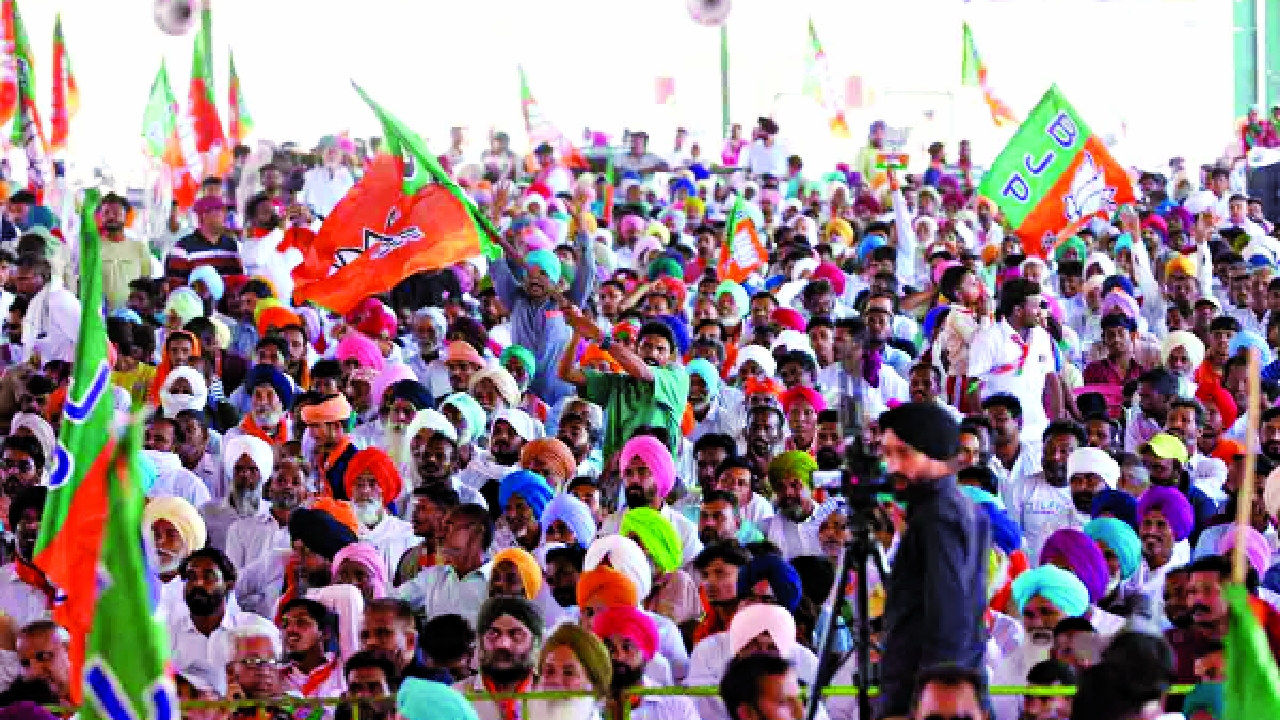
Punjab has rarely been comfortable political territory for the Bharatiya Janata Party (BJP). Yet, as the state moves towards the 2027 Assembly elections, the party’s central leadership appears determined to rewrite that political equation. The strategy emerging from Amit Shah’s political messaging in Moga suggests a calculated attempt to reposition the BJP in a state where it has historically remained peripheral.
The significance lies not in the speech itself but in the political architecture behind it. The signals were unmistakable - the BJP’s Punjab campaign will be centrally directed, its messaging carefully crafted around Sikh sensitivities, and its social outreach widened far beyond the party’s traditional urban Hindu base.
This is less a conventional election campaign and more a long-term experiment to construct a new political constituency in Punjab.One of the clearest messages from Shah’s intervention is that the BJP will not leave the Punjab battle solely to its state leadership. The campaign is likely to be driven by the national leadership, reflecting the party’s belief that Punjab requires a carefully controlled strategy rather than a routine state-level contest.
For the BJP, Punjab is politically delicate for multiple reasons. The aftershocks of the farm laws agitation continue to influence voter perceptions, especially in rural areas dominated by Sikh farmers. At the same time, the party’s traditional alliance architecture has collapsed, forcing it to redefine its role in the state’s political ecosystem.Shah’s approach appears to be aimed at building the party’s legitimacy step by step rather than chasing immediate electoral victory.
Rebuilding bridges with Sikh voters
The BJP’s biggest structural challenge in Punjab has always been its limited acceptance among Sikh voters. Without making inroads into this electorate, the party cannot realistically compete in the majority of Assembly constituencies.
The emphasis on visible Sikh leadership reflects an attempt to change that perception. The BJP now appears keen to project Sikh leaders prominently within the party structure, signalling that Sikh representation will not be tokenistic but central to its Punjab strategy.
Punjab’s electoral arithmetic explains the urgency of this effort. Sikh voters dominate roughly 70 to 75 of the state’s 117 Assembly constituencies. In regions such as Malwa and Majha, the Sikh electorate holds decisive influence in a majority of seats. For a party that has historically been viewed as urban-centric, building credibility in these constituencies is essential. The BJP’s ongoing induction of Sikh leaders and its effort to highlight their political visibility suggest a deliberate attempt to create a new leadership layer capable of engaging rural Punjab.
The farmer factor: Healing a political rupture
Even more challenging for the BJP is its strained relationship with farmers. The farm laws agitation, coupled with the unfulfilled promise of a legal guarantee on minimum support price (MSP), created a deep political rupture between the saffron party and large sections of Punjab’s agrarian community. Repairing this relationship is central to the BJP’s electoral ambitions. By emphasising that the Central Government continues to work in the interest of farmers and dismissing fears surrounding international trade agreements, the party appears to be attempting a slow process of trust rebuilding. This effort is as much psychological as political. The BJP’s leaders know that rural hostility once prevented them from entering villages in Punjab. Any improvement in that perception, even marginal, could open political space for the party.
A crucial element of the BJP’s messaging is the emphasis on its rising vote share in Punjab. The party’s vote share rose from 6.6 per cent in the 2022 Assembly elections to more than 19 per cent in the 2024 Lok Sabha polls. Shah’s narrative frames this increase as the beginning of a political trajectory that could eventually lead to power. The argument is designed less for immediate persuasion and more for long-term psychological impact. Within the party organisation, it seeks to instil confidence among workers who have long struggled in a difficult political environment. Among voters, it attempts to reposition the BJP as a growing political force rather than a marginal contender. In electoral politics, momentum can often become self-reinforcing. Shah’s strategy appears to rely on creating precisely that perception.
A new political agenda: Religious conversion
The BJP’s messaging in Punjab is also attempting to reshape the political agenda itself. By raising the issue of religious conversions and promising legislation to prevent them, the party has introduced a sensitive religious question into Punjab’s political discourse. The issue resonates particularly among Sikh groups concerned about conversion trends among marginalised communities. Simultaneously, the BJP is trying to claim ownership of governance issues that have long troubled the state - particularly the drug menace. By promising to eliminate drugs within two years, the party is attempting to position itself as a decisive alternative to governments that have repeatedly pledged action but struggled to deliver. These themes - identity, law and order, and governance - form the ideological backbone of the BJP’s emerging Punjab narrative.
The BJP’s strategy is not limited to Sikh outreach. It is also attempting to broaden its social coalition in Punjab by engaging other influential communities. One important component of this effort is outreach to Other Backward Classes. Haryana Chief Minister Nayab Singh Saini, himself an OBC leader, has been repeatedly deployed in Punjab to connect with these voters. His frequent appearances in the state reflect a deliberate attempt to build a political bridge with communities that have historically remained outside the BJP’s core support base. Similarly, the party is making a visible effort to connect with Dalit voters, who constitute a significant share of Punjab’s population. Prime Minister Narendra Modi’s visit to Dera Ballan in Jalandhar on 1 February, immediately after presenting the Union Budget in Parliament, was widely interpreted as a symbolic gesture towards the Ravidasia community. The dera is considered a nerve centre of Dalit politics in the state. These outreach efforts suggest that the BJP is attempting to build a multi-layered social coalition rather than relying on a single identity bloc.
Learning from the 2022 setback
The BJP’s current strategy also reflects lessons learned from its experience in the 2022 Assembly elections. After its alliance with the Akali Dal collapsed in 2020, the BJP effectively entered the contest almost alone. The party attempted to compensate by forming a coalition with breakaway factions - Capt Amarinder Singh’s Congress offshoot and Sukhdev Singh Dhindsa’s Akali faction. Yet, the arrangement proved politically ineffective, and the experiment ended in a disappointing electoral outcome.
That setback has forced the BJP to rethink its approach. Instead of relying on fragmented alliances, the party now appears focused on building its own organisational strength in the state.
The emerging signals suggest that the BJP is preparing to fight the next Assembly election largely on its own. This marks a significant shift from decades of politics in which the party functioned as the junior partner in the Akali-BJP alliance. Contesting independently indicates that the BJP now seeks to evolve from a supporting player into a principal political actor in Punjab. Such an ambition is undoubtedly risky. Punjab’s political landscape remains dominated by regional forces with deep social roots. For the BJP to challenge them, it will need far more than symbolic gestures or short-term campaign narratives.
What Amit Shah’s intervention ultimately reveals is that the BJP is preparing for a long political experiment in Punjab. The party is attempting to rebuild its relationship with Sikh voters, repair trust with farmers, cultivate OBC and Dalit support, and project itself as a credible governing alternative. Each of these objectives requires sustained political engagement over time.
Whether this strategy succeeds will depend not only on messaging but also on the BJP’s ability to build a genuine grassroots presence in rural Punjab. For now, the blueprint has been drawn. The real test will lie in whether the party can translate this carefully crafted political design into electoral reality.
The writer is Chief Reporter with The Pioneer, Chandigarh; views are personal