Bihar’s floods do not end when the water recedes
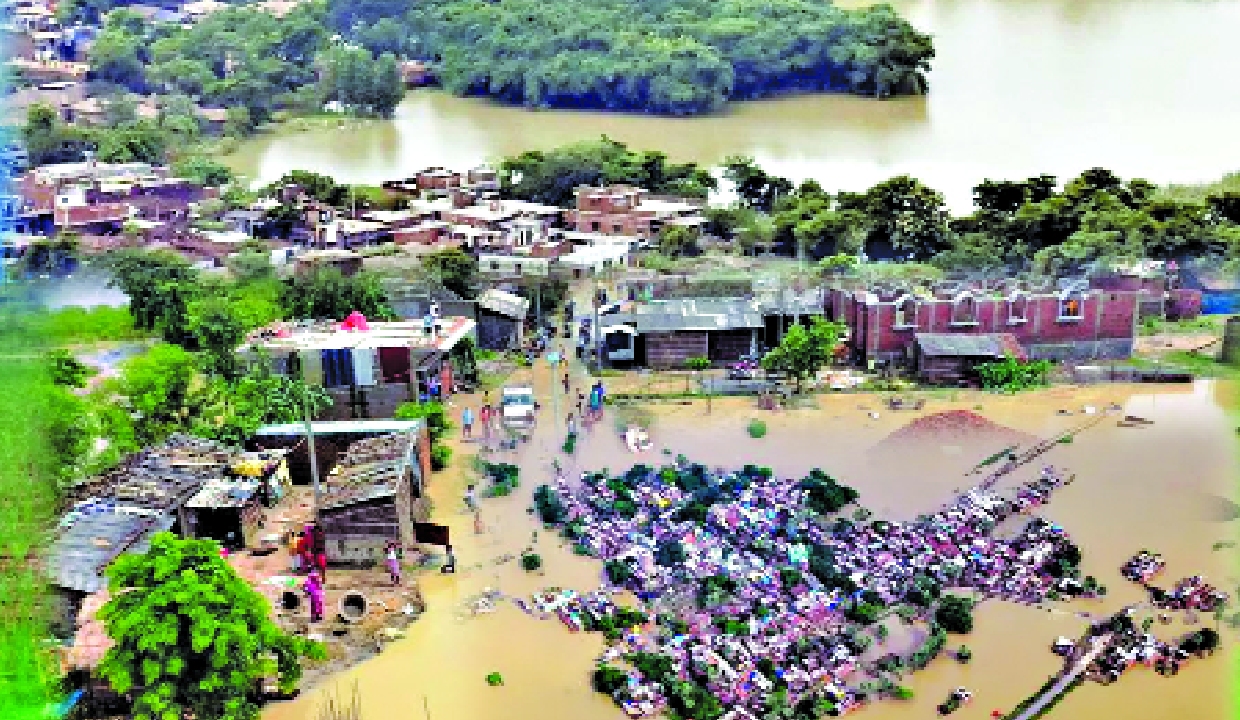
Nearly 50 lakh people have been affected by Bihar’s latest floods, but the official count captures only the scale of inundation, not the cost of recovery. For thousands of families, the real crisis begins after the waters recede — when damaged homes, lost livelihoods, debt and depleted assets remain
Bihar is in the grip of another flood season, and the images are painfully familiar: swollen rivers, submerged villages, cut-off roads and families ferried to safety. But behind the visuals lies a number that tells its own story. According to the state’s Disaster Management Department, as of September 14, close to 49.71 lakh people — roughly 9.94 lakh households — across 15 districts, 87 blocks and 575 gram panchayats had been affected.
What is striking is the pace. The count stood at barely 0.10 lakh on September 2, then leapt to 17.77 lakh by September 5 and 44.02 lakh by September 9. By September 11, it had crossed 48 lakh — an almost five-hundred-fold jump in nine days — before the increase slowed sharply, reaching 49.71 lakh by September 14.
That slowdown is easy to misread. A flatlining number is not the same as recovery. For a household, a flood’s consequences — displacement, a damaged home, a lost harvest and a disrupted livelihood - persist long after it drops out of the daily bulletin.
The real test of flood management is not how many people were counted, but how long it takes them to get their lives back.
For families living through it, the crisis does not end when the water goes down. In many ways, that is when a second one begins. Returning to a damaged home means clearing silt, replacing lost belongings, restoring drinking water and sanitation, and reckoning with dead livestock and ruined land. One household may lose a few possessions; its neighbour may lose land, housing, tools, documents and months of income. Two families in the same flooded village can emerge with entirely different losses — and entirely different capacities to recover.
This is where the administrative lens runs out of road. Counting affected districts, panchayats, people, houses and animals is essential for mounting a response, but it says almost nothing about what happened inside a single home, what was lost, or what recovery would actually require.
That gap became visible in a 2025 household-level assessment of the Phase II floods of 2024, conducted by Megh Pyne Abhiyan with support from Tata Trusts. It covered 2,290 households across 134 wards and 21 panchayats in seven of North Bihar’s worst-hit districts. It was not designed to be representative of Bihar as a whole — its purpose was to look past the headline numbers and see how losses were actually experienced, and how they varied by place and by the way the flood struck.
The findings were stark. Surveyed households reported total losses of about Rs 126.3 crore — an average of Rs 5.51 lakh per household, though the median was just Rs 2.11 lakh, a gap that itself shows how unevenly losses fall. Land damage made up Rs 55.4 crore of the total, or 47.2 per cent; house damage another Rs 42 crore, or 36.2 per cent. Ninety-one per cent of households had cut back on food; 82 per cent had been displaced. Borrowing and selling off assets were common ways of coping.
The point is not the rupee figure itself. It is what the figure implies for recovery: a damaged house needs one kind of help, lost land another, dead livestock a third, and a family that borrowed to buy food may need something else again.
The study went on to identify 12 distinct flood typologies in North Bihar — seven from the original assessment and four more from further analysis. These matter because the way water enters and moves through a settlement — an embankment breach, a river in overflow, clogged drainage, or several rivers interacting — determines the depth, duration and force of the flood, and therefore the shape of the loss. A settlement hit by a sudden embankment breach faces a different order of structural damage from one gradually submerged by clogged drainage, even under the same depth of water. Recovery needs, accordingly, vary just as widely.
That is precisely why treating “immediate relief” and “recovery” as one undifferentiated response undersells the problem.
Bihar’s machinery for the emergency phase is well established. It runs rescue and evacuation operations, relief camps and community kitchens, distributes food, dry rations and tarpaulins, and arranges drinking water, medical and veterinary care. In 2024, eligible flood-hit families also received Rs 7,000 each in Gratuitous Relief, transferred directly to bank accounts; the state disbursed Rs 532.22 crore across two rounds. These interventions matter — they get families through the emergency.
But getting through an emergency and recovering from it are not the same thing.
The Rs 7,000 GR payment is not a reconstruction programme. It does not assess how badly a house is damaged, replace productive assets, restore water and sanitation systems, rebuild a livelihood, or address the debt a family took on to survive.
Bihar has been here before. After the 2008 Kosi floods, the state ran a dedicated reconstruction and rehabilitation programme — owner-driven house reconstruction, backed by substantial public financing and World Bank support. What made 2008 different was that reconstruction was treated as a distinct public responsibility, not an extension of relief. Bihar has continued to flood since, and continued to disburse relief. What it has not had is a comparable, systematic framework for post-flood household recovery across those repeated events.
The gap, in other words, is not in the state’s capacity to give relief — it is in what comes after. A household can receive its Rs 7,000, survive the flood, and still be living in a half-repaired house a year later, or evacuated safely but returned to a ruined livelihood.
What is missing is a standardised, household-level post-flood assessment — one that documents damage to housing and productive assets, lost food stocks and livestock, disrupted livelihoods, damaged water and sanitation systems, displacement, debt and coping strategies, alongside the flood typology and location involved. Such an exercise need not delay emergency relief; it can follow once the immediate crisis has stabilised, run jointly by district administrations, local governments, technical institutions and civil society.
Done consistently, it would let support be matched to actual need — housing repair scaled to damage, livelihood aid targeted at asset loss, water and sanitation restoration prioritised where systems failed, and agricultural help shaped by the nature of crop and land loss. Repeated over successive floods, it would show which losses recur, where, and which villages keep losing the same assets year after year — evidence long-term policy rarely has.
The 2024 assessment is a beginning, not a template. Its Rs 5.51 lakh average cannot simply be multiplied across the state, and it was never meant to be. Its value lies in what became visible once households were actually asked what they had lost.
Bihar’s flood story is usually told through the scale of the water: people affected, villages inundated and hectares of crops destroyed.
It needs a second dimension — one that asks not just how quickly relief reached a family, but whether that family can repair its home, restore its water supply, replace what it lost, rebuild its livelihood, and enter the next flood season without sinking further into debt.
Bihar has learned to respond to floods. The precedent for the harder task exists too — it showed after the Kosi floods that recovery could be treated as a public responsibility in its own right. What is missing since is the will to make that the rule rather than the exception.
The study went on to identify 12 distinct flood typologies in North Bihar — seven from the original assessment and four more from further analysis. These matter because the way water enters and moves through a settlement — an embankment breach, a river in overflow, clogged drainage, or several rivers interacting — determines the depth, duration and force of the flood, and therefore the shape of the loss
The writer is the Managing Trustee of Megh Pyne Abhiyan; Views presented are personal.