Non-Duality as the Core of Religiosity
Not long ago, on an American podcast, a thoughtful host put a proposition to me. Religions, he said, are by their nature dualistic and separatist. They divide the creator from the created, the believer from the infidel, us from them. Human beings have persecuted and killed one another along exactly these lines. So perhaps humanity must now evolve beyond religion altogether.
I understand how one arrives there. Look at the history of organised faith and the evidence seems overwhelming. Yet the conclusion is backwards. We do not have to go beyond religion; we have to go beneath what has passed for religion, to its buried core. And at the core of every religious stream worth the name lies not division but the ending of division. At the core lies non-duality.
This will sound strange only because non-duality itself has been turned into a mystical commodity: cosmic consciousness, a special experience reserved for saints, a vision in which the universe melts into light. None of that is required, and much of it gets in the way. Duality is far simpler, and so is its ending.
The first duality is "I am"
Consciousness, as we live it, is dualistic. At one end stands the ego, the "I". At the other stand its objects. I am here and the world is there. I am the created and that is my creator. I am a man and you are a woman; I am a Hindu and you are a Muslim; I am the experiencer and that is my experience. The objects keep changing; the structure does not. At one end there is always the same claimant: me. Remove that claimant, and duality has nowhere to stand. That is non-duality.
It is not even oneness, because oneness too can become an object of thought, another concept the ego stores, repeats and wears. The ego that earlier said, "God is separate from me," can learn to say, "Everything is one." What has changed? The sentence. The speaker remains. Nor is it about escaping life or entering another loka. Life is all right. The world is all right. The problem is the one in the middle, endlessly announcing "I, I, I". So non-duality concerns the subject: the knower, the doer, the believer, the seeker, the achiever. And it asks that subject the one question almost nothing else asks it: are you what you claim to be?
Where does this "I" come from? The body is born, and with it arises a feeling: I am, and I am separate from the rest of the universe. Materially, the body and a rock are much the same, compounds, minerals, atoms. The rock simply lacks the configuration that gives rise to I-am-ness. So the ego is not merely social conditioning; society does not create it from nothing. The newborn does not merely encounter "mother"; the relationship is "my mother".
I like to call the ego an error. If the body is a machine, the ego is a bug in its code, a manufacturing defect carried from the factory. Society then lays layer upon layer over this biological seed. Hindu, Christian, upper caste, lower caste, rich, poor; these are my people, those are outsiders. The biological ego becomes a biological-social ego.
And then something remarkable happens. We test everything except the tester. A pain in the stomach is investigated, a strange sound in the car engine, atoms and galaxies. But the most intimate claim of all, "I am this separate one", is granted immunity. It came first, so it crowns itself the first truth. Yet this unquestioned self spends its entire existence uneasy. I am small, so I must become bigger. I am insecure, so I must accumulate. I am lonely, so I must possess people. I am uncertain, so I must collect beliefs. I am mortal, so I must invent continuity. All of life becomes an attempt by the incomplete centre to complete itself through objects, while the error sits royally on the throne.
Suffering is where dharma begins
Dharma does not begin with belief in God, scripture or ritual. It begins with suffering. Pain and suffering must be distinguished here. Pain belongs to the organism; the body is injured, falls ill, ages, grows hungry and tired. Suffering in the religious sense belongs to the ego. It is the unease of a centre that experiences itself as incomplete and so keeps reaching outward. I must have this person, this achievement, this approval, this security; I must know that I matter; tomorrow must validate today. Whatever the object, the inner movement is the same: as I am, I am not enough. That incompleteness is not an occasional disease visiting the ego. It is the ego.
And this suffering is also the great opportunity. Religion does not begin by declaring the suffering person secretly divine. It begins when a person has the honesty to say, "Something is fundamentally wrong with the way I am living." Its objective is not consolation but liberation.
Here the ego faces a peculiar difficulty. It is the sufferer, and it is also the one who must look at the suffering. Honest looking reduces suffering, but by reducing the sufferer. The ego senses the danger, so it looks everywhere except at itself. Peering into the atoms did not suffice, so now it peers into the heavens. That is how even religion becomes an escape from the religious question. The man who rushed blindly to the corporate office now rushes, in the same blindness, to an ashram. The attire changes. Has the centre?
Near, not far
The ordinary man talks of distant things: the faraway market, the faraway country, the faraway future. We easily see that such talk is not religious. But the so-called religious man also talks constantly of distant things; he has merely given them holy names. A distant market is called worldly, a distant sacred mountain religious. Both are equally far from oneself. Whether I look towards the madiralaya or the devalaya, the tavern or the temple, I am looking away from myself. Saint Kabir put it sharply: "Hai haazir tohe door dikhaave, door ki baat niraasi." What is present is shown to you as distant, and all this talk of the distant leads nowhere.
Religion therefore has only one legitimate subject: the one living your life. A plain conversation about your jealousy, fear, ambition, dependence or loneliness is more religious than a learned discourse on the holiest shrine on earth. The shrine is far away; your fear and your falsehood are here.
But merely turning inward is not enough. What happens when you look? "Who am I? I am the child of immortality. I am eternal peace. I am the light shining in the cave of the heart. I am Sachchidananda." The ego has merely swapped an ordinary identity for a magnificent one. Imagine a patient who opens a festering wound before a doctor and says, "Doctor, what you are seeing is not pus. It is the sacred flow of my inner purity." The doctor can do little for him.
Dharma begins when the wound is seen as a wound. What have I made of myself? Why does praise rule me and insult injure me? Why am I so afraid of being nobody? Why do I call my compulsions love, and my fears responsibility? Why do I decorate dependency with noble words? Now something religious is happening.
At a recent session, a young man told me that a previous teacher had taught him, "You are the witness. You are the Atman. You are Sachchidananda." I asked someone to poke his shoulder with a pen. The Atman has no shoulder; why did he flinch? When Marx called religion the opium of the people, this is precisely the religion that deserves the charge. Whatever is high, sacred and true is not a flattering description of the ego. It is the name of the ego's absence.
The seeker can be the ego's final refuge
There is a subtler danger still. The worldly man says, "I seek pleasure." The so-called religious man says, with some pride, "I seek Truth." We assume the second must be superior. Look carefully.
Pleasure at least exists as an experience. You want an object, acquire it, enjoy it, and then discover the pleasure fading. That very impermanence can wake you: the desired thing, once obtained, reveals its inadequacy. But what of the man who declares himself a seeker of the Infinite? He has chosen the perfect destination for endless travel. "I am a traveller on the path of Truth." What a durable identity. A finite object can eventually be obtained and exhausted; the Infinite, by definition, always remains beyond the next horizon. The seeker can remain a seeker for sixty years, and nothing forces that identity to break.
This is why truth cannot be another object of search, and neither can liberation or enlightenment. If the structure remains "I shall attain liberation", bondage has merely imagined itself in a glorified future. The task is not to find truth somewhere. The task is to find falsehood here.
That is the proper role of scripture. The Veda is not a portrait of truth; it is a mirror. Do not search the Vedas for truth. Search yourself for falsehood. Ask not what the scripture will give you, but what lie in you it is exposing. A scripture has succeeded not when you can quote it, but when something false has dropped.
Liberation is not another state of the ego
Once this is understood, the popular idea of final enlightenment has to be questioned too. If the ego has biological roots, if the body's very existence keeps generating the primitive sense of being a separate organism, then freedom cannot honestly become the permanent property of a person. There is no enlightened ego. There can be seeing, a thinning of the ego's compulsions, freedom from a particular falseness. But the moment someone says, "I have attained final enlightenment," the question returns: who has attained it? The ego issuing itself a certificate of enlightenment is the ego signing its own death certificate and then proudly carrying it around.
Mukti, therefore, has to be alive. Because the body continues, and society continues to offer identities, fears, desires and comparisons, the work cannot become a trophy from the past. The question is always immediate: right now, what am I taking myself to be? Dharma is not a graduation programme. Nobody receives a degree in liberation.
Why religion buried its own core
If non-duality is the core, why does so much religion appear so spectacularly dualistic? Religions are not conscious actors; the only doer in our world is the ego. So instead of asking why religions buried non-duality, ask why the ego would: because non-duality invalidates it. What follows is a pre-emptive strike: before non-duality can annihilate me, I will annihilate non-duality. Too rigorous, the ego says, too impractical, too slow to give any benefit.
Organised religion had another problem. Needing to propagate itself, it addressed the masses in the psyche of the masses. The masses want to believe they exist exactly as they experience themselves. Popular religion therefore leaves the ego where it is and hands it sacred objects. Earlier I wanted money, now merit; earlier status, now holy status; earlier possessions, now mantras, initiations and experiences. The signboards change; the traveller survives. Enlightenment becomes the next hustle.
This also explains why so much popular religion is harmless. Harmless, therefore useless; or useless, therefore harmless. True non-dual religion would demand the examination of identities, beliefs, cherished memories, narratives of victimhood, assumptions of entitlement, everything through which the ego knows itself. The person who came to religion for protection discovers that religion is asking him to surrender the protector itself.
Yet the core can still be found. Hinduism is Vedic in character, and Vedanta and Advaita are inseparable. It is one of the great curiosities of religious history that a civilisation possessing such an uncompromising non-dual core came to practise religion so extensively in dualistic forms. Buddhism is non-dualistic. Sikhism is non-dualistic. And I would go further: even the Abrahamic streams carry a non-dual core that has rarely been allowed to become central. When Jesus says, "I and my Father are one," why should that be treated as a theological curiosity rather than a central statement of the New Testament? The vocabulary changes across civilisations. The challenge to the ego does not.
Baba Bulleh Shah and the refusal of both sides
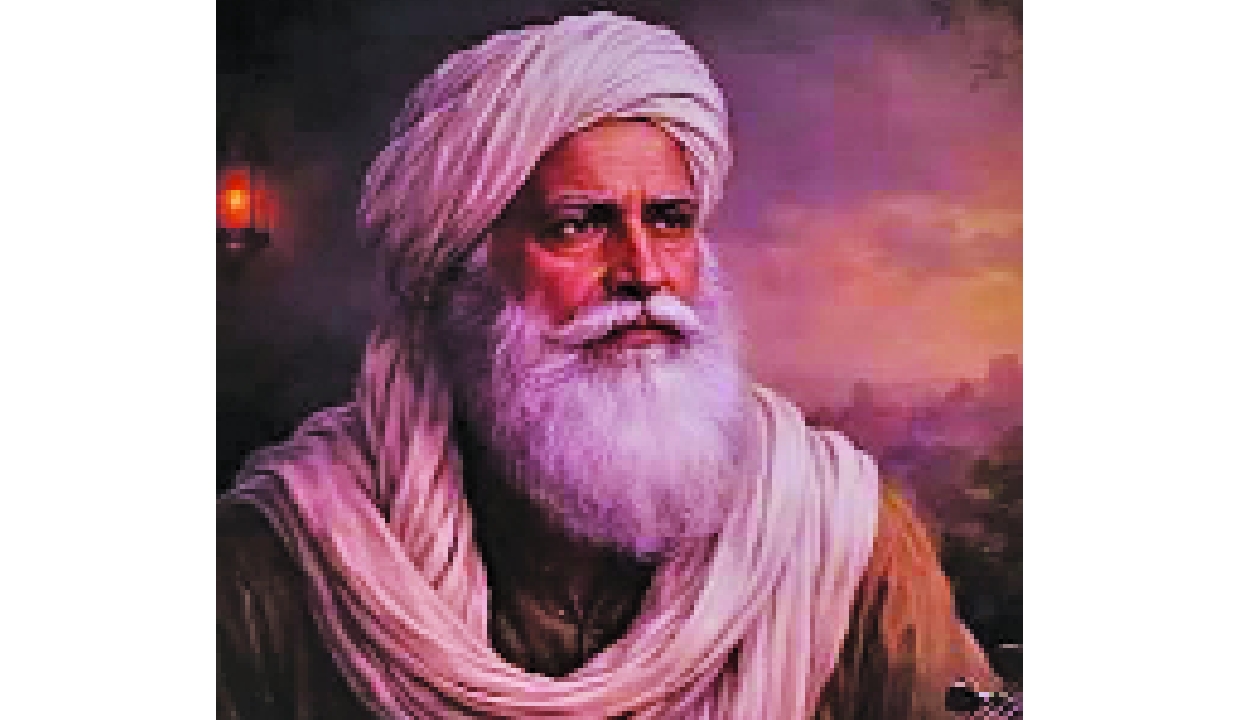
Few demonstrate this more beautifully than Baba Bulleh Shah. He was born a Sayyid, among the most prestigious Muslim lineages, with ancestry traditionally traced to the Prophet. Yet he took as his murshid Shah Inayat, an Arain of humbler social standing, and when his family came to drag him home, the story goes, he told them to forget their lineage and sit down as servants of his teacher.
Then comes the great movement of negation. "Na main momin vich maseetaan, na main vich kufar diyaan reetaan": not the believer in the mosque, not among the rites of unbelief. "Na main paakaan vich paleetaan": neither among the pure nor among the impure. "Na main Moosa, na Pharaun": neither Moses nor Pharaoh.
Notice the precision. He does not reject unbelief to become the perfect believer, or impurity to announce himself pure, or Pharaoh to acquire the exalted identity of Moses. Both poles are denied. The world traps us by presenting pairs and calling the selection between them freedom: saint or sinner, believer or atheist, traditionalist or rebel. The ego happily chooses either pole, because either pole gives it something to become. Indeed, the apparently higher pole can be the more dangerous one. An ego that calls itself a thief or a liar holds an identity whose falseness is easily exposed. An ego that calls itself a sage, a prophet, a pure person or an enlightened being has built itself a sacred fortress. Beautiful chains are harder to break than ugly ones.
Baba Bulleh Shah goes further: "Na main andar ved kitaabaan, na vich bhangaan na sharaabaan." Not in the holy books, and not in hemp and wine either. This rejects not only conventional respectability but also the romantic rebellion against it. One man is proud of the knowledge he has accumulated; another is proud of the knowledge he has rejected. One builds an identity out of praise, the other out of condemnation. The bowls are different. The hand holding both bowls is the same.
Acquiring knowledge will not liberate the ego if the ego becomes the owner of the knowledge. Deliberately forgetting, intoxicating or ruining oneself will not liberate it either. Put ten more garments on a person and the person remains; strip ten off and the person remains. Acquisition and renunciation are opposites only at the level of the object. The subject may stay exactly as it was. This is the razor of non-duality. And after all these negations, Baba Bulleh Shah refuses himself even the comfort of a final positive definition, even the "Shivoham" with which Adi Shankara closed his own negations. He returns, stanza after stanza, to "Bulla ki jaana main kaun": Bulla, what do I know of who I am?
Negation is love, not nihilism
To someone deeply invested in his identities, all this sounds dark. If I am not this and not that, what remains? If religion keeps taking away, what does it give? Teachings look dark only if we have already labelled ourselves bright. Admit that it is pitch dark within, and the teaching becomes the light; "Tamaso ma jyotirgamaya" is a prayer for exactly that.
Neti-neti is not rejection of life. It is love of freedom. A bird that loves the sky does not sit in its cage composing poems about the sky while carefully protecting the bars. It fights the bars until it bleeds; its love for the sky appears as opposition to the cage.
This is also why suffering can become sacred without being glorified. Suffering reveals the failure of the ego's project. I wanted completion from this relationship, this possession, this image of myself, and it did not come. Two possibilities now appear: find another object, or examine the one who keeps demanding fulfilment from objects. The second movement is dharma.
But seeing alone is not enough; it has to meet intent. A person may understand his bondage intellectually and still refuse freedom, because the bondage is familiar, pleasurable or socially rewarding. Liberation therefore requires not merely seeing but the intent to be free, and that intent is love. Love is the ego's willingness to choose its own thinning over its preservation. It is not sentiment, not attachment to a special person, but an inner consent: even if this cherished version of me has to disappear, let it disappear.
Shraddha belongs here too. It is not a deal with the heavens. "O Lord, I have renounced the world for you; now please protect me" is commerce: one support surrendered in exchange for another, a crutch exchanged for a sacred crutch. Freedom is the ending of the one who continuously demands a crutch.
Not a new action, a new centre
Does non-duality then lead to passivity? The question assumes the ego is the source of intelligent action, whereas the problems we face are the results of egoic action. Non-duality does not prescribe one more activity for the ego. It asks the compulsive actor to withdraw.
Take relations between men and women. One approach says: here is man, there is woman, now let us construct a more ethical relationship between the two. That may be socially useful, but non-duality goes deeper. What is this psychological division from which possession, hierarchy, superiority and discrimination emerge? Remove the division, and the discrimination loses its root. Non-duality does not teach the old ego better manners. It questions the centre that insists the other person remain psychologically "other".
Take the climate crisis. We keep imagining solutions without examining the idea of the successful life that generated the crisis. Prosperity means consuming more. Success means a bigger house, a bigger SUV, more flights, more possessions, larger celebrations. These are beliefs, rarely tested, and from them comes action, and from that action ecological destruction. So right action is not a new addition. It begins with stopping: stop treating desire as entitlement, stop defining prosperity as accumulation, stop behaving as though the rest of the planet exists as material for human gratification.
The same applies to animals. We separate our diet from the climate, our pleasure from the suffering of another species, our private choices from planetary consequences. These are downstream divisions. Upstream stands the same centre: my taste, my convenience, my tradition, my right to consume. What is on your plate is no more a private matter than a neighbour's smoking diesel generator.
Or take political freedom. We demand freedom from governments, neighbours, parents, employers and institutions. Inwardly we remain dictated by fear, identity, resentment, greed and the craving for approval. A person may therefore be legally free and psychologically unfree, and the unfree free man can use his freedom to vote against freedom itself.
A change of thought will not suffice; the same centre can learn green or holy vocabulary and continue untouched. What is required is a change of centre. Right action is therefore not a special ethical category listed in a religious manual. It is action without the old actor. The deed remains; the doer loses his throne.
Go to non-duality, or perish
Here, then, is the real test of religion. A teaching may speak of God or emptiness, Krishna or Christ, devotion or knowledge, prayer or meditation. The vocabulary is secondary. Ask what happens to the ego. Does the teaching expose it or decorate it? Does it bring the sufferer under examination, or promise the sufferer eternal continuation? If the ego emerges from religion more assured, more entitled and more convinced of its specialness, religion has failed, however ancient the ritual and however magnificent the temple. If the ego becomes available for examination, religion has begun.
Humanity could perhaps afford to ignore this distinction for most of its history. It cannot now. The primitive ego has acquired unprecedented technological power. Its desire alters the climate, its industries erase species and industrialise slaughter, its identities can turn millions against one another almost instantly. If religion merely gives this ego sacred justification, religion becomes part of the catastrophe. The religious task of our age is not to make the ego more pious but to expose it; not to assure man, "You are already divine," but to ask, "Who is the one so delighted to hear that?" We will have to go to non-duality, or perish.
None of this asks us to stop using the words "I" and "you". Language will remain dualistic. The question is whether a false centre must keep appropriating all of it: I am the thinker, the achiever, the sufferer, the believer, the enlightened one. There lies the entire problem. Religion does not have to be abolished. It has to be rescued from the one who hijacked it, and that hijacker is the ego.
So the most religious question is also the most dangerous one. Who is this "I" that wants happiness, God, truth, fulfilment, immortality and finally liberation itself? Do not answer too quickly; the answer can become another possession. Look, see what is false, and when it is seen, have the love to let it go. The world does not lack answers, it lacks mirrors.
Acharya Prashant is a philosopher and author. His work focuses on self-inquiry and its application to contemporary life; Views presented are personal.