Modi @ 25: 25 Years of national service, development and pride
For the past 25 years, Prime Minister Narendra Modi has worked continuously, tirelessly and relentlessly with the determination to build a New India. Despite the poisonous and hateful criticism from opponents, attempts at character assassination, baseless allegations of polarisation and verbal attacks from all sides, Modi has never allowed his eyes to stray from his goal
On October 7, 2001, Narendra Modi, a dedicated servant of the nation, took over as Gujarat’s Chief Minister. The career of service began and led to the office of Prime Minister of India on May 26, 2014. Looking back, this 25-year trip appears to be more than just the arc of one leader’s political career; rather, it has become a chapter in the country’s shifting political, social and developmental journey.
The 25-year journey of Prime Minister Narendra Modi is a journey of “service, resolve and dedication.” It is a journey reflecting the growing confidence of 1.4 billion Indians. On this occasion, on behalf of Maharashtra’s 130 million people and the Shiv Sena, I express my warm congratulations and best wishes to Prime Minister Narendra Modi.
The voice that emerged from the soil of Vadnagar has today become an influential voice representing India’s position on the global stage. During his tenure as Chief Minister of Gujarat from October 7, 2001 to May 2014, Modi took several important decisions for the development of the state. He assumed office against the backdrop of the devastating Bhuj earthquake. The pace of rehabilitation, reconstruction and rebuilding in Bhuj and the Kutch region was accelerated.
In 2003, he launched the ‘Vibrant Gujarat Global Summit’. Through this summit, major companies and industrialists from across the world were encouraged to invest in Gujarat. The Gujarat model appealed to the people of the country. At the same time, public discontent was growing against the hollow promises made in the name of development, corruption and attempts to fill the coffers of the wealthy in the name of eradicating poverty. Modi transformed the sparks of this discontent into political energy.
There is a significant difference between India before 2014 and India after 2014. When the Prime Minister of a country changes, it is not merely the government that changes — the future of the country changes. And that is precisely the transformation that took place after 2014.
Narendra Modi took oath as the Prime Minister of India on May 26, 2014. Thereafter, the policies of the central government placed particular emphasis on development, infrastructure, digital technology, social welfare and national security.
Through the Jan Dhan Yojana, efforts were made to connect a large number of citizens with the banking system. Direct Benefit Transfer and the digitisation of government services received a major boost. Through the Swachh Bharat Mission, emphasis was placed on sanitation and the construction of toilets. Through schemes such as Pradhan Mantri Awas Yojana, Ujjwala Yojana, Jal Jeevan Mission and PM-KISAN, the government undertook historic work in areas including housing, clean cooking fuel, piped water supply and direct financial assistance to farmers.
The expansion of Digital India and UPI brought about a major transformation in the field of digital transactions. The expansion of highways, railways, airports and other infrastructure was accelerated. Initiatives such as Make in India, Startup India and Atmanirbhar Bharat are giving a boost to domestic manufacturing, investment and entrepreneurship.
The New Education Policy, new criminal laws and the law against triple talaq were also introduced during the Modi government’s tenure. The Modi government also demonstrated the political courage to take the historic decision to abrogate Article 370 in Jammu and Kashmir. The numerous decisions taken over the past 12 years have had a broad and highly positive impact on the direction of Indian politics, the economy, administration and social policy.
Alongside the development agenda, efforts were also made during this period to bring India’s cultural heritage to the centre stage. The construction of the Shri Ram Temple in Ayodhya and the grand ceremony of the consecration of Ram Lalla, the development of Kashi Vishwanath Dham and Mahakal Lok, as well as the development of various pilgrimage sites, have highlighted religious tourism and cultural heritage.
Under the concept of ‘Vikas Ke Saath Virasat’ - development along with heritage — emphasis has been placed on preserving India’s cultural heritage alongside modern infrastructure.
Women’s empowerment has been another important component of the Central Government’s development agenda. From Beti Bachao, Beti Padhao to Lakhpati Didi, and from Ujjwala and Mudra to self-help groups, various schemes have been implemented to increase women’s economic and social participation.
In Maharashtra too, the Mahayuti government has taken several decisions in the same direction for women’s empowerment. Whether it is the Mukhyamantri Majhi Ladki Bahin Yojana or the decision to provide higher education to girls — the principle is clear: when a woman becomes empowered, the family becomes empowered; when the family becomes empowered, society becomes empowered; and the strength of the nation grows.
There have also been several important developments in the areas of national security and foreign policy during the Modi government’s tenure. India has adopted a more assertive position on the issue of cross-border terrorism. On issues such as BRICS, the Global South, climate change, digital technology, yoga and international cooperation, India has articulated its own distinct position.
Today, India’s voice is firmly heard on major global platforms. India’s growing economic, strategic and diplomatic capabilities have gained significance. The credit for creating a new and capable identity for India at the international level goes to Modi.
That is why Modi has been honoured with the highest civilian awards of nearly 36 countries.
The 12-year period of the Central Government under the leadership of Prime Minister Narendra Modi has also been important for Maharashtra’s infrastructure and economic development. The assistance received by Maharashtra from the Centre has not been limited merely to funding; it has also helped accelerate several long-term projects.
Between 2004 and 2014, the decade before 2014, the Central Government provided Rs 2 lakh crore for development works in Maharashtra. Between 2014 and 2024, Maharashtra received Rs 12 lakh crore in funding.
There has also been a substantial increase in railway allocations. The average annual allocation during 2009-2014 was Rs 1,171 crore, while in 2026-27 it has reached Rs 23,926 crore.
At present, infrastructure projects worth approximately Rs 1.5 lakh crore are underway in the state. Under the Amrit Bharat Station Scheme, redevelopment work is underway at 128 railway stations.
Projects such as the Atal Setu, Samruddhi Mahamarg, Mumbai Coastal Road, Navi Mumbai International Airport, Mumbai-Ahmedabad Bullet Train, and the Rs 76,000-crore Vadhavan Port, which will be important for the industrial development of Konkan and Palghar, are in every sense game-changing projects for Maharashtra.
Through welfare schemes as well, citizens of Maharashtra are benefiting from Central Government programmes. Under the Pradhan Mantri Awas Yojana, houses for 18 lakh poor families had been completed by May 2026. Through the Jal Jeevan Mission, the proportion of rural households receiving piped water supply increased from 33 per cent to 89 per cent. Eligible farmers in the state are receiving direct financial assistance through the PM-KISAN scheme.
Alongside Maharashtra’s development, the state’s cultural and historical identity has also received importance through decisions taken by the Central Government. The inclusion of the historic forts of Chhatrapati Shivaji Maharaj in the UNESCO World Heritage List, the development of the Panch Teerth associated with Babasaheb Ambedkar, and the decision to grant classical language status to Marathi are important milestones for Maharashtra.
The late Shiv Sena chief, Hindu Hriday Samrat Balasaheb Thackeray, had on several occasions clearly articulated his position regarding the politics of Hindutva in the context of Gujarat and Narendra Modi. The dialogue surrounding Hindutva has a long history in the political journeys of Maharashtra and Gujarat. Therefore, this thread of political and social relations between Maharashtra and Narendra Modi is also significant.
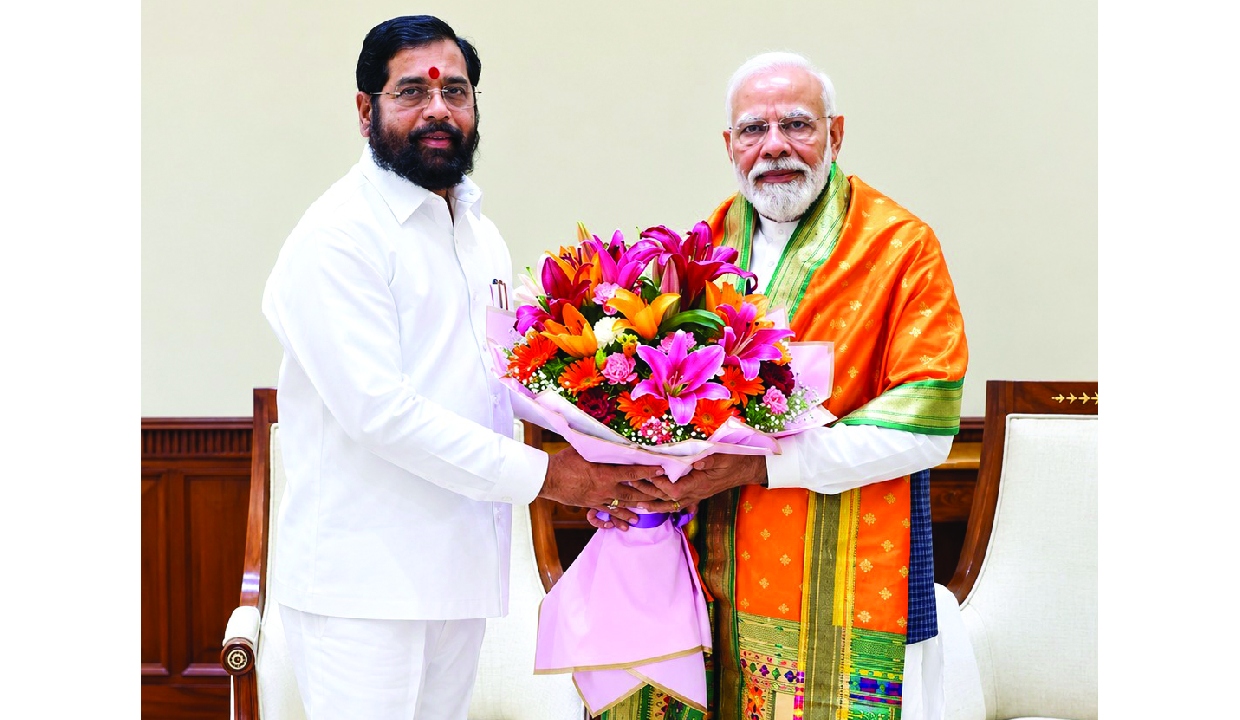
It is my great fortune that I have been blessed with the personal affection of the respected Prime Minister Narendra Modi, as has my entire family. The affection shown to me by Modi filled the void created in my life by the passing of Shiv Sena chief Balasaheb Thackeray and Dharmaveer Anand Dighe and gave me tremendous strength.
At every meeting, he asks me, “Kaise hain Eknathji?” and places his hand on my shoulder. At that moment, a new confidence emerges, a new sense of hope is created, and I gain the strength to work with even greater determination for Maharashtra’s progress. This bond of affection will always remain special to me.
For the past 25 years, Prime Minister Narendra Modi has worked continuously, tirelessly and relentlessly with the determination to build a New India. Despite the poisonous and hateful criticism from opponents, attempts at character assassination, baseless allegations of polarisation and verbal attacks from all sides, Modi has never allowed his eyes to stray from his goal.
Over the past 25 years, Narendra Modi’s responsibilities have changed and his positions have changed; however, his resolve and determination to serve the nation have not diminished even slightly.
This 25-year journey is not merely the duration of one person’s political career. It is an important chapter in the political and developmental journey of a changing India. From Gujarat to Delhi, and from there towards the vision of Viksit Bharat 2047, this journey is now looking towards its next phase.
The next major goal is “Viksit Bharat 2047” — a Developed India by 2047. It is a vision of building an economically strong, technologically advanced, self-reliant and secure India.
The vision seeks to create an India that provides opportunities to the poor, gives wings to the dreams of its youth, provides women with equal opportunities and leadership, and takes pride in its cultural heritage.
Recently, while speaking with the Prime Minister, Captain Smit Machhar, who saved the lives of 174 aircraft passengers by displaying presence of mind, said that he had drawn inspiration from the Prime Minister. Such incidents highlight the personal influence of Modi’s leadership and the image he has created in the public consciousness.
The records of popularity and tenure may be associated with the names of many leaders. But in the case of Narendra Modi, what is measured is not merely the number of days in office, but the scale of the decisions taken during his tenure and the political influence he has built. My heartfelt best wishes to Modi ji for his journey ahead. I pray that God blesses him with good health, a long life and immense strength to continue serving the nation.
The writer is the Deputy Chief Minister of Maharashtra; Views presented are personal.