Bangladesh’s Presidential flip-flops
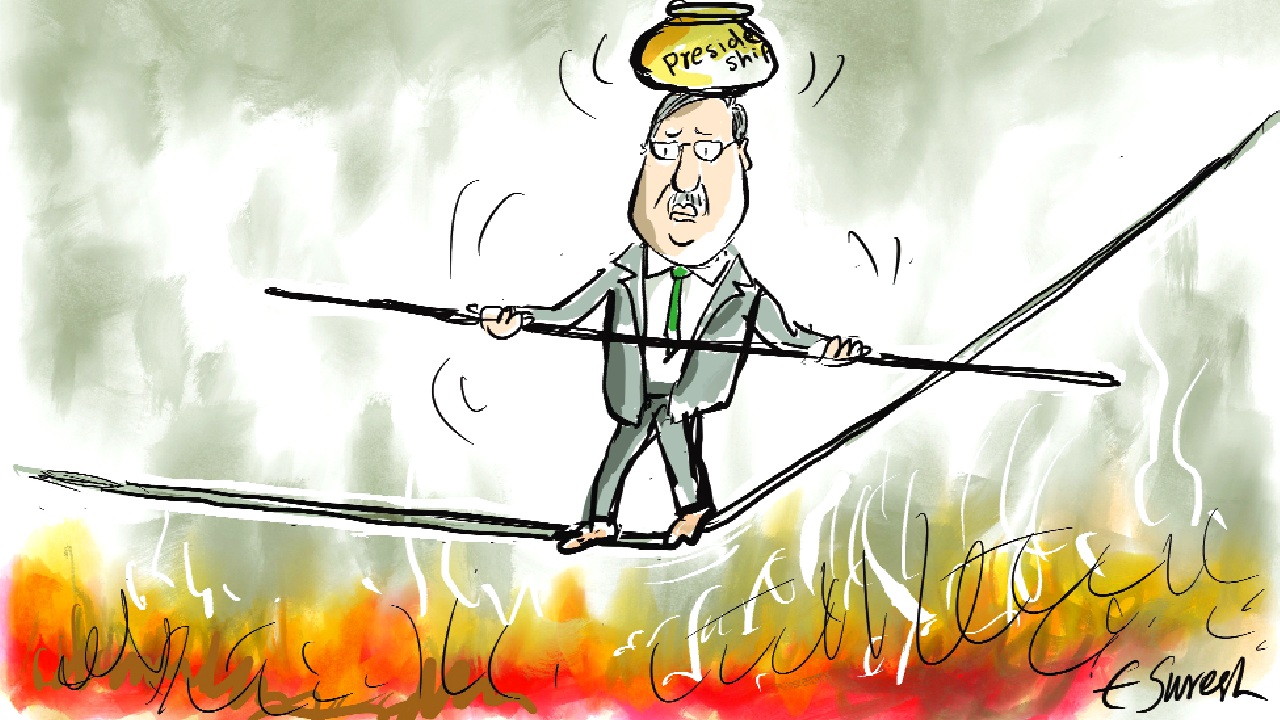
Recently, the President of Bangladesh, Mohammed Shahabuddin, made scathing comments about the outgoing interim government of Mohammad Yunus. He described himself as a “palace prisoner” and went as far as suggesting that there were attempts to oust him. However, President Shahabuddin had been a lifelong member of the Awami League before assuming supposed neutrality upon assuming the presidency in 2023. He had been personally chosen by Sheikh Hasina, and naturally the then opposition Bangladesh Nationalist Party (BNP) had not supported his candidature.
Under Shahabuddin’s watch, months of chaos involving protests, violence, suppressive clampdowns, and ultimately the resignation of Sheikh Hasina took place. Even attempts to rein in the situation - such as announcing Sheikh Hasina’s resignation - were left to the Bangladesh Army Chief, Waker uz-Zaman. Whereas the President and, more importantly, the Commander-in-Chief, Mohammed Shahabuddin, sounded wishy-washy. The President’s meek plea that he could not secure Sheikh Hasina’s resignation was slammed by the likes of Asif Nazrul (Interim Government’s Adviser for Law, Justice and Parliamentary Affairs): “The President’s statement that he did not receive Sheikh Hasina’s resignation letter is a lie, and it is a violation of his oath.”
It is very likely that the Mohammad Yunus dispensation did treat him lightly and relegated him to a rubber stamp (as is the sub-continental term) - but throughout the year and a half of Yunus’s administration, Shahabuddin did not make a squeak of protest when his presidential status certainly afforded him that opportunity. Shahabuddin secured his continued presidency by knowingly accepting what he now calls a violation of the Constitution by silently passing 133 ordinances.
Today, as the Tarique Rahman-led Bangladesh Nationalist Party (BNP) has stormed the electoral hustings, President Shahabuddin is now singing incredulous hosannas in favour of the BNP, a sworn rival of his own ideological past, i.e., the Awami League. Shahabuddin obsequiously praised the incoming government and its leader Tarique Rahman: “They had expressed their willingness to uphold the Constitution all through that time. I had a lot of curiosity about BNP Chairman Tarique Rahman, but with time, I got to know him as a genuine person. He was so cordial. BNP’s support was 100% there in my bad time.” Obviously, the exiled Awami League leader Sheikh Hasina (leader of Shahabuddin’s original party) must be cringing at his flip-flop.
Now, as the new Prime Minister Tarique Rahman goes about reshuffling the Bangladesh military leadership and curbing the powers of the Army Chief, Waker uz-Zaman, the ostensible Commander-in-Chief, President Shahabuddin yet again signs all decrees sycophantically. Incidentally, earlier, when marauding student mobs were baying for President Shahabuddin’s blood in the wake of Sheikh Hasina’s ouster, it was the same Army Chief, General Waker uz-Zaman, who had saved the life and presidency of Mohammed Shahabuddin.
Now abandoning his ideological fountainhead, the Awami League, bad-mouthing the outgoing Mohammad Yunus government, and ingratiatingly praising the incoming government of his one-time ideological rival - Tarique Rahman’s BNP — appears par for the course for Mohammed Shahabuddin.
There are personal reasons for this volte-face by Mohammed Shahabuddin. The Bangladeshi presidential term is for five years, with a maximum of two terms possible. However, in the relatively short span of 55 years of independence, there have been 17 Presidents. Only four of them were able to complete full terms. The other 14 were subjected to premature removals, coups, and even assassinations.
The first President of the Provisional Government of Bangladesh (1971-72) and later of the People’s Republic of Bangladesh, Sheikh Mujibur Rahman (Sheikh Hasina’s father), was assassinated along with his family members. His successor as Acting President, Syed Nazrul Islam, was also assassinated in mysterious circumstances in what is dubbed the Jail Killing. The third President, Abu Sayeed Chowdhury, later carried out an infamous partisan flip-flop by supporting the coup-led government of Mostaq Ahmad. Mostaq Ahmad himself
became President, only to be ousted in yet another coup. Mostaq’s successor, Abu Sadat Mohammad Sayem, took over until he too was removed in a stunning coup by General Ziaur Rahman (father of current Prime Minister Tarique Rahman). The curse on the Bangladeshi presidency continued with the assassination of General Ziaur Rahman in 1981. Thus, the saga of partisan vendetta and presidential flip-flops continued as Bangladesh remained on tenterhooks of instability with an estimated 25 coup attempts. The current President, Mohammed Shahabuddin, needs to look at the fate of his own predecessor, Mohammad Abdul Hamid (the longest-serving President with two terms). The July Revolution in 2024 led to charges of Mohammad Abdul Hamid assaulting protestors, and later his house was vandalised during the Bulldozer Programme. But the lawyer in Mohammed Shahabuddin knows that he must flip-flop and renege on his past partisan affiliation. He was once the coordinator in the case filed over the assassination of Sheikh Mujibur Rahman. He also served as chairman of the Judicial Inquiry Commission set up after the 2001 General Polls to investigate murders, rapes, looting and inhumane activities committed by BNP leaders.
Today, as he has sworn in the Tarique Rahman-led BNP government, Shahabuddin - with over two years of residual presidency still left - must dance to a completely different tune if he does not wish to suffer the fate of 14 out of the 17 Presidents of Bangladesh.
The writer, a military veteran, is a former Lt Governor of Andaman & Nicobar Islands and Puducherry; views are personal