AQI: Economic growth at what cost?
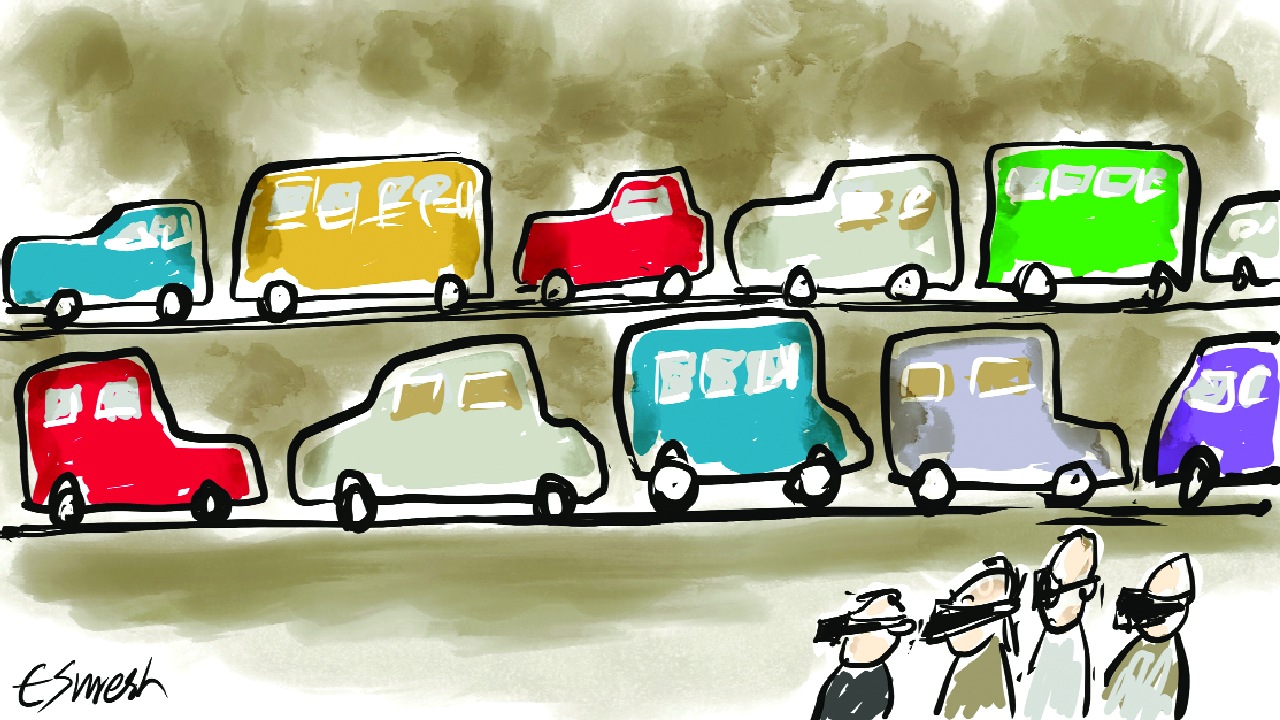
India has been one of the fastest-growing economies and is also on its way to becoming a $5 trillion economy, behind which lie strong macroeconomic parameters like high consumption, investment, industrial growth, construction and infrastructure development. Ironically, these promising economic development indicators are detrimental to the environment and a source of pollution. Several Indian states, including Delhi, reported alarming AQI levels, which also caught the world’s attention, in the latter half of 2025, raising alarm bells for urgent government action. Danish badminton player Anders Antonsen, World No 3, recently revealed that he withdrew from the ongoing India Open Super 750 due to ‘extreme’ Delhi pollution for the third year. This poses a critical question to our journey to Viksit Bharat@2047, where promising GDP numbers neglect the quality of life.
The road transport ministry’s January report states that 70 per cent of 41 crore vehicles do not comply with norms, including PUC and fitness. The government boasts of the recent GST cut on vehicles to encourage consumption, but a deeper analysis of it scares us with further choking roads and added pollution. India, being a developing economy, needs to reach its potential in all sectors, with high production complemented by higher consumption. With limited resources, efforts are always concentrated on maximising production, and other qualitative aspects, such as the impact on the environment, are consciously or unconsciously ignored. If the qualitative aspects are given priority, production and thereby economic growth would suffer, and it becomes a vicious cycle to break. Economic growth thus carries negative externalities and involves trade-offs, hampering the environment, public health, deteriorating living conditions, and hindering long-term sustainable development.
Macroeconomic models place growth as a function of human capital, which also includes labour productivity. A poor environment, while it affects public health, also bears economic costs as it lowers labour productivity and efficiency. Increased healthcare expenditure is a further burden on households and the government, leading to economic loss.
Any pollution control measures require environmental regulations, cleaner technologies and emission standards, which raise the cost of production for industries. If these costs are passed on to the consumers, it discourages demand, the driving force behind growth. In agriculture, alternatives to practices like stubble burning, such as machinery for crop residue management, are not affordable to small farmers without adequate support.
One of the most important yardsticks of development is infrastructure, but it is also one of the main causes of pollution. Rapid construction of roads, highways, bridges, airports, railways, dams, industries and urban housing often occurs without adequate environmental safeguards. If environmental regulations are imposed, it delays the projects, escalates project costs, discourages investment and slows economic growth.
Tourism, another significant source of income for the country, has become a concern in recent years due to overexposure. This has led to disruptions in natural ecosystems, the generation of unlimited waste, and traffic congestion, further exacerbating the already severe pollution problem. Environmental degradation raises climate-related disasters such as floods and droughts, causing massive economic damage.
Undoubtedly, given the present stage of the Indian economy, it is difficult to manage growth and sustain other environmental quality parameters. But that does not give us an excuse to overlook the latter; we need smart and inclusive solutions to reduce pollution without severe economic disruption.
A phased and flexible implementation of environmental regulations to adopt cleaner technologies gives industries time to adapt, avoiding economic shocks. Fiscal incentives to encourage a shift to green technologies and renewable resources in the form of tax incentives, subsidies, and concessional interest rates on loans can help economise the costs for industries. Urban planning with public-private partnerships, strengthening of public transport, a shift to electric vehicles, and waste management are unavoidable necessities now, which may raise the cost presently, but would serve as a sustainable investment for long-term development.
Conclusion
India stands at a decisive crossroads where economic ambition must align with environmental responsibility. Growth that erodes public health, productivity and living conditions cannot be sustained indefinitely. The challenge is not to choose between development and the environment, but to redesign growth itself-through cleaner technologies, smarter urban planning and phased regulations. Only by internalising environmental costs can India ensure that its journey to Viksit Bharat@2047 delivers prosperity with dignity and a liveable future.
The writer is an assistant professor at Sri Guru Gobind Singh College of Commerce, Delhi University; views are personal