A resurgent India marches ahead
The visible transformational advancements that India has successfully achieved during the last decade have unnerved several advanced nations, as well as its neighbours. Those who enjoyed power and authority for over six decades after independence did make significant strides in the growth and development of the nation by establishing futuristic institutions and finding solutions to acute problems such as the shortage of food grains, eventually becoming an exporter of food grains, and much more. Unfortunately for them, they seem to have forgotten the strategic initiatives of the past. Obviously, they are unhappy, unsure, and unable to formulate strategic initiatives to return to power. In a democratic set-up, generational transfer of power and authority can only be a rare occurrence, not a general pattern, as then it would no longer be a democratic system of governance. Once in power, only an enlightened mind can sincerely and honestly prepare for a life beyond it.
The elected representatives in India have blessed themselves with so many perks, privileges and pensions that were unthinkable in the initial phase of the post-independence years. India now has a small conglomerate of people who have tasted power and authority for long or short durations, stand ousted, and are aware of the current situation that promises them only a no-return ticket, and nothing else. The consequent frustration has firmly snatched away from them the capacity to accept facts and learn to appreciate the good work done by those in power, elected by the people. One often wonders why those in opposition do not go back to the people, interact more intensively with them, ascertain their concerns, and be with them in their efforts to find solutions. Mere criticism, in language that abounds in the pouring out of frustration, never helps. People ignore it. The fact is: India is on the move, and it only creates a distasteful climate when some Indians go abroad, criticise their own democratically elected government, and even seek external assistance to oust it from power. They turn a blind eye to India’s recent achievements, extending from the social sector to science and external security, which have received global attention and even appreciation. The pace that India has acquired in its march to become a developed nation — Vikasita Bharat — by 2047 deserves unstinted support from every Indian, irrespective of political, ideological, regional, linguistic or religious inclinations and affiliations. Every Indian must realise that this swift march towards becoming a developed nation has unnerved some of the developed countries, as they have not fully recovered from the psyche of their imperialistic past. The manner in which the sovereignty of Venezuela has been usurped by its neighbour clearly indicates the failure of major global efforts such as the creation of the UN, UNSC, UNHRC, and even UNESCO. Those who constitute the political scenario of India — whether in power or in opposition — must redefine their role in the face of jealous global machinations intended to keep India subjugated and obedient.
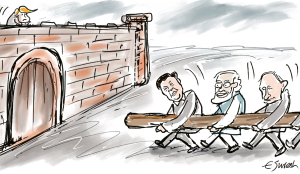
The ‘major global powers’ around the world, including the US and China, are just not attuned to envisioning India as another major global power on par with them. They know that once India reaches that level, it will not be easy to check its onward march. Unfortunately for them, in recent years India has acquired an unprecedented level of self-confidence and faith in its conviction and determination.
This background was created by the futuristic vision of post-independence leadership in establishing institutions of science, technology, space advancements, management, agriculture, naval power, education, and others. The Constitution of India articulated all the required steps necessary to achieve social cohesion and religious amity. It also included directions on how India must move ahead swiftly in providing equality of opportunity up to the last man in the line. The present Indian leadership has successfully built upon this great legacy of the contemporary past, as well as the great tradition of the Indian knowledge quest that emerged in ancient India and made it a place of attraction and appreciation for knowledge-seekers from various nations abroad.
Colonial India was inhumanly squeezed of its resources. Its culture, traditions, knowledge contributions and scriptures — all that had made it great — were impeded, retarded and ridiculed. It had to focus on the availability of toilets, clean cooking fuel and potable water even in the 21st century. The spectrum of deficiencies was vast and wide. India had to reduce dependence on arms imports and become a leader in space sciences and artificial intelligence. It strengthened its security concerns.
The momentum that this newly resurgent India has acquired is unstoppable.
This is so in spite of retarding forces within the country, inimical neighbours and global powers that feel threatened. Growth and development shall remain the key words in the year 2026 as well, but there would be a big difference: India now has several notable instances of success within the country and among the global community of nations that would inspire the younger generation to a dedicated commitment to achieve the goal of Vikasita Bharat 2047. This target has gained currency, inspires the youth of India, boosts their self-confidence, and encourages them to delineate their own role in achieving it.
It is indeed encouraging to participate in and observe animated deliberations conducted with great enthusiasm in schools, universities and other institutions and organisations. Those who are genuinely interested in national development and wish to be a part of it do realise that independent India has significant achievements to write home about. None can ignore the success of initiatives and achievements in sectors such as housing, sanitation and energy that have reached the last man in the line. ‘Make in India’ and ‘Startup India’ have achieved an attitudinal transformation among India’s youth. One could go on citing numerous initiatives and innovations. All of this is being analysed, scrutinised and assessed - from gatherings of intellectuals in the posh locations of Lutyens’ Delhi to deep and isolated rural areas across the country.
Informed and knowledgeable deliberations among professionals and intellectuals often get clouded by the ideological orientations of some participants, which obviously impacts the level of objectivity. Rural India is still capable of expressing views that emanate straight from the heart — its faith in national leadership and the Constitution of India. The people may be deficient in facts, but not in commitment and sincerity of purpose. If such inputs were systematically accumulated and seriously considered by policymakers, it would certainly make implementation more pragmatic.
Could India really get rid of Macaulay and his impact by 2035? Yes, if it realises what the eminent jurist Nani Palkhivala said in one of his learned lectures:
“It is my long-standing conviction that India is like a donkey carrying a sack of gold - the donkey does not know what it is carrying but is content to go along with the load on its back.”
It is for the institutional leaders and the youth of India to open the sack and put it to the right use for humanity.
The author is an educationist, a Padma Shri awardee, and works in religious amity and social cohesion; views are personal