A Capital under siege, an ECI under scrutiny: The legal war behind the street unrest
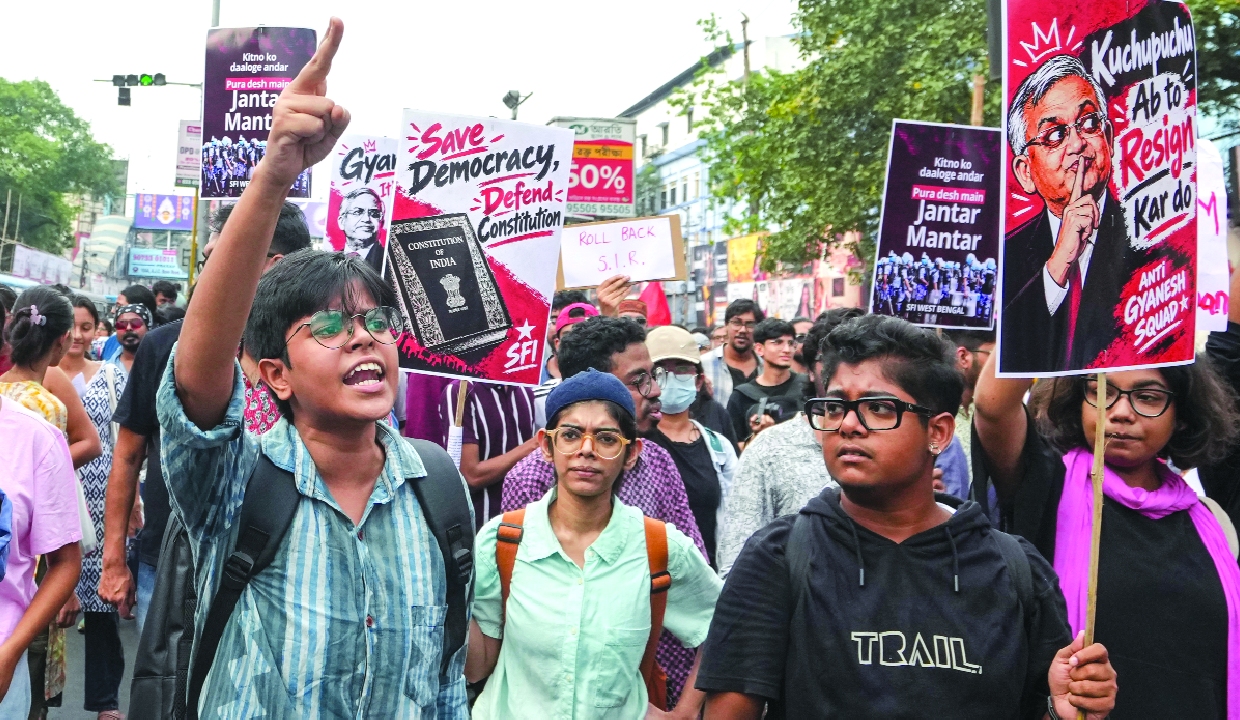
The week gone by witnessed massive protests, agitations, and an unprecedented security crackdown in New Delhi, paralysing normal life.
Authorities designated roads and streets leading to Jantar Mantar as prohibited zones, enforced internet shutdowns within a four-kilometer radius, and cancelled several incoming trains to restrict entry into the capital.
What began as opposition parties taking to the streets-culminating in a peace march to Raj Ghat-escalated when groups like the Cockroach Janata Party (CJP) called for a mass rally at Jantar Mantar, prompting security forces to erect elaborate barricades.
At the center of this widespread unrest are the Election Commission of India (ECI), its controversial Special Intensive Revision (SIR) exercise of electoral rolls, and mounting political calls for Chief Election Commissioner Gyanesh Kumar’s resignation.
For its part, the poll panel maintains that the SIR exercise is an essential administrative clean-up designed to purge duplicate entries, update legacy rolls, and maintain voter list integrity.
Yet, opposition parties and political groups view the procedural shifts as an opaque hurdle to voter inclusion.
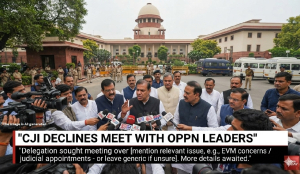
Even as the capital reeled under street-level agitations, an intense parallel confrontation played out inside the Supreme Court over the course of the week.
A bench led by Chief Justice Surya Kant faced urgent petitions challenging the legality of the ECI’s administrative moves, specifically zooming in on the controversial modifications made to Form 6 and the core integrity of the multi-member constitutional body.
Petitioners pressed for an immediate interim suspension of CEC Gyanesh Kumar, alleging that crucial electoral roll decisions and procedural shifts had been executed unilaterally without securing the mandatory consensus or approval of fellow election commissioners.
During the hearings, the Apex Court scrutinised the records closely, with the Chief Justice explicitly remarking, “Any modified Form 6 has not been approved by us... when records are produced, we would like to see who has modified what.”
While the Bench declined to grant an immediate ex parte interim stay to suspend the CEC-noting that it could not act solely on political friction or unverified filings-it sternly directed the respondents (Union of India, ECI, and CEC Gyanesh Kumar) to file transparent replies.
The Apex Court warned that if official records ultimately establish that key institutional decisions bypassed collective consensus, those actions would be declared ultra vires.
Beyond the procedural legality of the SIR exercise, the judicial scrutiny directly confronted the executive’s heavy-handed lockdown of the capital.
Challenged over blanket metro station closures, train cancellations, and public transit disruptions, CJI Surya Kant invoked the principle of constitutional proportionality, admonishing the authorities that while maintaining law and order is a sovereign duty, “that does not mean you use a hammer to kill a fly.”
The Apex Court ordered the state to strike a balance between security measures and the fundamental mobility rights of ordinary citizens.
Now, the week commencing October 12 would be vital as the response of the Union of India, ECI, and CEC Gyanesh Kumar would be analyzed by the Supreme Court.
It would become crystal clear whether key decisions-including the controversial changes to Form 6 and the Special Intensive Revision (SIR) exercise-were taken unilaterally by the CEC or if fellow Election Commissioners Dr. Sukhbir Singh Sandhu and Dr. Vivek Joshi were in full concurrence.
If the internal files prove that the CEC acted strictly in accordance with the law and statutory rules, he stands completely vindicated.
However, if the records show that crucial decisions bypassed mandatory multi-member consensus, it could bring a severe setback to his administrative leadership. Any unauthorized actions will be declared ultra vires, creating a massive legal precedent for the Election Commission.
The stakes are equally high for political parties. If the Apex Court validates the ECI’s actions, it would deal a heavy blow to the Opposition and groups like the Cockroach Janata Party (CJP), blunting their street momentum.
But if the Court validates their allegations of procedural lapses, it would give them a massive political victory and severely dent public trust in the election management body.
So the need of the hour is the early and urgent adjudication of these burning issues by the Supreme Court. Any delay would add fuel to the fire of the already uncomfortable situation for common citizens in the capital.
What is required is that neither the responding parties should make any procedural delays, nor should those who are agitating in the apex court against the poll body and the CEC, which will give more opportunities for street unrest.
To halt street issues and restore calm, the Supreme Court could consider taking a few decisive steps. Setting a strict, short deadline for all parties to complete their submissions without endless adjournments.
Issuing clear guidelines directing political groups to confine demonstrations to designated areas without paralyzing public transit.
Monitoring police actions to ensure security measures remain fair, balanced, and proportionate.
A swift, authoritative judgment by the apex court is the only way to shift the battlefield back from chaotic city streets into the rule of law, restoring public trust and bringing much-needed relief to the citizens of New Delhi.
A final end to this crisis will ultimately help restore faith in the founding principles of Indian democracy. When constitutional bodies operate with complete transparency and courts step in to safeguard rights, public trust is renewed.
Resolving this conflict through legal due process will prove that no institution is above scrutiny and that citizen voices remain the true bedrock of the republic.
The Writer is a Senior Journalist covering legal affairs. Views presented are personal; Views presented are personal.