When Heritage Finds a New Stage: Gaudiya Nritya and the Creative Economy
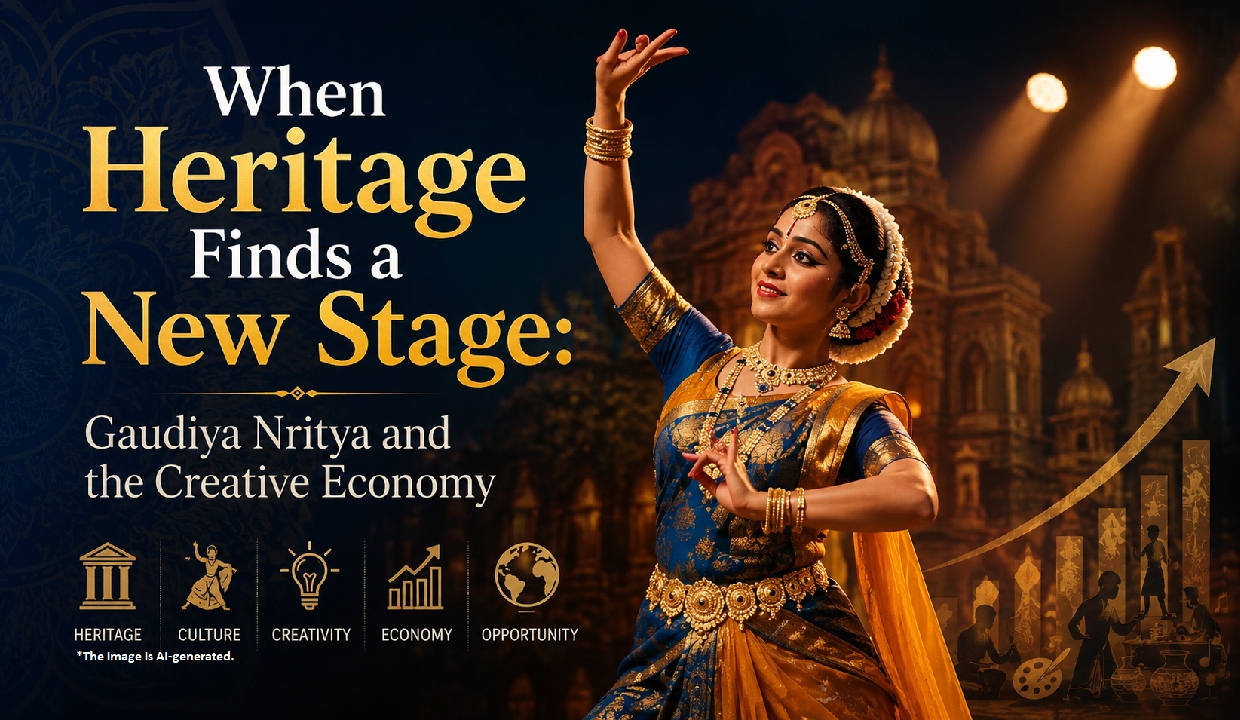
Gaudiya Nritya is a reconstructed classical dance tradition of Bengal whose historical evidence can be explored through literature, Natyasastra, manuscripts and sculpture. It is thus important to examine how this rich heritage can contribute to Bengal's creative economy and strengthen India's cultural soft power.
The word Gaudiya offers an important point to understand the cultural geography of the tradition. This Nritya is now associated with Bengal region. The Gauda region originally represented the region west and south of Padma River and centred around present-day Malda and Murshidabad districts. However, on account of conquests by Sena and Pala dynasties this word along with "Vanga/Banga" also reflected the entire region, including the area east of Padma River that is now Bangladesh. The term appears in Sanskrit literary traditions, inscriptions and later cultural usage. Bengal's rulers were at different points described by titles such as Gaudadhipati and Gaudeshvara, which reflecting the continuing association of the region with Gauda. The Bengal of earlier centuries, however, cannot be mapped neatly onto the political boundaries of the present. Its cultural landscape extended across areas that now form parts of India and Bangladesh. Rivers, pilgrimage routes, temples, monastic centres, royal courts and settlements connected these regions, allowing Sanskrit, Bengali and other vernacular traditions to develop in constant interaction. This Pan-Bengal character is particularly important when considering the history of Gaudiya Nritya. Unlike traditions preserved through a single, continuous textual or institutional lineage, its evidence is dispersed across different kinds of sources. Literary works, Sanskrit treatises on dance and music, architectural remains, sculptures, paintings and living performance traditions each preserve fragments of a larger cultural memory. The reconstruction of Gaudiya Nritya therefore, involves reading these sources alongside one another rather than searching for a single definitive manuscript that might explain the tradition in its entirety.
The literary evidence offers some of the earliest clues. The source connects the pre-Pala theatrical tradition described in the Natyasastra with regional forms and identifies Oidramagadhi as a possible ancient antecedent of Gaudiya. Later literary traditions provide a richer portrait of dance as a social and aesthetic practice. The Caryapada for example refers to women associated with the Siddhacharyas who were accomplished in singing and dancing. Moreover, the Sena period adds another layer when literature, music and the performing arts flourished together. This dance form is deeply rooted in the Natyashastra's basics of 'Bhav", 'Mudra 'and 'Abhinaya'. Religious underpinning came from Shakta and Shaiva traditions.
Subsequently, when Jayadeva composed the Gitagovinda, a work that brought poetry and music into close relationship with dance and performance. Jayadeva was known for his Gitikavya, while Padmavati was associated was a dancer. Chaitanya, through his Bhakti cult took it to Assam and Manipur. Those regions also derived their dance forms. Vaishnavite traditions provided form and musical basis. So, we have Dashavatar, Raslila of Radha-Krishna of Vaishnav tradition and Mahisasura-Mardini that reflect Shakta tradition. This eclectic mix reflects a cultural world in which poetry, music and dance were not separate arts but part of a shared aesthetic tradition. Padavali Kirtan and Khol (Mridangam) became an integral part of the performance of this dance. Percussion artists playing 'Kartal' broadened the musical base of this art form.
As mentioned earlier, the four familiar abhinayas are angika (bodily expression), vacika (speech or musical expression), aharya (costume and visual representation) and sattvika (inner emotional expression). The textual sources associated with the tradition further elaborate its aesthetic and technical terminology such as the Sangita Damodara discusses several fundamental aspects of performance, including bhramari, padaveda, karana, sthanaka and various rasa. The Sri-Hasta-Muktavali which is an important theoretical source that offers an extensive treatment of hand gestures or mudra and their expressive functions.
There are literary works, such as Mangalakavya tradition provides yet another window. In the Manasamangalakavya, that suggest that dance was closely intertwined into the religious imagination and social life of Bengal, rather than being restricted merely royal courts or formal performances.
The sculptural record provides another importance. Archaeological sites such as Paharpur and Mahasthangarh preserve sculptural representations like various dance postures, gestures and expressive forms. Particularly draws attention to image of Natesvara, Siva as the Lord of Dance, including a tenth-century image associated with the Pala period in present-day Bangladesh. The principle behind such evidence is beautifully expressed in the Visnudharmottara Purana: "Chitrasutram na janati…" This sloka helps to understand the relationship between the knowledge of dance and the interpretation of painting and iconography, reflecting the close interconnection of the visual and performing arts. In this context, Gaudiya Nritya is not simply a sequence of movement. It is a cultural grammar assembled from several archives.
Subsequent to conquest of this region by Bakhtiyar Khalji, destruction of temples and literary traditions took place at a large scale. Multiple invasions and subsequent neglect of this tradition in 'Bhadra-lok' circle led to decline of this classical dance form.
Yet cultural traditions may become marginalised but their historical traces continue to survive. Social attitudes, impacted by external invasions and subsequent neglect of our traditions as well as partition that caused vivisection of what was known as "Gaud Pradesh or Banga" contributed to the marginalisation of dancers, that displaced dance from mainstream cultural life.
Although the twentieth century witnessed the revival and institutionalisation of several Indian classical dance traditions, Bengal's own classical dance heritage remained comparatively obscured and received limited recognition within the broader national narrative of Indian classical dance. The turning point came through renewed questioning. During an excursion to the Ananta Basudev temple, Prof. Mahua Mukherjee encountered sculptures of dancers and asked a deceptively simple question: if Bengal had no classical dance tradition of its own the why were these dancing figures there? That question led to decades of investigation. Mukherjee drew upon Bengali and Sanskrit literature, classical texts, sculptures, paintings and rural dance practices in an attempt to reconstruct the lost vocabulary. In 1994, following extensive research, the dance form presented as Gaudiya Nritya. Its contemporary form is therefore understood neither as an unbroken survival from antiquity nor as a tradition detached from its historical foundations. Rather, it represents a process of reconstruction grounded in textual, visual, and performative evidence, and sustained through continuing research, interpretation and practice.
The priority now must be to move from revival to institutional sustainability like establishing a dedicated ecosystem for Gaudiya Nritya, supporting Guru-Shishya training, youth engagement, digital archiving, research, festivals and cultural tourism. Durga Puja can serve as a national and global platform. Such policy support can create sustainable livelihoods for artists and scholars while strengthening Bengal's tourism economy and India's cultural soft power.
Atanu Chakrabarty, Former Economic Affairs Secretary, MOF, GOI; Manashi Ghosh, Junior Research Fellow, Bharat Ki Soch; Views presented are personal.