When wars burn more than oil
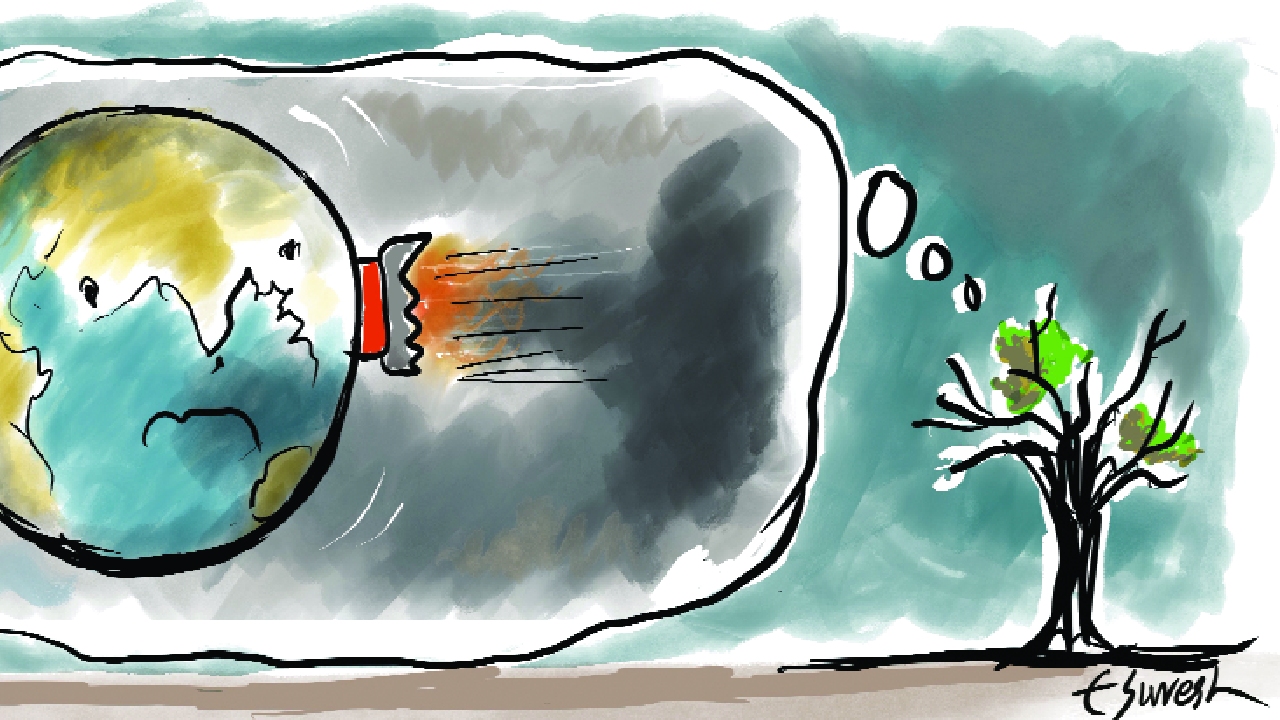
Never before have climate science and geopolitics converged so sharply, or so consequentially. The ongoing conflict involving Iran is not merely a crisis of regional security; it is a slow-motion assault on the planet's atmospheric dynamics and on the energy futures of nations thousands of kilometres away. India, sitting at the intersection of both vulnerabilities, has reason to pay particular attention.
The recently released World Meteorological Organisation's State of Global Climate Report offers a sobering baseline. Greenhouse gas concentrations have reached an all-time high. Global temperatures have breached the 1.2°C threshold consecutively since 2025. The past decade has been the hottest period recorded so far. The Earth, as scientists are no longer reluctant to say plainly, is already boiling. Yet what is often treated as a futuristic problem has an urgent, present dimension, one that active warfare is now making dramatically worse.
The conflict has introduced a carbon shock that few anticipated. The Climate and Community Institute estimates that the bombing of fossil fuel infrastructure alone released approximately 5 million tonnes of carbon dioxide in just the first two weeks of the war. To place that in proportion: India's carbon dioxide sink stood at 2 billion tonnes in 2025, a hard-won achievement of years of afforestation and renewable energy push. A single fortnight of distant conflict has carved a visible dent into that ledger. Geopolitics, it turns out, does not respect national carbon budgets.
The dangers compound in two distinct directions, and understanding both is essential to grasp why this conflict demands the attention of climate diplomats and energy policymakers simultaneously.
The energy security fault line
The first danger is one of supply. India imports approximately 88 per cent of its crude oil and nearly half of its liquefied petroleum gas and liquefied natural gas through the Strait of Hormuz. While oil and gas together account for nearly 6 per cent of India's total power generation, their role is far more critical in the sectors that keep the economy moving: transport, fertiliser and chemical manufacturing, and household energy. Any sustained disruption to this chokepoint is not an abstract geopolitical inconvenience; it is a direct threat to the fuel that runs India's transport networks, powers its industries, and keeps household energy affordable for hundreds of millions.
Energy security has always carried two faces: the availability of supply, and the prudence with which available resources are used. Both are now under stress. When supply tightens, the instinct, individually and institutionally, is to reach for whatever is cheapest and most accessible. In practice, that means a reversion to more polluting sources. Some Indian households, facing LPG shortages or price spikes, are already turning back to open-fire chulhas, echoing methods that a decade of public health campaigns worked hard to displace. The health consequences are well documented: indoor combustion of solid fuels produces soot, carbon monoxide, and particulate matter at concentrations that cause chronic respiratory and cardiovascular disease. An entire research and policy campaign was built to wean households off exactly this practice by promoting smokeless chulhas. Conflict-driven energy scarcity risks undoing it.
The atmospheric feedback loop
The second danger operates through the atmosphere itself, and its timeline is shorter than most people assume. There is now substantial evidence that changes in greenhouse gas concentrations and the accompanying rise in particulate matter alter weather patterns on timescales of days and weeks, not decades. The world had an inadvertent demonstration of this during the COVID-19 pandemic, when industrial and vehicular activity shut down almost simultaneously. Within days, air quality in major cities transformed visibly. Skies cleared. Rivers ran cleaner. Climate impacts, the pandemic revealed, are not solely the province of a distant future.
Additional carbon dioxide in the atmosphere drives global temperatures upward. Hotter temperatures in turn drive up energy demand, particularly for cooling. And in countries like India, where grid capacity remains stretched and the energy mix still leans heavily on fossil fuels, peak demand spikes are met predominantly through thermal power. The loop is self-reinforcing: more emissions produce more heat, more heat produces more demand, more demand produces more emissions.
For the hundreds of millions living in India's heat-stressed geographies - the Indo-Gangetic Plain, coastal Odisha, interior Maharashtra - this is not an abstraction. Extreme heat events, intensifying monsoons, urban flooding, and erratic weather are already realities that require energy access to manage. Cooling, clean water pumping, flood response: all depend on reliable, affordable power. The cruelest irony of the present moment is that the geopolitical disruptions contributing to a hotter atmosphere are simultaneously threatening the energy access that people need to survive that heat.
What India must insist upon
India's position is uncomfortable but clarifying. It is a country with a credible decarbonisation trajectory, genuine energy poverty challenges, and acute exposure to Hormuz-dependent supply chains, all at once. The conflict throws each of these into sharper relief.
This is a moment to argue, with renewed urgency, for accelerating the domestic renewable energy transition, not merely as a climate commitment, but as a national security imperative. Every gigawatt of solar or wind capacity built domestically is a unit of energy that cannot be held hostage by a strait or a war. It is also a moment to insist, in multilateral forums, that the climate costs of warfare be accounted for, and that the carbon emissions of conflict become part of the reckoning when peace settlements and reconstruction agreements are negotiated. Climate science and geopolitics have never been better connected. The tragedy is that the connection is being forged not by cooperation, but by crisis.
The writer is an Assistant Professor, Sustainability Management and Centre of Public Policy at the Indian Institute of Management Mumbai; views are personal
Leave a Comment
Comments (1)
Very Insightful!