FTA: Towards closer ties with New Zealand
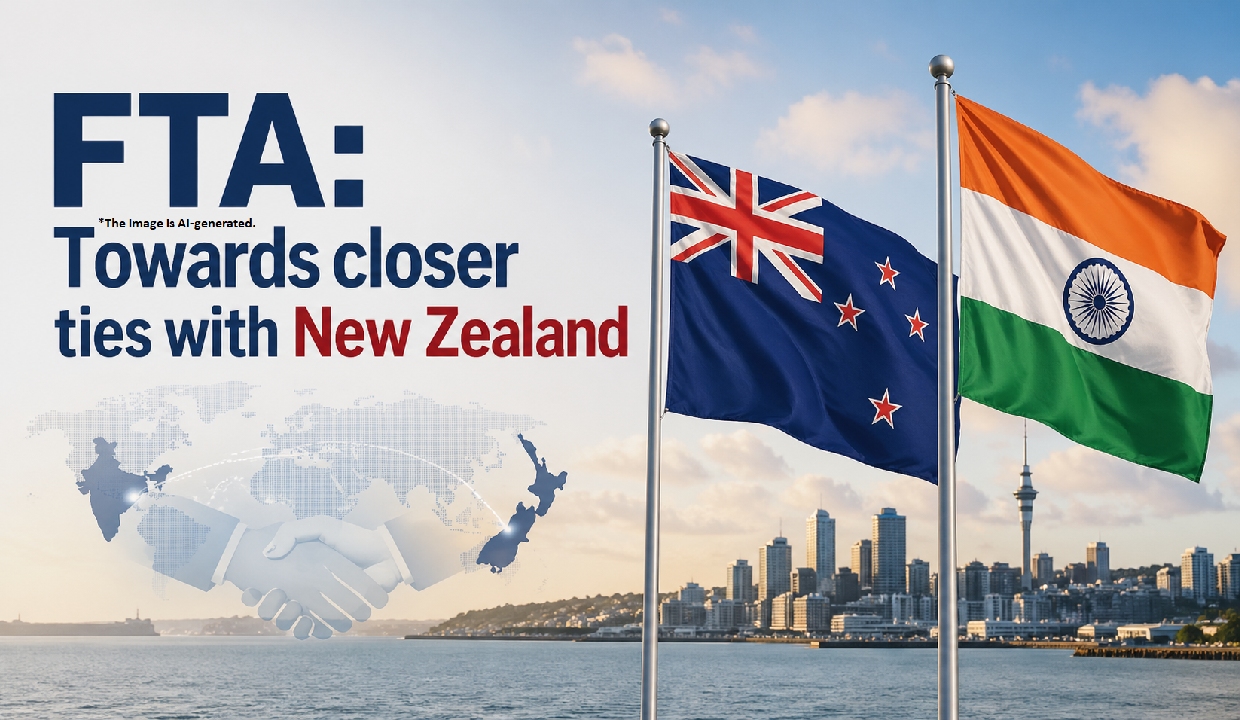
The India-New Zealand FTA is less about immediate trade gains and more about strategic positioning, and reflects India’s resolve to increase its global outreach
It is a Trump world where uncertainty reigns. Whether in trade or geopolitics, the US President can always spring a surprise, disrupting national economies and nations themselves. In this scenario, India has moved swiftly to diversify its trade ties and lessen its trade dependence on the United States. It is now exploring and committing itself to bilateral ties that insulate it from the vagaries of geopolitical headwinds. India has already established bilateral ties with the UAE and Australia, and is exploring further possibilities with many other countries. In the chain of these agreements comes the recently concluded India-New Zealand Free Trade Agreement, which again signals a calibrated shift in New Delhi’s economic diplomacy. The agreement was signed by Piyush Goyal and Todd McClay, and endorsed by Christopher Luxon as a “once-in-a-generation” deal. The agreement may have a limited impact on India’s trade, as Indo-New Zealand trade is not substantial, but it does show a direction and purpose.
The pact undoubtedly gives India new market access and certainty. New Zealand has agreed to give 100 per cent duty-free access to all Indian exports-covering over 8,000 tariff lines-creating a rare opportunity for frictionless entry into a developed market. For Indian sectors such as textiles, leather, pharmaceuticals, and auto components, this is an immediate competitive advantage. While New Zealand’s market size is modest, the value lies in predictability and the ability to scale niche exports. In today’s world, increasingly marked by protectionism, this is a big deal. Equally important is the agreement’s role in diversifying India’s trade partnerships. The agreement enhances India’s Indo-Pacific trade footprint. Though bilateral trade is currently limited, the target of doubling it to $5 billion within five years is realistic. Beyond goods, the FTA’s emphasis on services and mobility reflects the changing nature of global trade. The provision for visas for Indian professionals in the IT, healthcare, and engineering sectors is a notable gain. It aligns with India’s strength as a services exporter and addresses long-standing demands for easier movement of skilled labour. For Indian youth and students, expanded post-study work opportunities in New Zealand open new avenues for global exposure and skill acquisition. The investment dimension of the pact is another significant pillar. New Zealand’s commitment to invest up to $20 billion in India over the next 15 years has the potential to catalyse growth in sectors such as technology, manufacturing, and food processing. The fast-track arrangement allowing Indian food processors to import New Zealand inputs duty-free for re-export is particularly strategic. It strengthens India’s ambition to position itself as a global food processing hub while integrating it more deeply into international value chains.
Yet, the agreement is not without riders. India’s cautious approach in excluding critical sectors such as dairy, sugar, and edible oils underscores the political economy of trade. If effectively implemented, it could serve as a template for future engagements-where ambition is matched by caution, and openness is anchored in national priorities.