Addressing India’s jobs crisis
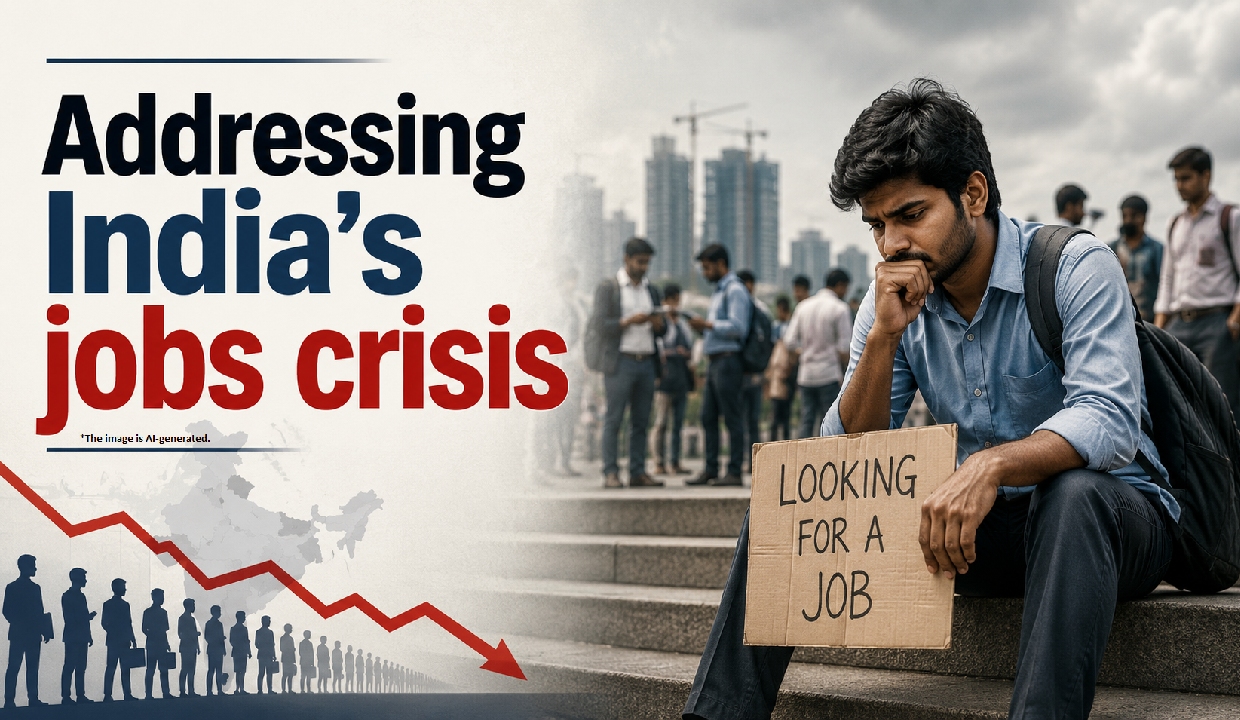
The employment question is not merely economic — it is deeply linked to dignity and aspiration of the youth and affects national confidence
Any nation that aspires to be a superpower must be backed by its youth that is meaningfully employed and has a positive mindset. Indeed, India is one of the youngest nation of the world has a sizable youthful energy. But if it is not engaged in constructive work there is a high chance of it going wayward. In keeping with his commitment to provide jobs, Prime Minister Narendra Modi presided over the 19th edition of the Rozgar Mela, distributing appointment letters to over 51,000 freshly recruited government employees across 47 locations nationwide. The ceremony was warm. The intent, no doubt, is genuine. But the arithmetic is brutal. India adds roughly a million young people to its workforce every single month. Fifty-one thousand government posts, distributed once every few months, is a gesture — not a solution. Youth unemployment in India stood at 15.2 per cent as of March 2026, up from lows of 13.8 per cent just a year earlier, with young women faring far worse at nearly 18 per cent. The Centre for Monitoring Indian Economy (CMIE), an independent body, has consistently placed unemployment between 7–8 per cent — more than double the government’s own survey figures — reflecting a chasm between how joblessness is measured and how it is experienced. Behind every statistic is a graduate sending out hundreds of applications, a young person cycling between gig stints, a family waiting on one steady income that never seems to arrive. Over 30 lakh vacancies remain unfilled in central government departments alone — even as Rozgar Melas distribute letters in the tens of thousands. The PM’s original 2014 promise of two crore jobs a year now reads as a stark reminder of the distance between ambition and delivery. None of this is to say the Rozgar Mela is without value. For the 51,000 individuals who received their letters on Friday, this is life-changing. A government job in India remains a rare, coveted thing — stable, pensioned, insulated from the chaos of informal work that employs the vast majority of Indians. Every vacancy filled is a family’s circumstances altered. That matters.
But the deeper crisis is structural, and ceremonial hiring drives cannot fix it. India’s private sector — particularly manufacturing — has failed to absorb the demographic dividend at scale. The Production Linked Incentive scheme holds promise, and PM Modi’s recent agreements with the Netherlands, Sweden, Norway, and Italy in semiconductors, AI, and advanced manufacturing could, over time, seed high-quality employment. The keyword is time. Youth cannot wait a decade. The way forward demands three urgent shifts. First, a serious and transparent accounting of vacancies — not as political ammunition, but as a national obligation. If 30 lakh posts are empty in central government, they must be filled. Second, invest massively in quality skilling under PMKVY and allied programmes so that the millions outside government employment can compete in formal private sector jobs. Third, make it genuinely easier for small and medium enterprises to hire, expand, and formalise — because that is where the bulk of India’s employment must ultimately come from.