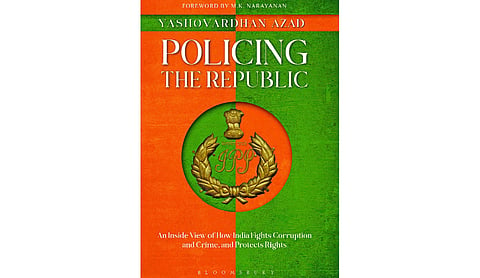

India’s police still function under a law written for a colonial power to control its subjects, not a republic to serve its citizens. The Police Act of 1861, drafted in the aftermath of the 1857 uprising, remains in force in large parts of the country. In 2006, the Supreme Court, ruling on a petition filed a decade earlier by former Uttar Pradesh DGP Prakash Singh, issued seven binding directives ordering every state to insulate its police from political interference - fixed tenures for top officers, security commissions to buffer the force from the government of the day, and a clear separation between investigation and law-and-order duties. Nearly two decades on, compliance across most states remains cosmetic at best. It is against this backdrop of a reform that never quite arrived that Yashovardhan Azad’s new book, Policing the Republic, lands with particular weight.
Published by Bloomsbury India and priced at Rs 699. Its subtitle - An Inside View of How India Fights Corruption and Crime, and Protects Rights - is a fair description of its ambition. The foreword is written by M.K. Narayanan, India’s former National Security Adviser, which signals the seriousness with which the book is being positioned within the country’s security and policy establishment.
Azad’s is not a voice from the sidelines. He is a 1976-batch IPS officer whose four-decade career took him from district postings in Madhya Pradesh to the innermost circles of India’s intelligence and security apparatus.
Policing the Republic moves well beyond memoir. It takes on corruption, the criminalisation of politics, terrorism, insurgency, the machinery of intelligence-gathering, and the broader question of how India’s internal security architecture has evolved - and where it has stalled. Azad is billed as making the case that political interference and systemic weakness inside these institutions have eroded the guarantees the Constitution makes to citizens.