From ‘reluctant prince’ to assertive challenger
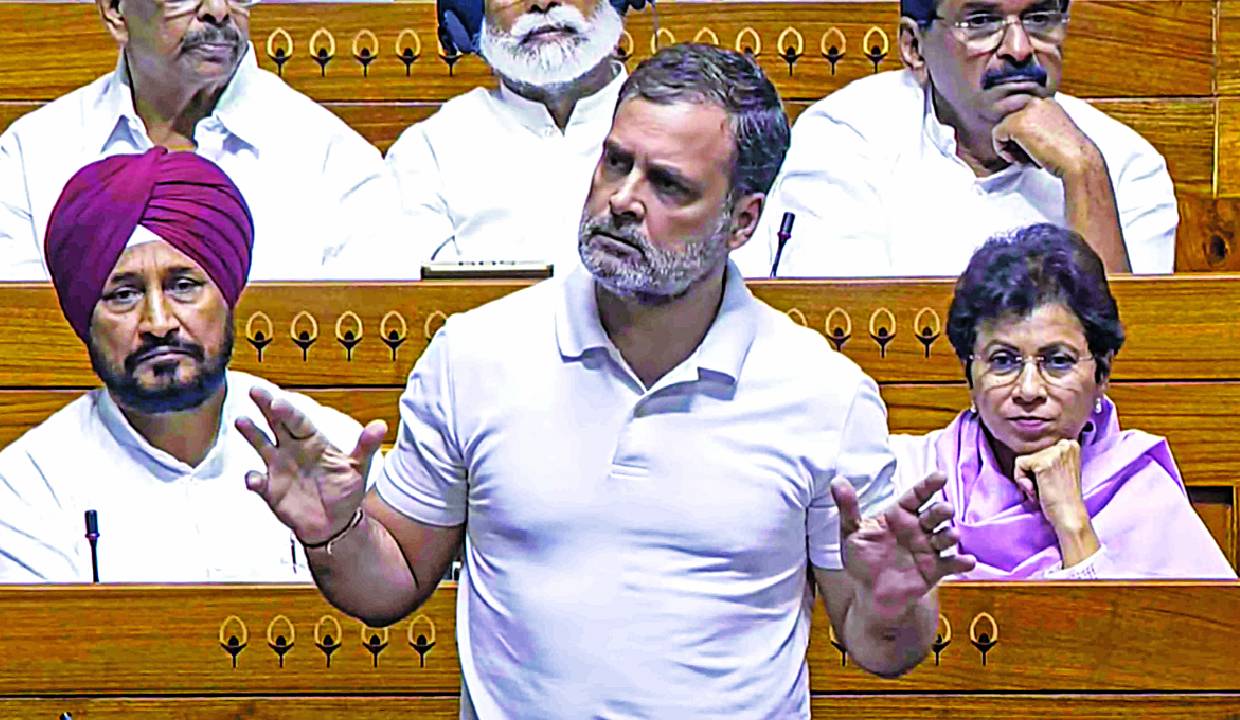
Has Rahul Gandhi become a credible Leader of the Opposition in the Lok Sabha since his appointment in June 2024? With nearly two years having passed, how effective has he been? Has he held the government accountable and changed his party's approach to budget reviews? Has he demonstrated leadership qualities such as strategic communication and coalition-building during this time? These questions are essential for evaluating his influence and effectiveness.
Rahul began his political career in 2004 and has faced both successes, challenges, and failures.
He has worked behind the scenes, guiding the party through victories and defeats, while choosing not to take a ministerial role in the Manmohan Singh government from 2004 to 2014.
Gandhi's rise to a prominent position within the Congress Party was largely expected, reflecting his positioning within the party. He has the final say in party appointments.
While many party members viewed his leadership as a positive development, others expressed concern that it highlighted the party's lack of alternatives and its dependence on the Nehru-Gandhi family. Ultimately, he resigned, and senior leader Mallikarjun Kharge became the party president.
Rahul's role as LOP has included pointing out the government's mistakes in Parliament and outside on behalf of the Opposition and his own party. However, there have been important occasions when he was not present.
Rahul has taken on a more assertive, visible role, focusing on defending the Constitution, addressing income inequality, and challenging the BJP-led government on various issues.
He has rebranded his image to align with the formal role, focusing on job creation, safety for marginalised groups, and the rights of farmers.
This is the first time in a decade that a cabinet-level position has been filled. Since 2014, no opposition party has achieved the 10% of 543 seats needed to be recognised as the Leader of the Opposition. This presents a significant opportunity for the Opposition to challenge the Narendra Modi government.
On his first day in the Lok Sabha as LOP, Rahul Gandhi stressed the need for the ruling coalition to uphold the rule of law and for the Opposition to address issues such as the economic downturn, unemployment, a caste census, and the farmers' crisis. As the Leader of the Opposition, he participates in selecting key officials, such as the Chief Election Commissioner and the CBI Chief, to ensure that the Opposition has a say in these appointments.
Rahul's presence in Parliament has become more confrontational and assertive, reflecting his strategic shift to challenge the government directly. With the ruling party loudly defending the Modi government, noisy scenes have ensued in Parliament. Still, it has also enabled the Opposition to oppose key bills, such as the Women's Reservation Bill and the farmers' bills.
His active participation in legislative debates and initiatives demonstrates his growing influence and impact as Leader of the Opposition, consistently challenging the Modi government on multiple issues.
One successful step was his Bharat Jodo Yatra, which boosted his image by allowing him to mingle with the public and learn about their problems firsthand.
Educated at some of India's most prestigious schools, he went on to study economics in the United States and gain international experience working in London before returning to Mumbai in 2002.
Gandhi is often referred to as the "reluctant prince" by his critics, who believe he is hesitant to fully embrace the responsibilities that accompany his significant influence. However, many consider him to have been the unofficial number two in the party for a long time.
However, some were worried about the party's continued reliance on the Nehru-Gandhi family for leadership.
Rahul decided to enter politics and won a seat in 2004 from Amethi. In September 2007, he became the party's secretary-general while his mother, Sonia Gandhi, remained president. By January 2013, he had risen to Vice-President of Congress, highlighting his growing influence.
Critics say that even though he is more visible now, the party lost key state assembly elections in late 2024 and 2025. This raises doubts about his ability to turn popularity into votes.
Rahul became the Leader of the Opposition in the Lok Sabha in June 2024. As time passes, he could lose support if he fails to secure the backing of regional allies and continues to struggle in local politics.
The Opposition created the INDIA bloc and worked together in the 2024 General Election. As a result, the Opposition won more seats. The Congress Party doubled its number of seats.
Additionally, there has been feedback regarding his attendance at key events and his focus on topics that some critics view as less significant.
He is trying to be more approachable by engaging in activities that demonstrate his commitment to ordinary people's concerns. Different groups view his performance differently.
During Rahul Gandhi's tenure as Leader of the Opposition, he has become a more focused and articulate leader. However, whether he has gained "credibility" is subjective. Supporters see improvement, while opponents argue his style remains unchanged.