Vivekananda changed global thought
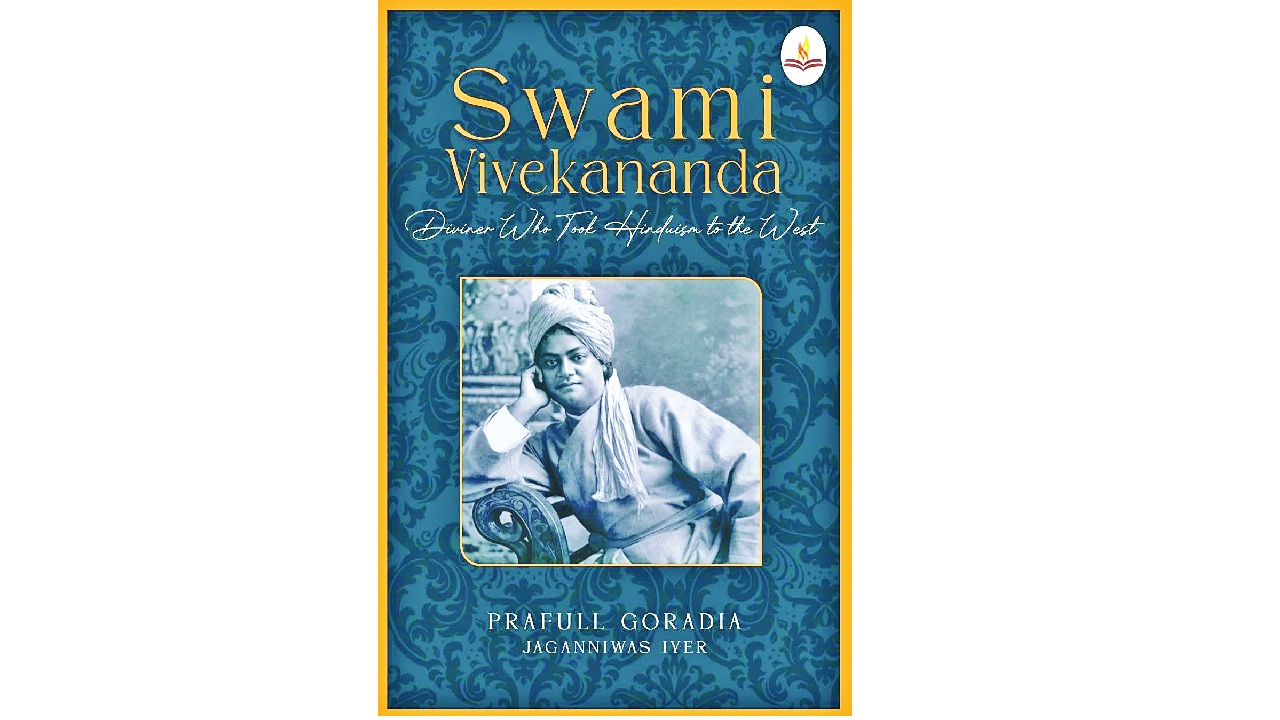
The very recent book on Swami Vivekananda, The Diviner Who Took Hinduism to the West, represents a modern and more interpretative approach to understanding the Swami’s life and mission. Earlier works on Vivekananda-particularly those produced by the Ramakrishna Mission-tended to be restrained, devotional, and focused primarily on his spiritual teachings. While valuable, they often underplayed the historical and global significance of his work. This newer perspective seeks to place Vivekananda within the broader currents of modernity, nationalism, and cross-cultural exchange. His most active and visible public life lasted barely a decade, from 1893 to 1902, yet within this short span he achieved what few figures in history have managed. His early death at the age of 39 cut short a career that might have reshaped even more profoundly the intellectual relationship between East and West.
To understand Vivekananda’s importance, one must consider the historical backdrop. India was still recovering from the shock of the Indian Rebellion of 1857, often referred to as the Sepoy Mutiny. The rebellion had failed, but it left behind a deeply scarred society. British authority became more centralised and assertive, while Indians began to introspect about their identity, traditions, and future. Social reform movements were emerging, and there was a growing need to reinterpret Indian civilisation in a way that could stand confidently before the modern world. It was in this environment that Vivekananda appeared — not as a relic of the past, but as a remarkably modern thinker.
In many ways, Vivekananda embodied the synthesis of tradition and modernity. Educated in Western philosophy and deeply rooted in the teachings of his guru Ramakrishna Paramahamsa, he was able to articulate ancient Indian ideas in a language that resonated with contemporary audiences. At a time when colonial narratives often portrayed Indians as inferior, Vivekananda’s intellectual confidence challenged such stereotypes. He did not imitate the West; instead, he engaged with it as an equal. His journey to the Parliament of the World’s Religions marked a turning point not only in his life but also in the global perception of Hinduism. Supported by enlightened Indian rulers such as the Maharaja of Mysore and others, Vivekananda managed to travel to the United States at a time when such a journey was neither easy nor common. His arrival in Chicago was initially fraught with difficulties-financial constraints, lack of formal credentials, and unfamiliarity with the environment. Yet, these obstacles only made his subsequent success more remarkable. When Vivekananda finally addressed the Parliament in September 1893, his impact was immediate and electrifying. His famous opening words, “Sisters and Brothers of America,” broke through the formal stiffness of the gathering and created an emotional connection with the audience. In a forum largely dominated by Christian representatives, Vivekananda presented Hinduism not as an exotic or inferior tradition but as a profound and inclusive philosophy. His assertion that Hinduism was the “mother of all religions” was not merely a claim of superiority but a reflection of its long history of accommodating diverse beliefs and practices.
Until that moment, global religious discourse had been heavily centred around Christianity, particularly in the Western world. Swami Vivekananda disrupted this monopoly by introducing Vedanta as a universal philosophy that transcended sectarian boundaries. He emphasised tolerance, acceptance, and the unity of all religions-ideas both ancient and strikingly modern. His message resonated with American audiences seeking spiritual meaning beyond traditional frameworks.
The United States, still a young and dynamic nation, provided fertile ground for his teachings. He became a sought-after speaker, engaging widely through lectures and dialogue. His ability to communicate complex ideas in simple terms made him immensely popular. Notably, he adapted his message without diluting its essence. Presenting Hinduism-especially Vedanta — as a rational and philosophical system rather than mere ritual, he addressed misconceptions and articulated ideas like the divinity of the soul and the unity of existence. In doing so, he emerged as one of the earliest ambassadors of Indian thought on the global stage.
During his extended stay in America, which lasted over a year and a half on a single trip, Vivekananda also underwent a transformation. He began to see more clearly the gap between how India understood itself and how it was perceived abroad. This realisation strengthened his resolve to educate the West about India’s true intellectual and spiritual heritage.
At the same time, he also reflected on the weaknesses within Indian society, particularly poverty, lack of education, and social divisions. His later work in India would increasingly focus on these issues, emphasising practical spirituality and social service. In retrospect, Swami Vivekananda’s Western journey redefined Hinduism in a universal language and shaped global spiritual dialogue. Without it, Indian philosophy might have remained confined; instead, it became a worldwide conversation.