How Science Embraces Spirituality: When President Kalam Met His Ultimate Teacher
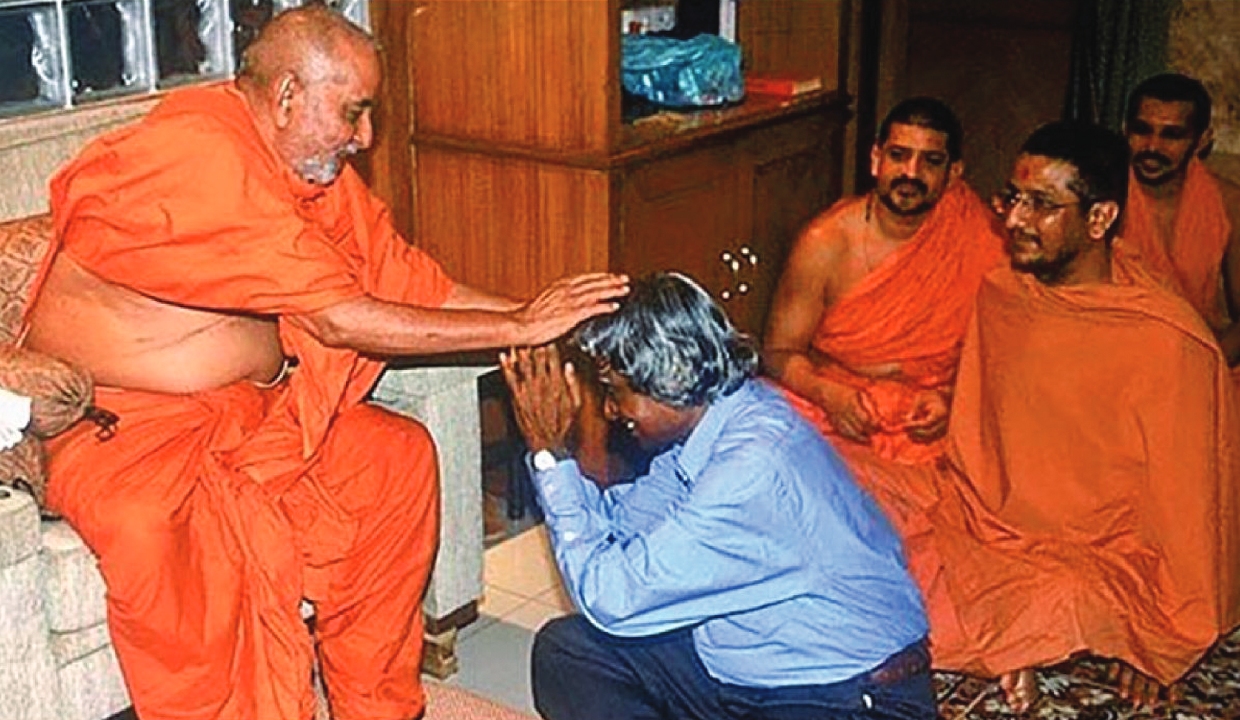
The architect of our sophisticated space and missile technology, and a rare scientist whose vision was to develop society upon the foundation of values, Bharat Ratna APJ Abdul Kalam came calling upon HDH Pramukh Swami Maharaj, with his fellow scientist YS Rajan. This special meeting on June 30, 2001, in New Delhi, turned out to be a beautiful fusion of science and spirituality
“It was a hot summer evening on June 30, 2001, when I met Pramukh Swamiji for the first time. Resplendent in saffron robes, the gentle, fair-complexioned Pramukh Swamiji was radiating divinity.” With these timeless words, APJ Abdul Kalam begins his remarkable and widely celebrated book Transcendence, setting the tone for a deeply spiritual and reflective journey.
During the construction of the world-renowned Akshardham Mandir, Pramukh Swami Maharaj came to Delhi to personally guide and review the progress of this monumental project. It was during one such visit that Kalam came to meet him. When he entered the serene room of Swamiji, the attendant sadhus respectfully offered him a sofa befitting the great scientist of India. But Kalam, with his characteristic simplicity, gently declined. Instead, he chose to sit cross-legged on the floor among the devotees.
After warm greetings, Kalam posed a question: “Swamiji, five hundred members like me are thinking about what should be the next vision for India. How do we transform a developing country into a developed country in the next 30 years? We have identified five important areas to transform India: education and healthcare, agriculture, information and communication, infrastructure, and critical technology.”
He added further, “Swamiji, our problem is that we may present this before the Government, but how do we create people with values to carry out such a big vision? What we need is a cadre of value-based citizens. For this, you are an expert. We need your advice.”
Swamiji answered, “Along with these five, add a sixth-faith in God and developing people through spirituality. We need to first generate a moral and spiritual atmosphere. With these character-based people, problems will be solved and we shall be able to achieve what we dream.”
In further conversation, Swamiji explained that material advancement and spiritual growth are not separate paths, but parallel forces that must move together. Drawing from India’s timeless wisdom, he emphasised the harmony of Apara Vidya (worldly knowledge) and Para Vidya (spiritual knowledge): one empowers, the other guides; one builds capability, the other shapes character. Science gives us tools; spirituality gives us direction. Science builds capability; spirituality builds character. In that moment, the two worlds-science and spirituality-did not collide, but complemented each other.
From that day on, Kalam did not merely remember Pramukh Swami; he wished to meet him again and again, as a seeker returns to a source. Then came a defining moment. Having risen to the highest office in the nation, he got the opportunity to visit Ahmedabad on August 13, 2002.
In a move that surprised many, the President of India arrived at the BAPS Swaminarayan Mandir, seeking not ceremony, but guidance and blessings from Pramukh Swami. What followed was not just a meeting; it was a revelation waiting to unfold.
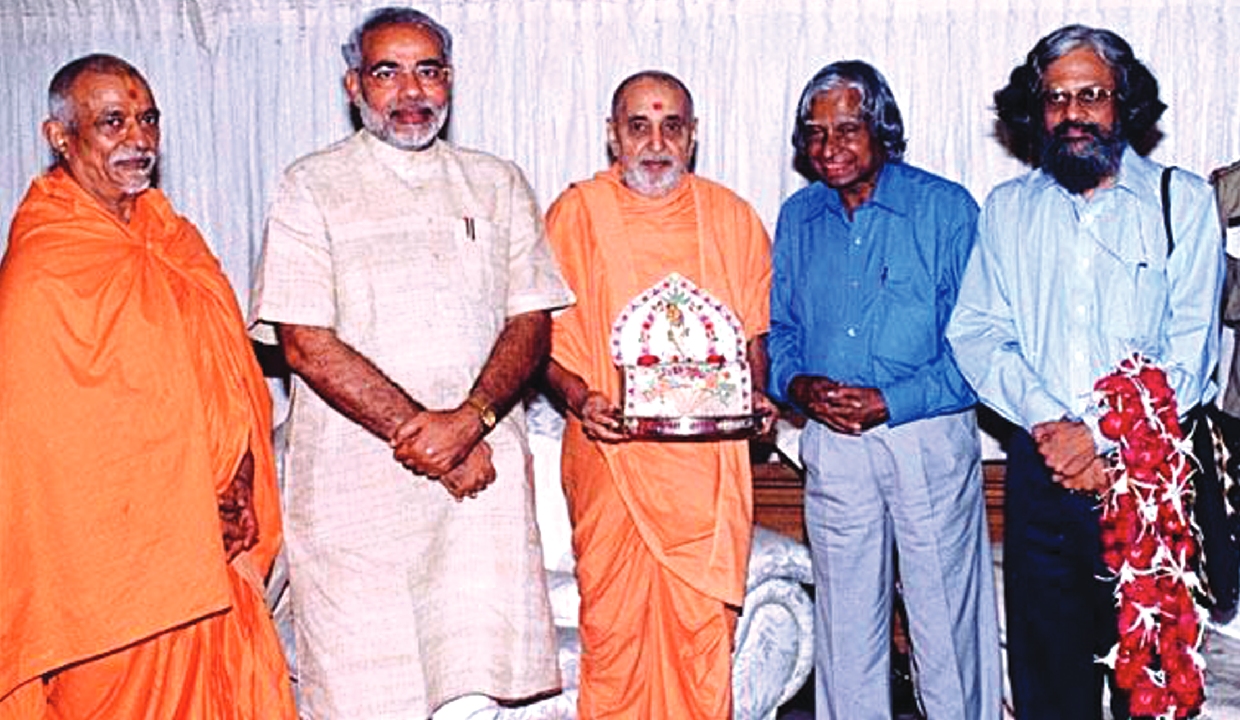
Swamiji welcomed the President with deep love and care. On this occasion, the Chief Minister of Gujarat, Shri Narendrabhai Modi, Vadibhai Patel, Secretary YS Rajan, Secretary Shri Sheridan, and other dignitaries accompanying the President were also garlanded. In the meeting, their dialogue extended to the theme of national unity. The President asked, “Unity of thought is important for our country and its progress. How can this unity be attained?”
Pramukh Swamiji replied, “Our Indian tradition teaches us that we are all the children of God, and God resides within all of us; thus, we are all one. We should live together and work for the progress of the country.”
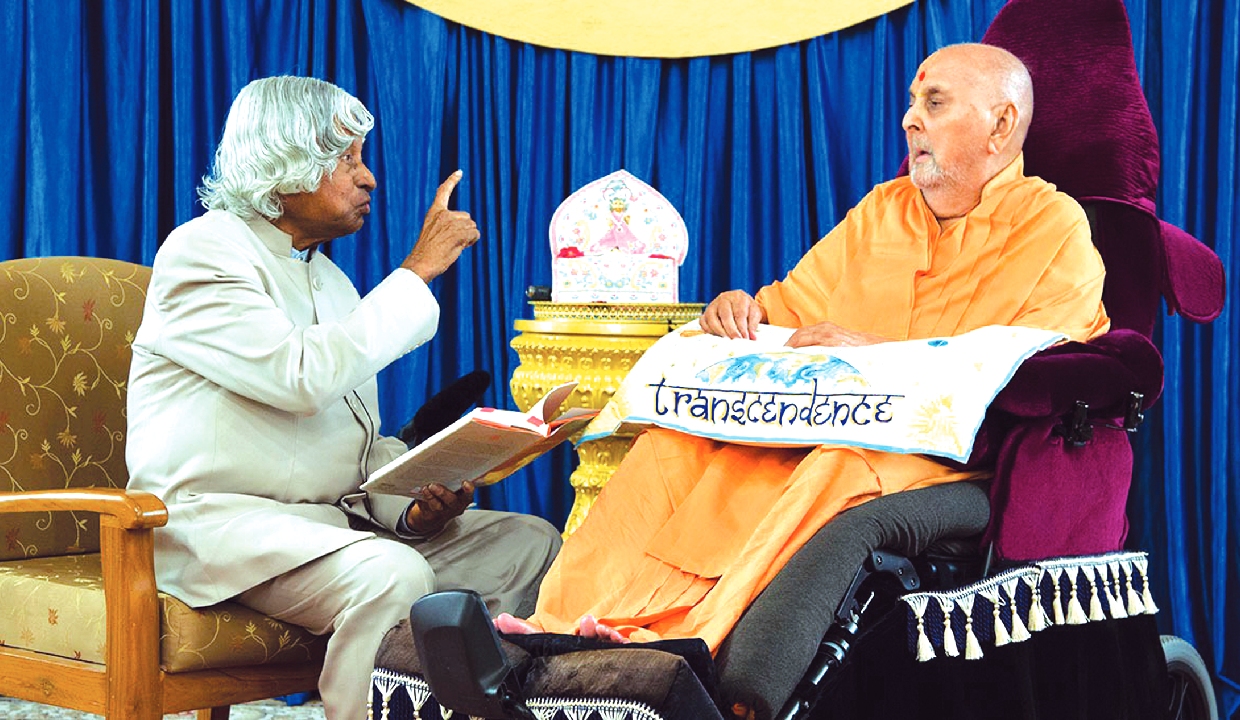
It was the fundamental source of unity. When one learns to see God in every person, the very basis of conflict dissolves. You cannot harm, insult, or exploit someone in whom you perceive divinity; respect becomes natural, not forced. This vision shifts reactions from ego to empathy, reducing anger at its root. Whether in a family disagreement or a global dispute, it replaces “defeat the other” with “understand the other”. Thus, from street quarrels to world conflicts, this principle offers a deeply logical path to lasting peace.
In this way, APJ Abdul Kalam met Pramukh Swami Maharaj several times. Each encounter deepened his admiration and inner connection. Profoundly touched by Swamiji’s purity, wisdom, and quiet spiritual power, Kalam felt an irresistible urge to share this experience with the world.
This inspiration eventually took shape as the book Transcendence. On June 20, 2015, in a moment of deep reverence, Kalam personally travelled to Sarangpur, Gujarat, to present the very first copy of the book to Swamiji — an offering of gratitude from a scientist whose heart had been deeply touched by the Guru, whom he himself admired as “my ultimate teacher”. He added, “I have learned a great lesson from him: how to remove ‘I’ and ‘me’ (I-ness and my-ness).”
The writer is an Assistant Director, BAPS Research Institute, Akshardham, Delhi and In-charge of the Media Cell of BAPS Swaminarayan Sanstha; Views presented are personal.