Delimitation and the new politics of power
Every democracy must periodically redraw its electoral map to reflect population change. In India, this process is known as delimitation. On paper, it is a routine constitutional exercise. In reality, the next delimitation due after Census 2027 will be the most consequential redrawing of political power since Independence. It will redefine how seats are distributed in the Lok Sabha and how India understands fairness, federalism, and regional balance.
The Constitution originally mandated reapportionment after every census. But this principle has been suspended for nearly half a century. The inter-state distribution of Lok Sabha seats has remained frozen since 1976, based on the 1971 Census, to ensure that States were not penalised for successfully controlling population growth. The 84th Constitutional Amendment (2001) extended this freeze until “the first census taken after the year 2026.”
That suspension effectively ends with Census 2027. With the census process now underway, delimitation has moved from a distant prospect to an approaching institutional reality. Yet representation today continues to rest on an India of 548 million people, not the present reality of over 1.4 billion.
Delimitation is neither simple nor swift. India’s previous four Delimitation Commissions took between three and five-and-a-half years. The last exercise (2002-2008) took over six years, though it was limited to redrawing constituency boundaries within States, without reallocating seats among them. The next Commission will face a far more complex task: redistributing seats among States for the first time since 1976, redrawing all constituencies, and operationalising the 33 per cent reservation for women.
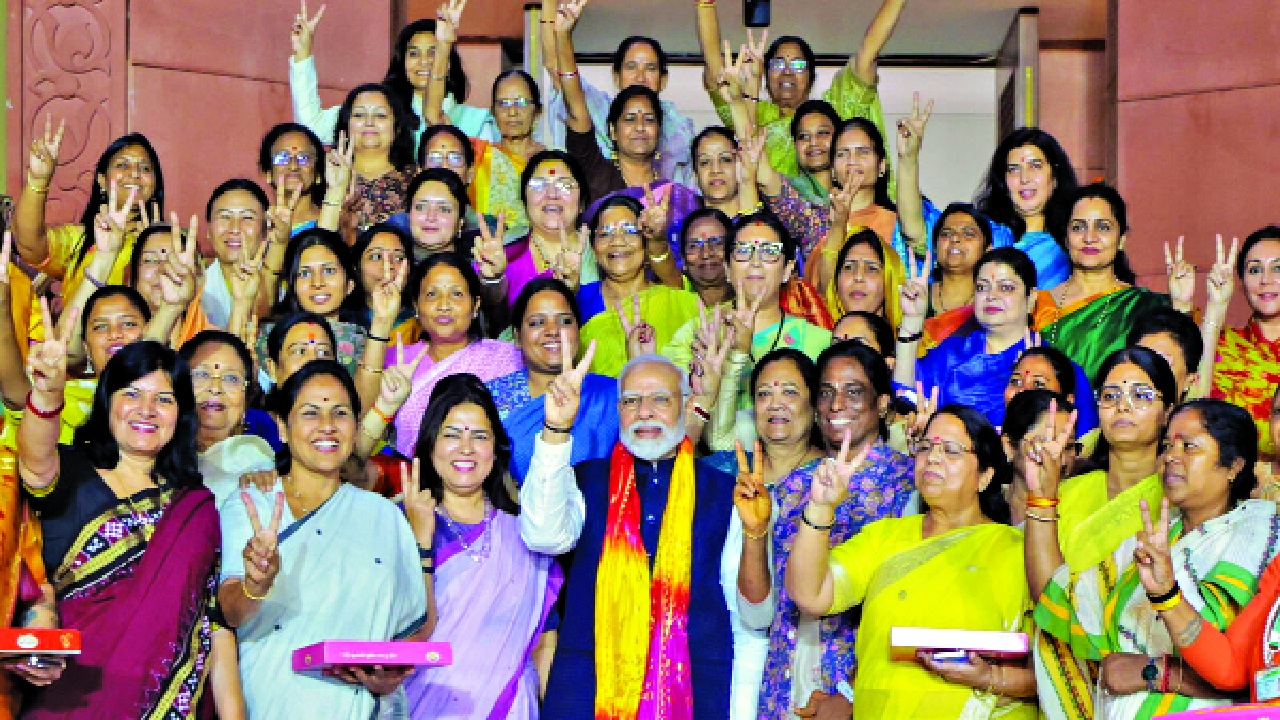
Recent developments suggest that the political system may seek to advance parts of this process even before formal delimitation begins. The special session of Parliament convened on April 17-18, 2026, to consider measures relating to women’s reservation and a possible expansion of the Lok Sabha indicates an emerging attempt to operationalise representation changes ahead of the more contentious exercise of inter-state redistribution. This raises the possibility of decoupling seat expansion and reservation from delimitation, at least in the interim.
Even if Census data becomes available by 2028, completing delimitation before 2031-32 would be difficult. Consequently, the full implementation of women’s reservation, if tied strictly to delimitation, may not occur before the 2034 general election. The current policy direction, however, suggests that alternative pathways may be explored.
The context today is fundamentally different from the 1970s. Then, fertility rates across States were broadly similar. Today, they have sharply diverged. Southern and western States have achieved below-replacement fertility through sustained investments in education, health, and women’s empowerment. In contrast, States such as Uttar Pradesh and Bihar continue to record higher population growth.
If representation is recalibrated purely on population, the consequences will be stark. States that succeeded in controlling population growth will see their relative political weight decline, while those with higher growth will gain significantly.
Projections illustrate the scale of change. In an expanded Lok Sabha of around 816 seats, Uttar Pradesh could rise from 80 to about 139 seats, and Bihar from 40 to around 75, together approaching a quarter of the House. Tamil Nadu and Kerala would see their absolute numbers rise modestly, but their share would decline from 7.2 per cent to about 6.1 per cent and from 3.7 per cent to around 2.7 per cent, respectively. The shift is not merely numerical; it is structural.
This produces a moral and political paradox: should States be disadvantaged for good governance? For decades, India incentivised population stabilisation. Those who responded effectively now risk diminished representation. The logic that justified the freeze in 1976 and 2001 has not lost its relevance.
The Union Home Minister has assured that “not even one seat will be reduced” for any southern State, nor proportion disturbed. Yet such assurances, while politically significant, do not resolve the structural imbalance. Even if no State loses seats in absolute terms, a sharp increase in representation for others inevitably alters relative influence. Parliament functions through numbers, not proportions.
The arithmetic conceals a deeper shift. When two States together approach a quarter of the Lok Sabha, the dynamics of coalition-building and legislative negotiation change fundamentally. The balance of federal power cannot be understood only in terms of absolute seats; it must be assessed in terms of relative weight.
Several options merit consideration.
First, the current freeze could be extended beyond 2026 until fertility rates converge further. This would preserve the existing balance but raise legitimate concerns about representational fairness and could invite constitutional challenge under Article 14, as prolonged reliance on outdated population data weakens the principle of equal suffrage.
Second, a weighted formula could be considered: for example, 70-80 per cent weight for population and 20-30 per cent for development indicators such as literacy, health outcomes, or sustained fertility reduction. This would mirror the composite criteria used by the Finance Commission and reward governance outcomes alongside demographic size.
Third, the Rajya Sabha could be strengthened as a genuinely federal chamber. The dilution of domicile requirements has weakened the organic link between members and their States.
Restoring this connection is essential. More fundamentally, representation in the Rajya Sabha remains broadly population-based, limiting its federal balancing role. Alternative models-such as tiered representation or equal representation within defined categories of States-could be explored to restore equilibrium.
Fourth, the possibility of reorganising large States, particularly Uttar Pradesh, merits discussion. The creation of smaller States has precedent, and proposals for regions such as Bundelkhand and Purvanchal have persisted for long. Dividing a State with overwhelming projected representation could rebalance federal power without altering constitutional principles.
Fifth, redistribution could be phased across two electoral cycles-partially implemented in 2034 and completed in 2039-allowing political systems and regional balances to adjust gradually.
Beyond the formula, the process itself will be critical. The Delimitation Commission must be equipped with expertise in demography, constitutional law, and federal studies, and must ensure meaningful consultation with States. Transparency, public hearings, and institutional oversight will be essential to building trust.
The exercise will also redraw internal constituency boundaries. While the number of constituencies reserved for Scheduled Castes and Scheduled Tribes is determined strictly by population, the selection of specific constituencies, particularly for SCs, allows for flexibility, which must be exercised transparently and consistently.
Delimitation is not a technical exercise; it is a constitutional moment. It will redistribute political voice, reshape coalition politics, and test the resilience of India’s federal compact.
The Census will measure India’s population; delimitation will measure its democracy. Once Census figures are published, positions will harden, and consensus will become difficult. That is why the time for reasoned debate is now.
Handled with care, delimitation can modernise representation while preserving federal balance. Mishandled, it risks deepening regional anxieties and unsettling the moral equilibrium of the Republic.
The writer is a former Chief Election Commissioner of India and the author of ‘An Undocumented Wonder - The Making of the Great Indian Election’ and Democracy’s Heartland: Inside the Battle for Power in South Asia