The return of homegrown terror
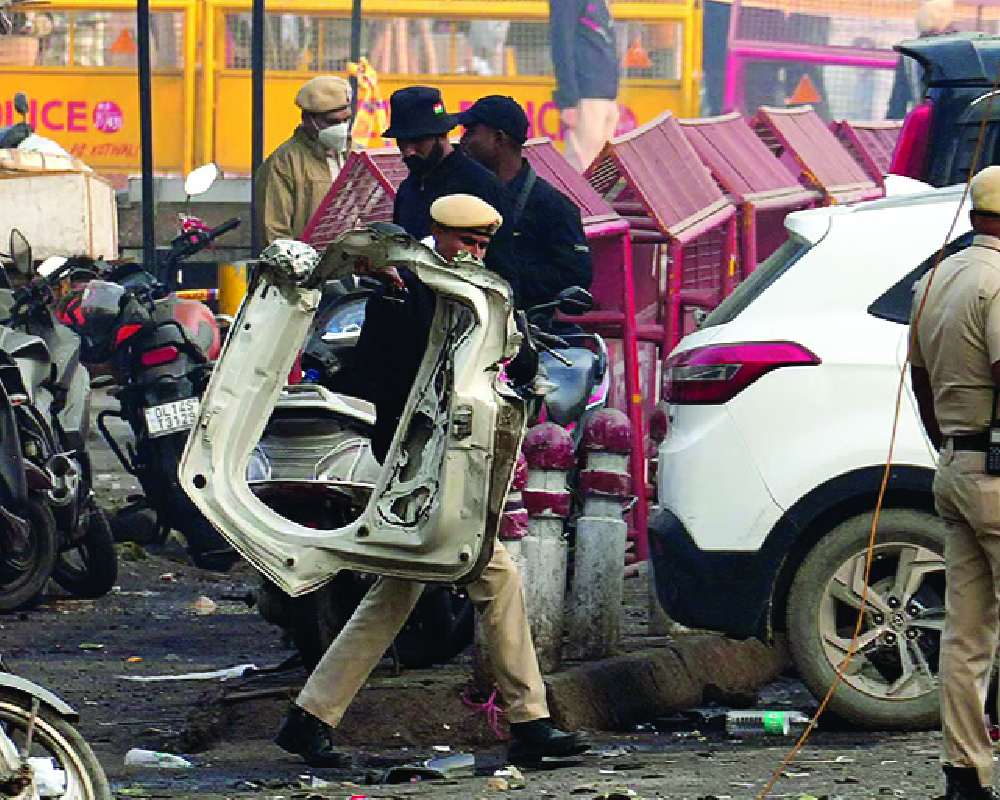
Much has been written about the Red Fort blast. More dots in the terror trail will unearth additional evidence. The terrorist plot must have been incubating for two years, according to reports, for three tonnes of explosives to be collected. The revocation of Article 370, the unprecedented demotion of the J&K state to a Union Territory, and growing alienation led to the emergence of the so-called “white-collar” urban doctors’ terror module. Coupled with the inequitable treatment of Muslims through issues such as Love Jihad, lynching, and the bulldozing of their property, the terror bomb was ticking. The 2020 Delhi riots case, currently before the court, was probably a trailer. With 3,000 kg of explosives, including 350 kg of ammonium nitrate, a spectacular terrorist attack like the 1993 Mumbai blasts following the Babri Masjid demolition could have been pre-empted, but who knows how many more sleeper cells remain buried. As for whether the car blast was accidentally triggered or was a suicide attack, it is reasonable to conclude that it was accidental, as suicide techniques are not part of the culture of Muslims in Kashmir.
The classical suicide attack, or a human bomber who blows himself up in self-attrition, is unknown in these parts. The 1990s Badami Bagh cantonment car bombing in Srinagar was the nearest to a suicide strike. Fidayeen fight to the end, but many have got away in J&K. The government’s claim that there have been no terrorist attacks since 2014 has now been disproved. A wealth of writing on urban terrorist networks, radicalisation, and lone-wolf attacks indicates that terrorism is here to stay. Serious attention to terrorism was given by the United States following the 9/11 convulsions. Acronyms related to terrorism were born sequentially and proliferated.
The Global War on Terrorism (GWOT) was the first; since it sounded politically incorrect, it was replaced by Overseas Contingency Operations (OCO) by the Bush administration. Obama changed it to Countering Violent Extremism (CVE). The Long War made its debut, but Biden introduced Over-the-Horizon Counter-Terrorism after vacating Afghanistan. Integrated Counter-Terrorism and Strengthening Resistance to Violent Extremism (STRIVE) were accompanied by PREVENT and Far-Right Extremism (FRET). During the ISIS era in the Middle East, other terminology cropped up. Al-Qaeda and ISIS now largely operate in Africa. The Taliban has been tamed after capturing Afghanistan not once but twice by military force. The Department of Homeland Security, established after 9/11 in the US, is active and effective. No obituary can be written for terrorism.
In India, the establishment believed domestic terrorism had been eliminated; it was assumed that only cross-border terrorism infiltrated mainly from Pakistan and sometimes from Sri Lanka and Nepal. Clearly, homegrown terrorism never disappeared. Similarly, counter-terrorism authorities (India does not have offices equivalent to Homeland Security or Internal Security) completely forgot about radicalisation-its antidotes, anti- and counter-radicalisation, as well as de-radicalisation.
J&K Police had set up an organisation for de-radicalisation. Much more was needed across India. Alienation in Kashmir grew, rather than reduced, after the 2019 constitutional transformation. While stone-pelting was stopped, Over-Ground Workers and sleeper cells multiplied, fuelled from across the LoC. A non-elected Governor has ruled the roost while the elected Chief Minister plays second fiddle. All security-related matters are handled by the Governor in consultation with national and state security resources. The Pahalgam attack was a major security lapse, which the Governor acknowledged, but no action was taken. Similarly, the Pulwama bombing was also an intelligence lapse. Clearly, human and intelligence voids exist in Kashmir, which have linked the terror modules in Faridabad, Lucknow, and Saharanpur to Kashmir and enabled abetment by Jaish-e-Mohammad.
The Red Fort blast was avoidable. On 27 October, J&K Police detected terrorist posters in Srinagar, which led to the arrest of Dr Muzammil Gana in Faridabad on 30 October, ten days before the blast. On November 5, Dr Adeel Rather from Kashmir was apprehended in Saharanpur. The police clearly failed to connect the dots and avert the blast by nabbing Umar Nabi before he reached the Red Fort on 10 November. Interestingly, the CCS, which met on 11 November, noted that it was a “terrorist incident” by “anti-national elements.” The MHA had already declared it a terrorist attack, rendering it liable to be deemed an act of war as per the new-normal counter-terrorism doctrine. All India Radio attributed the arrest in Faridabad to a briefing by Satender Gupta, Police Commissioner of Faridabad. Too many cogs in the wheel precluded a central, focused, and coordinated overwatch.
The second blast at Nowgam, Srinagar, was also avoidable. Transporting 300 kg of highly sensitive ammonium nitrate 50 km to Srinagar was unnecessary. Forensic laboratory tests could have been done in Faridabad by Haryana Police or by Delhi Police nearby. So why was the dangerous explosive shifted to Kashmir? Fifteen lives need not have been lost and colossal collateral damage could have been prevented. In 1994, explosives captured from terrorists were being examined in the Ordnance Depot in Srinagar, resulting in the death of a dozen officers and several soldiers. The policy in J&K to demolish the homes of terrorists is probably unlawful. Just as the pension of a government servant cannot be stopped as it is meant for members of the family, so too is a house a family entity. After Pahalgam and Pulwama, homes of terrorists were blown up. This collective punishment is also illegal. In addition, 650 Kashmiris have been arrested following the Red Fort blast. Of the eight doctors arrested, seven are Kashmiris. According to the South Asia Terrorism Portal, sixteen doctors have been arrested and fifty-six other doctors are being questioned. Chief Minister Omar Abdullah and former Chief Minister Mehbooba Mufti have urged the Government of India not to treat all Kashmiris as terrorists. Mehbooba added that the government must not stoke the deep-seated distrust and alienation Kashmiris feel, but adopt a humane approach that does not invalidate Kashmiri dignity or ruin their lives. Unfortunately, it is likely that Kashmiri Muslims in India will once again become pariahs. It would help if either PM Modi or Home Minister Shah affirmed that all residents of the Kashmir Valley are not terrorists. Meanwhile, intelligence agencies must get their act together, and it is high time the government took punitive action to curb intelligence lapses.
The writer, a retired Major General, served as Commander, IPKF (South), Sri Lanka, and was a founder member of the Defence Planning Staff, now the Integrated Defence Staff; views are personal