
- HOME
- INDIA
- WORLD
- BUSINESS
- STATES
- LAW & JUSTICE
- ENTERTAINMENT
- SPORTS
- VIEWPOINT
- LIFESTYLE
- TECH
“Whoever rules the waves rules the world’s trade.” — Alfred Thayer Mahan
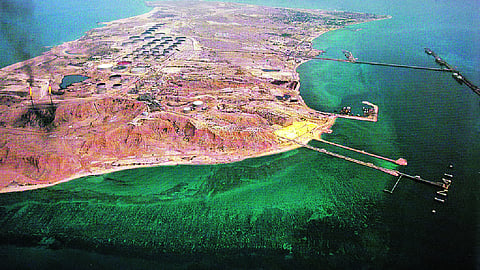
A tiny island in the northern waters of the Persian Gulf has suddenly become the focus of global attention. Kharg Island, a small stretch of land off the Iranian coast, stands today as one of the most crucial energy hubs on the planet. Recent claims by Donald Trump that Iranian oil facilities could face military action pushed this island into the headlines of the world press. Geography made it small; energy politics made it powerful.
The island occupies a pivotal place in the strategic landscape of West Asia. Nearly ninety per cent of Iran’s oil exports leave the country through terminals located on Kharg Island. Pipelines carrying crude oil from Iran’s vast oil fields converge here. Tankers then transport this oil to markets across Asia and the rest of the world. The island functions as the principal gateway through which Iranian energy flows into the arteries of the global economy.
Its importance grows even greater because of its proximity to the Strait of Hormuz, the world’s most vital maritime energy corridor. This narrow waterway links the Persian Gulf with the Arabian Sea. Thousands of vessels cross it every month, carrying crude oil and liquefied natural gas from the Gulf region. Global energy security depends heavily on this route.
The geographical characteristics of the strait amplify its strategic value. The narrowest section measures barely thirty-three kilometres across. Iran lies on one side of the strait, while countries such as Oman and the United Arab Emirates stand on the other. International maritime law allows coastal states to control large portions of the surrounding waters. This geographical reality provides Iran with significant leverage over the movement of ships passing through the corridor.
Kharg Island sits just twenty-five kilometres from the Iranian mainland. The island enjoys deep waters capable of accommodating massive oil tankers. Much of Iran’s coastline remains shallow and unsuitable for such vessels. Kharg therefore became the natural oil export hub of the country. Huge storage tanks, loading terminals and pipeline networks dominate the island’s landscape. Every day between 1.3 and 1.6 million barrels of crude oil depart from this location.
The geoeconomic implications of this infrastructure stretch far beyond Iran. Asian economies rely heavily on energy shipments that pass through the Strait of Hormuz and originate from the Persian Gulf. Countries such as China, India and Japan remain among the largest importers of Gulf oil. More than eighty per cent of the oil transported through the strait ultimately reaches Asian markets. Any disruption around Kharg Island would immediately shake the energy security of these nations.
The island also stores enormous reserves of crude oil. Strategic storage facilities hold millions of barrels ready for export. Iran possesses nearly twelve per cent of the world’s proven oil reserves. Kharg operates as the central distribution hub for a significant portion of this wealth. The island functions not merely as a loading terminal but as the economic heartbeat of the Iranian petroleum sector.
Energy markets react swiftly to geopolitical tension in this region. Even the possibility of disruption at Kharg Island can push global oil prices sharply upward. Analysts estimate that a shutdown of the island’s export facilities could propel crude prices far beyond one hundred and fifty dollars per barrel. Rising energy prices would influence inflation, trade costs and industrial production across the globe.
Military strategists remain deeply aware of the island’s sensitivity. During the Iran-Iraq War, Kharg Island became a frequent target because both sides understood its critical role in Iran’s economy.
Modern conflicts in the region carry similar calculations. A strike on the island would damage Iran’s export capacity and simultaneously send shockwaves through global energy markets.
Geopolitics often revolves around powerful ideas and strategic spaces. The American naval thinker Alfred Thayer Mahan shaped maritime strategy through his theory of sea power and introduced the geopolitical expression “Middle East” to describe this pivotal region. The German philosopher Jürgen Habermas contributed another influential idea by explaining the “public sphere”, the space where society debates its future through communication. In the physical world of geopolitics, islands such as Kharg function as strategic spheres where geography, economics and power intersect.
Kharg Island stands as a striking example of how a small geographical feature can influence the destiny of nations. The pipelines running across Iran’s deserts end here. The tankers anchored in its waters carry fuel that powers factories, vehicles and industries thousands of kilometres away. Markets in Asia, financial institutions in Europe and strategic planners in Washington, DC watch this island carefully.
Energy corridors and maritime choke points shape the structure of the global economy. The Strait of Hormuz remains the gateway of the Persian Gulf. Kharg Island acts as the oil nerve centre connected to that gateway. A quiet island with storage tanks and pipelines continues to hold enormous geopolitical influence over the modern world.
As Alfred Thayer Mahan reminded the world, control of strategic maritime spaces determines the course of international power. Kharg Island silently confirms that lesson every day.
The writer is Professor at Centre for South Asian Studies, School of International Studies & Social Sciences Pondicherry Central University; views are personal