Why good people are quietly disappearing?
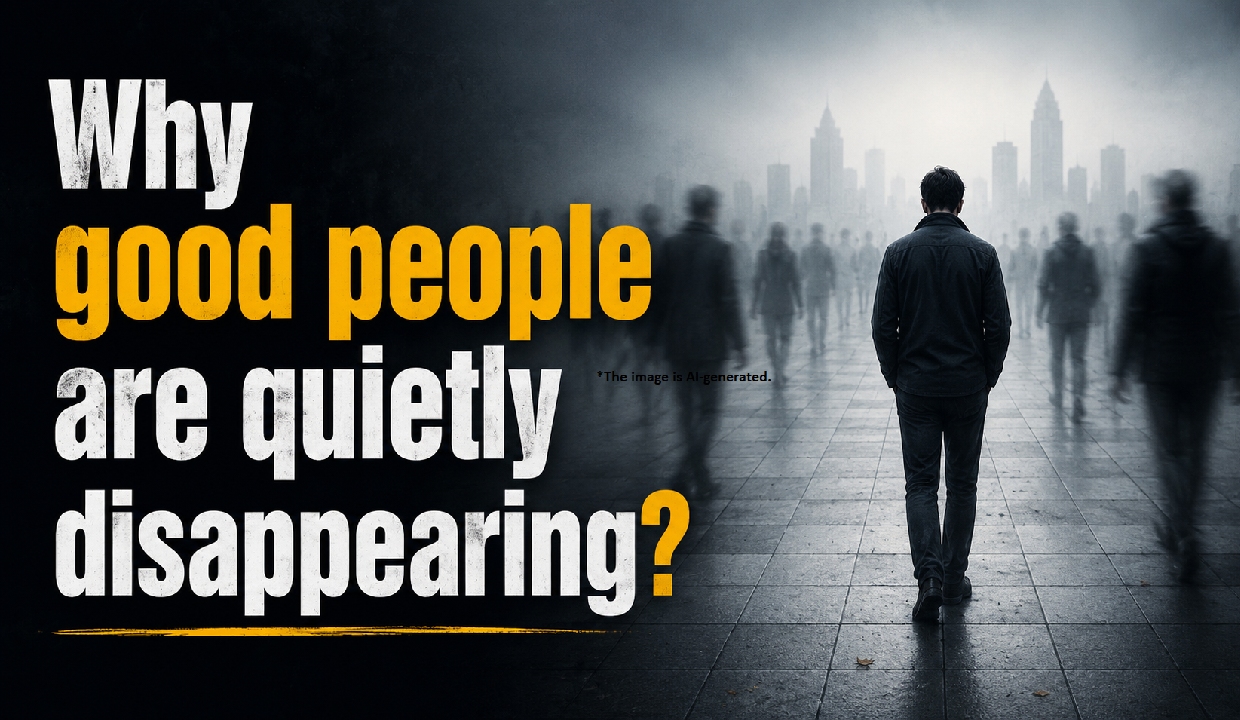
We often hear of animal and bird species being declared endangered by governments and international organisations, leading to campaigns for their protection and conservation. Yet, very little attention is paid to another endangered species emerging in our times: the morally upright human being. In today’s disturbed moral ecology, marked by corruption, crime, mental pollution and growing insensitivity, the ethically sound elite and morally strong middle class are slowly becoming a vanishing tribe. The drought in human compassion and the steady erosion of values have created a crisis far more dangerous than the extinction of wildlife.
This decline has not happened overnight. It has entered society quietly under attractive labels such as modernity, competition, success and personal freedom. In the relentless pursuit of wealth, comfort and social visibility, people have compromised the principles that once gave strength to families, institutions and national character. Honesty is now often viewed as a weakness, while manipulation and opportunism are celebrated as intelligence. As a result, moral values that once shaped society have steadily lost their relevance in public life.
A major role in this transformation has been played by electronic and social media. Television, digital platforms and endless streams of entertainment dominate everyday life. The print media, too, is increasingly driven by sensationalism, conflict, celebrity gossip and “breaking news”. Stories of integrity, sacrifice and moral courage rarely find space. One seldom reads about a businessman refusing a bribe, a teacher serving selflessly, or a doctor placing humanity above profit.
Educational and value-based content has become scarce, leaving readers vulnerable to shallow popular culture, propaganda and manipulative advertising.
Even in the world of books and magazines, commercial success often matters more than intellectual or moral enrichment. Publishers aggressively market material that entertains, shocks or excites because the market follows a simple rule: “What entertains well, sells well.” A visit to any railway station bookstall reveals the trend clearly: sensational headlines, lurid covers and gossip packaged as journalism. Such material gradually weakens society’s appetite for ethical reflection and meaningful education.
This situation calls for urgent corrective measures. Society must consciously cultivate an interest in moral and spiritual values. The media, both print and electronic, should collaborate with educational and cultural institutions to promote ethical interpretations of events and issues. What is needed is not censorship, but conscience. People, especially the young and intellectually vulnerable, must be protected from becoming passive consumers of harmful content disguised as entertainment.
India once enjoyed immense respect among nations because of its moral and spiritual stature. Today, however, ethics appears increasingly absent from classrooms, clinics, courtrooms and boardrooms. Many believe that honesty and success cannot coexist. Those who firmly uphold moral principles despite heavy odds have become rare. Therefore, there is a pressing need to establish moral and spiritual centres across the country to preserve and promote ethical values. Just as wildlife sanctuaries protect endangered species, such centres can nurture people committed to integrity and inspire society at large. If action is not taken now, the extinction of moral character may become irreversible.
The writer is spiritual teacher and a popular columnist; Views presented are personal.