TFR Drop: When progress becomes a peril
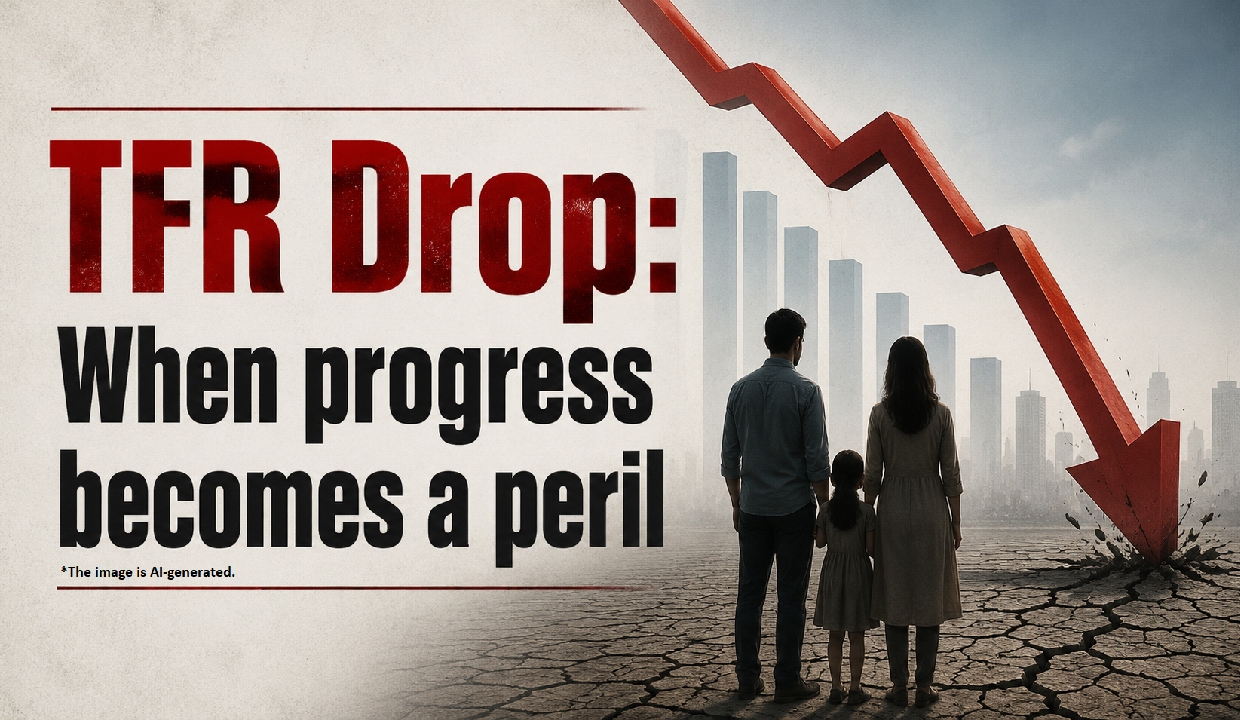
India’s fertility decline is a sign of progress. Managing its consequences wisely will be the real test of governance
It is irony at its finest. India has long been obsessed with its population — too many people chasing too few resources. Decades of family planning campaigns, incentives and occasional coercion were aimed at one goal: fewer births.
As the Total Fertility Rate (TFR) drops below sustainable levels, the real concern is no longer population explosion, but the consequences of falling fertility. The data now confirm that we have largely succeeded. But the big question that stares us in the face is: what happens next?
The latest estimates reveal that India’s Total Fertility Rate (TFR) has slipped well below comfortable levels. Urban India now records a TFR of just 1.5 — a number closer to ageing Japan than to a young, growing nation. Rural India holds steady at 2.1, precisely the replacement level, but that fragile equilibrium will not last long as urbanisation accelerates. The country that once feared a population explosion is quietly moving towards a population implosion, a trend seen in many developed nations.
The causes are neither mysterious nor uniquely Indian. Rapid urbanisation has compressed living spaces and inflated costs, making large families economically unviable. Women’s rising educational attainment and workforce participation — unambiguously good things - have delayed marriage and childbearing. Access to contraception has improved dramatically. And perhaps most powerfully, aspirations have changed: urban couples increasingly invest heavily in one or two children rather than raising several. The shift from quantity to quality of offspring is a universal feature of development. India has simply reached that inflection point faster in its cities than anticipated.
A falling TFR is not, by itself, a crisis. The danger lies in the transition and in what it does to the age structure of society. Within a generation, India’s celebrated demographic dividend — its vast working-age population - will begin to invert. A shrinking workforce will be asked to support a growing elderly population, placing pressure on pension systems, healthcare infrastructure and social security frameworks, which are already under strain.
The political consequences could be equally disruptive. India’s federal system allocates parliamentary seats and central funds partly on the basis of population. States in the south and urban centres — which have controlled fertility the longest — stand to lose representation relative to states where TFRs remain higher. This threatens to deepen regional grievances.
India needs a smarter, three-pronged response. First, make parenthood less economically punishing through affordable childcare, housing subsidies for young families and flexible work policies. Second, build the social infrastructure for an ageing population now, not after the crisis arrives.
Third, revisit the political compact around delimitation, finding formulae that reward states for human development rather than penalising them for it.