The Forgotten Heroes of Rezang La
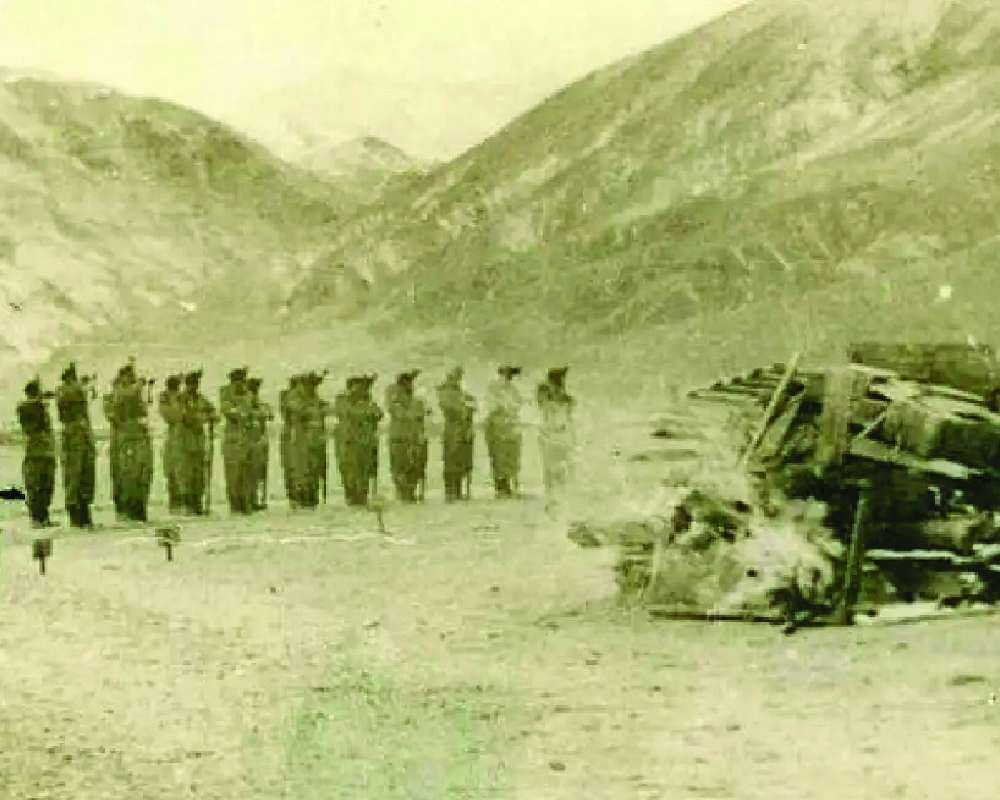
The Battle of Rezang La, fought on 18 November 1962 during the India-China War, remains one of the most extraordinary last stands in global military history. At 18,000 feet, in temperatures dropping to –40°C, with limited winter clothing, scarce ammunition, and absolutely no artillery or air support, 120 soldiers of the 13 Kumaon Regiment’s Charlie Company stood firm against a massive Chinese offensive. Of these 120 soldiers, 117 belonged to the Ahir or Yaduvanshi community. Their heroic resistance resulted in an estimated 1,310 Chinese casualties — an achievement unparalleled in modern warfare. If ever there was a story that deserved to be celebrated across India, it was this one. Yet, a series of sustained efforts since 1964 have repeatedly attempted to dilute, distort, or erase the role of the Ahir soldiers who fought and died at Rezang La.
The first and most glaring injustice was the drastic reduction in the gallantry awards recommended for the company. Soon after the war, Prime Minister Jawaharlal Nehru remarked that India should not excessively glorify the conflict, as it had ended in defeat. This statement was widely misinterpreted by sections of the military leadership, who took it as a signal to scale down recognition for the soldiers.
As a result, the originally recommended awards — nine Param Vir Chakras, nineteen Maha Vir Chakras, forty-four Vir Chakras, seventeen Sena Medals, and eleven Mentions in Dispatches — were reduced to a single Param Vir Chakra, eight Vir Chakras, four Sena Medals, and one Mention.
In 1963, the patriotic song Ae Mere Watan Ke Logon was commissioned by Prime Minister Nehru to honour the martyrs of the 1962 war. Written by Pradeep and sung by Lata Mangeshkar, it moved the nation to tears. However, although created conceptually as a tribute to Rezang La, the song made no mention of the Ahir soldiers. Instead, it referenced communities not involved in the battle. What should have been a lyrical homage to the Ahirs’ collective heroism became yet another instance of their erasure from national memory.
A similar distortion occurred in 1964 with the release of the film Haqeeqat. Although the film was based on the Rezang La battle, it portrayed soldiers from other regiments and used inaccurate uniforms, insignia, and identities. This creative liberty permanently altered public perception of the battle. Cinema shapes collective memory, and by presenting an inaccurate version of events, Haqeeqat effectively sidelined the true protagonists — the Ahir soldiers who fought to the
last man.
Nearly six decades later, in 2021, when the Rezang La Memorial was renovated under the supervision of the Ministry of Defence, another troubling incident emerged. The iconic plaque bearing the inscription “Ahir Dham — 0 Kilometre” was removed and discarded at the side of the site. The plaque held historic and emotional significance, symbolising the Ahir community’s deep connection with the battleground. Only after the intervention of Dr TC Rao, Convener of the Martyrs’ Family Welfare Foundation, along with senior military officials, was the plaque retrieved.
The attempts to soften or remove the Ahir narrative did not stop there. At the memorial site, a sand-model installation and accompanying audio commentary were added for visitors. Shockingly, the commentary avoided using the words “Ahir” or “Yadav”, despite the overwhelming fact that 117 of the 120 soldiers belonged to this community.
The official honourific title awarded to 13 Kumaon — “Veer Ahir, Surveeron Mein Ati Surveer” — was omitted from these audio-visual presentations. Instead, the narrative shifted to a selective portrayal centred solely on Major Shaitan Singh, PVC, while the collective nature of the Ahir soldiers’ sacrifice was pushed into the background.
The commemorative theatre film at the memorial similarly attempted to shape a new narrative. It opens by suggesting that Major Shaitan Singh grew up listening to stories of Maharana Pratap, linking his bravery to a specific community rather than acknowledging the Ahir soldiers who formed the backbone of the unit. The voiceover by Amitabh Bachchan added emotional depth but reinforced an incomplete and skewed representation. Such distortions at a war memorial undermine its purpose — to preserve truth, not rewrite it.
The most recent and widely debated attempt at narrative manipulation came in 2025 with the film 120 Bahadur, directed by Rajnish Ghai and produced by Farhan Akhtar. Although ostensibly based on the Rezang La battle, the film again avoided highlighting the Ahir identity of the soldiers. A fictional surname, “Bhati”, was appended to Major Shaitan Singh, and nearly 90 per cent of the scenes were reported to be fictionalised dramatisations. Even more troubling was the film’s title: “Bahadur”, a term culturally associated with Gurkha soldiers, rather than “Veer Ahir”, which would have accurately reflected the composition of the company. None of the eight Vir Chakra or four Sena Medal awardees were portrayed with their real names or identities.
This deliberate sidelining sparked widespread protests across the country beginning on 5 August 2025. The Ahir community organised peaceful demonstrations, submitted legal notices, held mahapanchayats, and appealed to government authorities, but their concerns have so far been ignored.
Viewed collectively, these events reveal a disturbing pattern that has persisted for over six decades: a consistent attempt, whether through institutions, cultural mediums, or public memorials, to dilute the role of the Ahir soldiers of Rezang La.
War history is not merely the story of a battlefield — it is a matter of national honour. When history is selectively altered, an entire generation grows up believing an incomplete truth. India, must consider stronger safeguards to protect historical accuracy. The Ahir soldiers of Rezang La represent the very essence of Indian courage — ordinary villagers with extraordinary resolve. Their sacrifice was not for their community alone; it was for India. To erase or distort their identity is to do injustice not only to them, but to the nation they died defending.
The truth of Rezang La is permanent, and no matter how many times it is pushed aside, it stands tall — like the mountains of Ladakh that witnessed their last stand. It is time for India to restore this truth, honour these heroes without dilution, and ensure that future generations know exactly who stood, fought, and fell at Rezang La.
The writer is a military historian; views are personal