Reimagining Centre, State relations
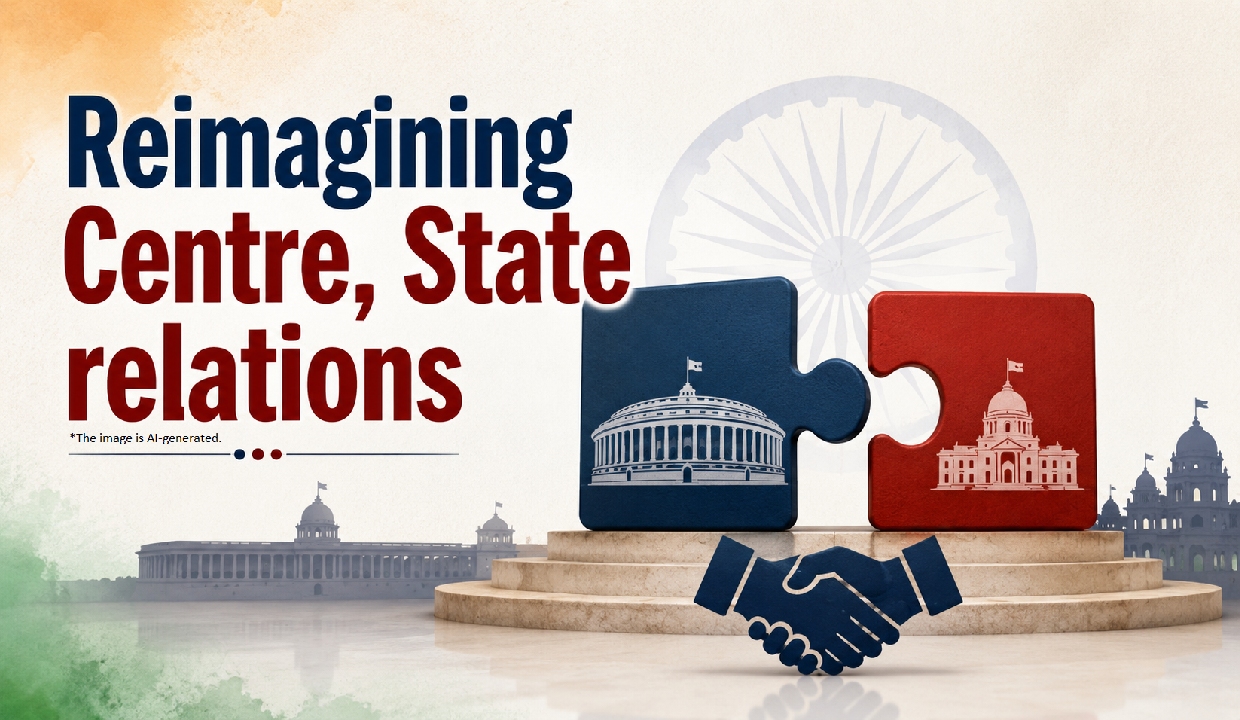
PM Modi’s call for partnership at the NITI Aayog meet is welcome — but Centre-State fault lines demand structural repair
When Prime Minister Narendra Modi chaired the 11th NITI Aayog Governing Council meeting, his assertion that “states play a vital role in furthering national progress” resonated with constitutional wisdom. After a long time, Chief Ministers of all 28 states sat together at the Governing Council table - a symbolic moment for cooperative federalism. Yet symbolism and structural reality remain stubbornly apart in India’s Centre-State relationship.
The Indian Constitution envisioned a strong Centre with empowered states. Seventy-five years on, that balance remains contested. The grievances of states are not new, but they have grown louder and more urgent. At the heart of state frustrations lies the money question. The GST regime, hailed as a transformative reform, has effectively curtailed states’ independent tax powers. Compensation promises have been honoured in part and delayed in practice. States routinely complain of shrinking untied funds - money they can spend according to local priorities - while centrally sponsored schemes come with rigid conditions that often ignore ground realities. A state like Tamil Nadu or Kerala, with strong development metrics, resents being subjected to the same formula applied to a newly formed state. The Finance Commission devolution figures tell only part of the story. What states receive on paper and what actually flows into their treasuries are different things. Delayed transfers, high cess and surcharge collections that do not enter the divisible pool, and the expanding footprint of central schemes leave state finance ministers perennially short.
Beyond money lies the question of jurisdiction. Governors appointed by the Centre have, in recent years, become a flashpoint in states governed by opposition parties. Prolonged delays in giving assent to Bills passed by elected state assemblies - in Kerala, Tamil Nadu and Punjab - have raised serious constitutional questions about the role of Raj Bhavan as an instrument of political interference rather than a constitutional check. The elected legislature’s mandate is being held hostage to the Governor’s pleasure, which cuts to the core of democratic federalism. The deployment of central agencies in states in ways perceived as politically motivated, often without the consent of the state concerned, is another irritant in Centre-State relations. What is needed is structural reform.
A revamped Finance Commission framework that ring-fences state transfers from cess dilutions would be a start. A codified, time-bound process for gubernatorial assent would restore constitutional propriety. Expanding the role of the Inter-State Council - a body that has met far too infrequently - as a genuine deliberative forum rather than a ceremonial gathering would give states a real voice.
PM Modi’s Viksit Bharat vision is unachievable without genuinely empowered states. Districts, blocks and villages - the units he invoked - answer to state governments, not Delhi. A thriving democracy must trust its constituent units to lead. That trust must be backed by an institutional architecture that makes cooperative federalism real in its truest form.