Women’s quota, held hostage to delimitation
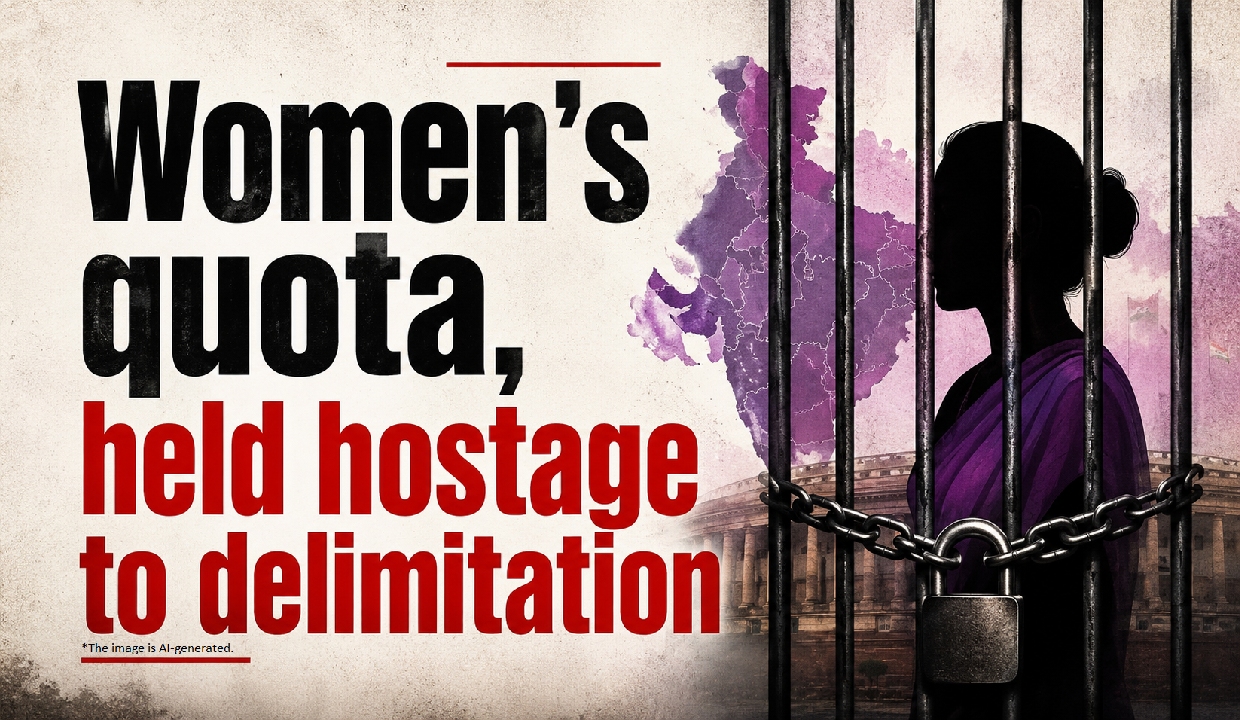
The women’s reservation law, passed three ago, is yet to be implemented as it remains trapped in a political maze linking census, delimitation and federal interests
Three years ago, Parliament did something it rarely does: agree unanimously. The Rajya Sabha passed the Nari Shakti Vandan Adhiniyam, the Constitution (106th Amendment) Act, 2023, by 214 votes to none, promising a third of all seats in the Lok Sabha and state assemblies to women, with a further third of that share reserved for Scheduled Caste and Scheduled Tribe women. Six previous attempts had failed since 1996; this one finally succeeded.
What has still not happened, even now, is a single woman entering a legislature under its provisions — because the Act made its own arrival conditional on events outside its control. Article 334A ties the reservation’s commencement to a fresh delimitation exercise, and delimitation cannot proceed without a fresh census. India’s census, due in 2021, remains uncompleted five years on. No census, no delimitation; no delimitation, no quota.
The government’s stated reasoning — that redrawing constituencies on decades-old population data would be unfair to faster-growing states — is defensible in principle. In practice, it has left a landmark law in permanent suspension. In April, the government tried to force the issue with a package deal. The Constitution (131st Amendment) Bill would use 2011 census figures to redraw constituencies at once, expand the Lok Sabha toward 850 seats — about 273 of them reserved for women — and deliver the quota by 2029. It fell 54 votes short of the two-thirds majority required, 298 for and 230 against, and the government withdrew the companion Delimitation and Union Territories bills alongside it. The Monsoon Session, due to end August 13, has kept both off the agenda.
The Opposition’s objection was never to reservation itself; several parties have also pressed for an explicit OBC sub-quota within it. But their core case is that the 2023 Act never needed a national head-count to hand women a third of the seats that already exist; only a fresh redrawing of constituency boundaries requires fresh population data.
Bundling the two, Congress and its allies argue, was designed to smuggle a contentious redistribution — one that would shift seats away from southern and north-eastern states, which slowed population growth fastest, toward the more populous north — inside a bill no party could be seen opposing.
That the government needed a mid-course rewrite of its own 2023 law to attempt this only strengthens that suspicion. The way forward needs no new drafting genius, only the will to separate two questions that were never one. Implement the 33 per cent quota now, on the map as it stands, rotating reserved seats each term as the law already allows. Negotiate delimitation on its own track, with the interstate guarantees the South is asking for settled before the exercise begins, not promised after. Three years of consensus on paper deserve better than a fourth year of deadlock in practice.
Leave a Comment
Comments (1)
The quota for women has become a big drama. In real life nobody is worried or concerned about the problems of women. All the leaders are big hypocrites. For example, see the working conditions of women employees in banks. Woman employees are transferred without their consent to the far away places from their families and parents. Actually trasfer policy of banks is the most unkindest cut. First they have to live alone in an unknown city, far away from their families and parents. Second their families are broken and their children suffer. The government should look into this matter rather doing this drama in the name of reservation.