Xi in DC: Pageantry, but little substance
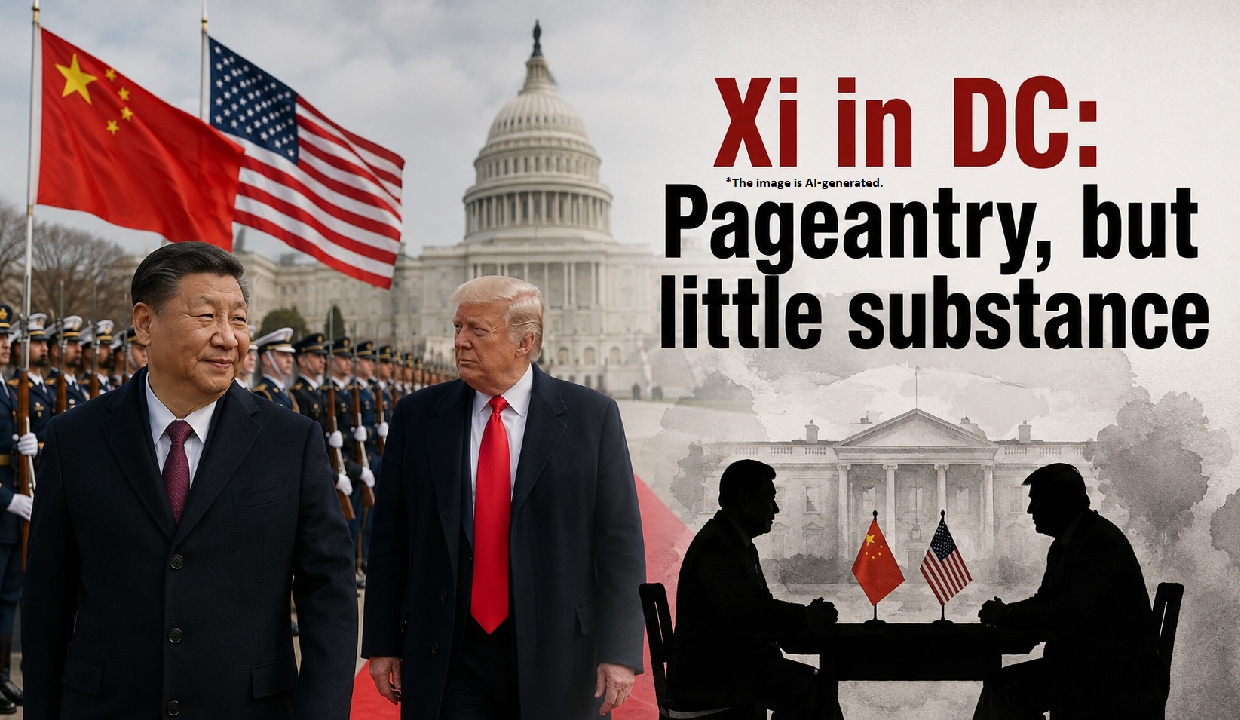
The Trump-Xi summit leaves the US-China rivalry largely unchanged, managing competition rather than delivering a breakthrough
Xi Jinping walked down the red carpet at Joint Base Andrews this week for his first Washington visit in over a decade — the third face-to-face meeting between him and Donald Trump in under a year, after Busan in October and Beijing in May. The optics were unmistakably warm: a military review in the Rose Garden, a state dinner in the East Room, and both leaders speaking of mutual respect.
Beneath it, the same unresolved fault lines — trade, technology, Taiwan — remain exactly where they were. Xi’s concerns were not disguised. On artificial intelligence, Beijing wants Washington to ease chip export controls and open the door to Chinese AI models, while offering rhetorical convergence on keeping AI “under human control” and pitching a multilateral governance framework built around China’s newly launched World AI Cooperation Organisation.
On trade, China wants relief from tariffs and validation of the rare-earth leverage it has built, in exchange for renewing the Busan truce. On Taiwan, Xi’s line hasn’t moved: no separation, and “utmost caution” urged on US arms sales.
None of this travels far. Washington’s own reporting shows Beijing’s offer to extend the rare-earths truce to the end of Trump’s term collapsed on mutual distrust before the summit even began. The May Beijing agreement — $17 billion in annual agricultural purchases, 200 Boeing jets, new trade boards — is already behind schedule, with farm purchases undershooting and the boards still not operational.
AI cooperation, the one area both sides call promising, is constrained by the same suspicion: Beijing believes safety talk is a pretext for containment, while Washington doubts any Chinese commitment would be honoured. The realistic ceiling is a narrow, symbolic step — perhaps an incident-warning channel - not a governance breakthrough. The real story is what each side is buying with this summit, not what they’re solving. Trump needs a trade win before midterms dominated by cost-of-living anger. Xi needs to project strength before his party congress, and he has spent recent weeks doing exactly that - courting BRICS in Delhi, pitching a Middle East “security architecture” in Cairo, and positioning China as the stabilising power to Washington’s war-fatigued unpredictability.
Iran’s war, in its seventh month, has quietly shifted leverage towards Beijing: depleted US munitions stocks need the rare earths and critical minerals China still dominates.
Expect the Busan truce extended, an AI working group formalised without teeth, and Taiwan left carefully unresolved. That last point deserves attention: allies from Tokyo to Taipei worry Trump could trade Taiwan assurances for a trade headline, and nothing in his instincts rules that out.
For the rest of the world, including India, the takeaway is a fragile equilibrium, not a settled order. Two leaders too entrenched in their own judgement to concede ground are buying time, not making peace. The contest for technological and economic primacy continues exactly as before - only with better photographs.