Nepal’s quest for economic statecraft

As Balen Shah begins engaging India, China and others, the larger test will be whether this diplomatic space can be translated into strategic economic opportunities — particularly through deeper India-Nepal value-chain integration and access to global markets
A compliment is certainly due to newly elected Prime Minister Balendra Shah for taking time to find his feet before engaging Nepal's key partners. He has demonstrated resilience and composure amid relentless social-media berating over what many described as his "strategic silence." Perhaps, in the process, PM Shah stole all the gossip!
Setting aside the pun, all eyes are now on Monday, August 10, when Prime Minister Shah is expected to meet the Indian and Chinese envoys, followed by the US Chargé d'affaires on Tuesday, as reported by The Kathmandu Post.
This appears to be a carefully sequenced set of engagements with Nepal's two vital neighbours.
India remains strategically vital to Nepal for trade, commerce, connectivity and extensive people-to-people linkages. Nepal's historic linkages with China likewise extend beyond contemporary geopolitics, including important economic, cultural and people-to-people exchanges with the Tibet Autonomous Region, particularly across Nepal's northern region.
Interestingly, The Kathmandu Post has reported that Prime Minister Shah did not receive requests for meetings with US Assistant Secretary of State for South and Central Asian Affairs Samir Paul Kapur and President Donald Trump's Special Envoy for South and Central Asia Sergio Gor, and subsequently did not grant an audience to US Under Secretary of State for Public Diplomacy Sarah B. Rogers. I do not have details of these requests or the circumstances surrounding the reported decisions. It would therefore be inappropriate to draw definitive conclusions about the Prime Minister's intent. But the reported sequence deserves more than passing diplomatic commentary. The issue is not whether Nepal should engage the United States. Of course it should. Nor is declining a meeting, by itself, evidence of hostility.
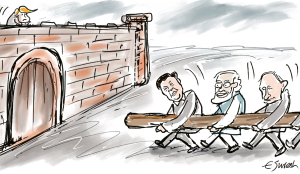
The larger question is whether the expectations, approach or conduct of some external actors adequately recognise Nepal's sovereign diplomatic space. Nepal is a sovereign state pursuing a delicate foreign policy between its two immediate neighbours, India and China, while maintaining relations with the United States and other international partners. Its leadership has every right to determine whom it meets, when it meets and at what level. Nepal may be a smaller state in economic and military terms, but its geopolitical significance far exceeds its size. Situated between two major Asian powers, it is strategically important not only to its neighbours but also to global powers.
That makes sensitivity and calibration essential. Diplomatic presence should not become an end in itself, nor should access to a sovereign government be treated as an entitlement. Nepal is not closing its doors. It is engaging. But the reported sequencing could indicate that engagement must take place on the basis of sovereign choice, reciprocity and diplomatic respect.
For policymakers in Washington, Kathmandu and beyond, the more important question is not simply, "Why did Nepal decline the meeting?", a question to which I do not have the answer but: What can observers learn from this reported pattern of engagement, and what does it tell us about the assumptions, expectations and methods of external diplomatic engagement in Nepal?
For a newly elected Prime Minister, taking time to understand the lay of the land, domestically, regionally and geopolitically before opening the diplomatic calendar may not be hesitation. It may simply be statecraft.
If this is the beginning, Nepal's young leadership has certainly made a noteworthy start. From Sovereign Agency to Economic Statecraft: What Next for Nepal-India Relations?
Sovereign agency, however, is not an end in itself. The real test of statecraft is what Nepal does with it. This is where the next conversation should begin with economic diplomacy and, more importantly, economic statecraft.
The impetus being given by Nepal's Ministry of Foreign Affairs to economic diplomacy is welcome. Its engagement with government, business, chambers, investors and other stakeholders recognises an important reality: economic diplomacy cannot remain confined to the Foreign Ministry or diplomatic corps. It must translate diplomatic relationships into measurable economic opportunities.
For India-Nepal relations, this could be transformational. The conversation should move beyond trade figures and aid narratives towards value chains, investment, manufacturing, services, energy, tourism, digital connectivity, logistics and market access.
As Prime Minister Balendra Shah's engagement with India takes shape, one strategic question ought to be placed squarely on the table:
How can Nepal leverage India's network of Free Trade Agreements (FTAs) and Comprehensive Economic Partnership Agreements (CEPAs) with third countries to expand Nepal's own exports, attract investment, strengthen manufacturing and integrate into regional and global value chains? This is precisely the kind of question Nepal's Chambers of Commerce should be asking and developing into a concrete economic strategy. To date, however, I have not seen a dedicated chamber-led study going sufficiently deep into this opportunity.
Nor is this opportunity merely for Nepal. India's Chambers of Commerce should equally examine how India's growing network of FTAs and CEPAs can give regional economic integration a strategic boost. India has built what could be described as a treasure trove of market-access arrangements. The question now is how these agreements can become more than instruments for bilateral trade and provide a platform for regional value-chain integration.
Nepal should therefore ask: Where can Nepal add value? Where can Indian investment create manufacturing capacity in Nepal? Which products can enter Indian and regional supply chains? Which sectors can jointly target FTA/CEPA markets? And what rules of origin, standards, connectivity and policy arrangements would make this commercially viable? This is where economic diplomacy must move beyond trade statistics and Memorandum of Understanding (MoUs) to strategic value-chain thinking. The opportunity could extend across hydropower and clean energy, agro-processing, tea and coffee, herbs and essential oils, textiles, tourism, IT and digital services, pharmaceuticals, light manufacturing and logistics.
For India, deeper value chain integration in above-mentioned areas with Nepal could strengthen the economic architecture of the neighbourhood while creating additional production and supply-chain capabilities for accessing third-country markets.
It is time to reframe the question from:
"How much does Nepal export to India?"
to: "How can India and Nepal together create value in Nepal, integrate that value into Indian supply chains, and leverage India's global market access?" That is the conversation I would like to see begin with Prime Minister Shah and Ambassador Srivastava, and, equally importantly, with the Chambers of Commerce on both sides. For Nepal, sovereignty is not simply the ability to choose whom to meet. It is also the ability to define what it seeks from those relationships. The next test of Nepal's young leadership is to convert sovereign agency into strategic economic opportunity.
The larger question is whether the expectations, approach or conduct of some external actors adequately recognise Nepal's sovereign diplomatic space. Nepal is a sovereign state pursuing a delicate foreign policy between its two immediate neighbours, India and China, while maintaining relations with the United States and other international partners
The writer is a financial, geopolitical, security analyst and an India-Nepal relations observer; Views presented are personal.