Nepal reaffirm bilateral route to resolve India border row
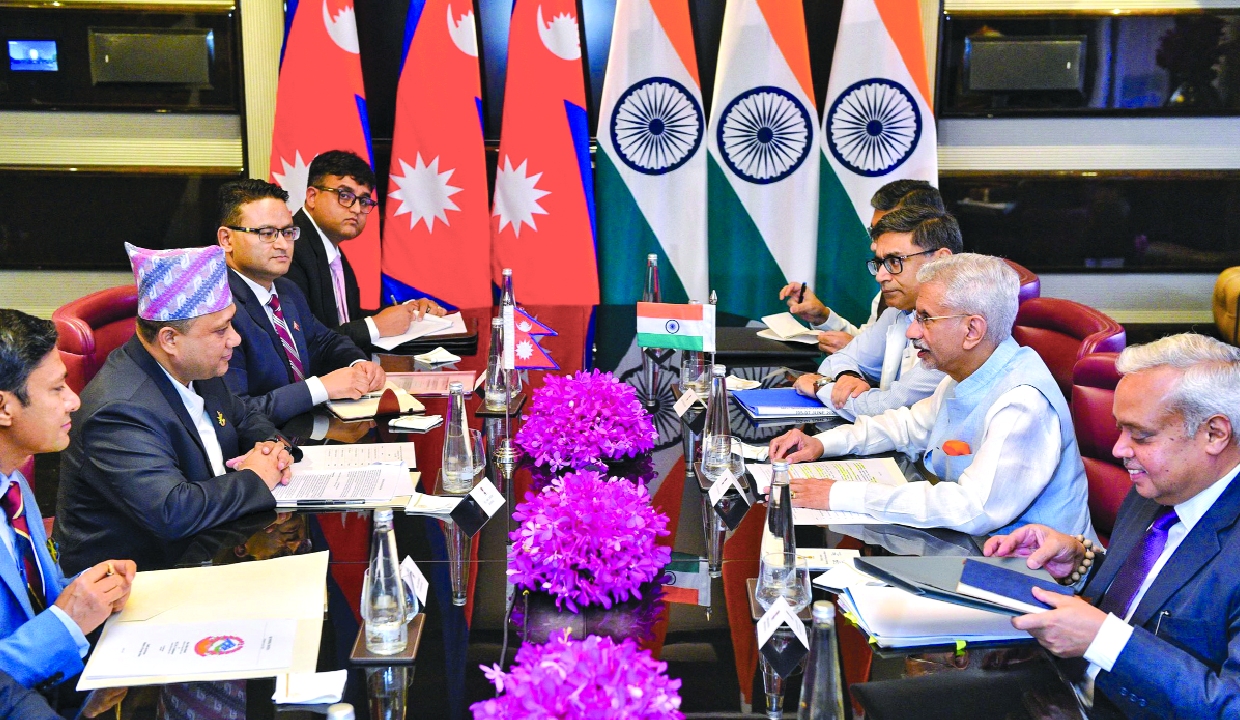
Nepal has reaffirmed its commitment to resolving its long-standing border dispute with India through existing bilateral mechanisms. “No problem is too large, and no boundary too complex, when we sit down with an open heart, a rational mind and mutual respect,” said Nepalese Foreign Minister Shishir Khanal, speaking to the media on Sunday following wide-ranging talks with Indian External Affairs Minister S Jaishankar
The minister stressed that Kathmandu views India not through what he described as a “distorted, hyper-sensitive lens” of contemporary geopolitics but as a crucial partner in Nepal’s economic transformation.
“We want to engage with this India of intense aspiration, cutting-edge technology, and relentless execution. In turn, we bring the energy of an aspiring Nepal,” he stated.
Khanal’s three-day visit to New Delhi came amid heightened attention over recent remarks by Nepalese Prime Minister Balendra Shah.
The Nepalese PM had recently suggested that China and the United Kingdom could play a role in addressing the decades-old boundary dispute between Nepal and India.
India had earlier categorically rejected any role for third parties in resolving the border issue.
Clarifying Nepal’s position, Khanal said Kathmandu was not seeking international mediation. Instead, references to the United Kingdom were related solely to obtaining historical documents and archival records that may help inform discussions.
“We want to solve our disputes through diplomatic processes. We just want to see if we can access some of the documents that might be in libraries or museums in the UK. Our position was not that we were asking for mediation,” he explained.
The boundary dispute centres on the Lipulekh, Limpiyadhura, and Kalapani regions. Nepal claims the territories belong to it, while India maintains they are part of the northern state of Uttarakhand.
Addressing concerns over the Kailash Mansarovar Yatra route through Lipulekh, Khanal reiterated Nepal’s objection to agreements between India and China concerning the area without Nepal’s participation.
“Our concerns are with the renewal of the agreement between India and China over the Kalapani and Lipulekh area, where we have said for a very long time that the land belongs to us,” he said.
According to Khanal, Nepal has formally conveyed its position to both countries through diplomatic channels and official notes.
Despite these differences, he maintained that Kathmandu remains committed to resolving the issue through established bilateral frameworks rather than public confrontation.
Khanal described 2026 as a uniquely favorable moment for India and Nepal to elevate their relationship.
“The year 2026 has provided the most conducive and highly aligned window for the two countries in decades to completely elevate and transform our relations,” he said.
He emphasized the need to convert diplomatic commitments into tangible outcomes that improve the lives of citizens on both sides of the border.
“Our primary responsibility is to close the gap between bold promises made on paper and the physical reality delivered on the ground,” he remarked.
Reflecting on the deep cultural and historical ties between the two nations, Khanal said India and Nepal share far more than a geographical boundary.
“We are not merely neighbours joined by political lines drawn on a map; we are the children of the same rivers, the same mountains and the same ancient wisdom,” he said.
The minister also indicated that Nepal’s new Government is eager to deepen engagement with India across trade, connectivity, energy, and technology sectors.
When asked about domestic political developments in Nepal and recent protests, Khanal declined detailed comment, saying only that the political.