Litmus test awaits Jan-Suraaj in Bankipur
Even before the Election Commission of India issues a formal notification for the by-election to the Bankipur assembly seat, the political temperature in Bihar-and Patna in particular-has already risen sharply. Political parties have begun a war of words to grab public attention, months ahead of the actual contest.
The seat fell vacant after the BJP’s central leadership elevated Nitin Nabin-winner of five consecutive elections, including once from the erstwhile Patna West constituency before delimitation-to the post of national president. His new responsibilities require him to move to the Rajya Sabha, and he has accordingly resigned from the Bankipur assembly seat, triggering the by-election. The Election Commission is yet to announce the schedule, but parties across the spectrum are already positioning themselves for what promises to be a keenly fought contest. Bankipur is set to be one of the most closely watched contests in Bihar, for two broad reasons.
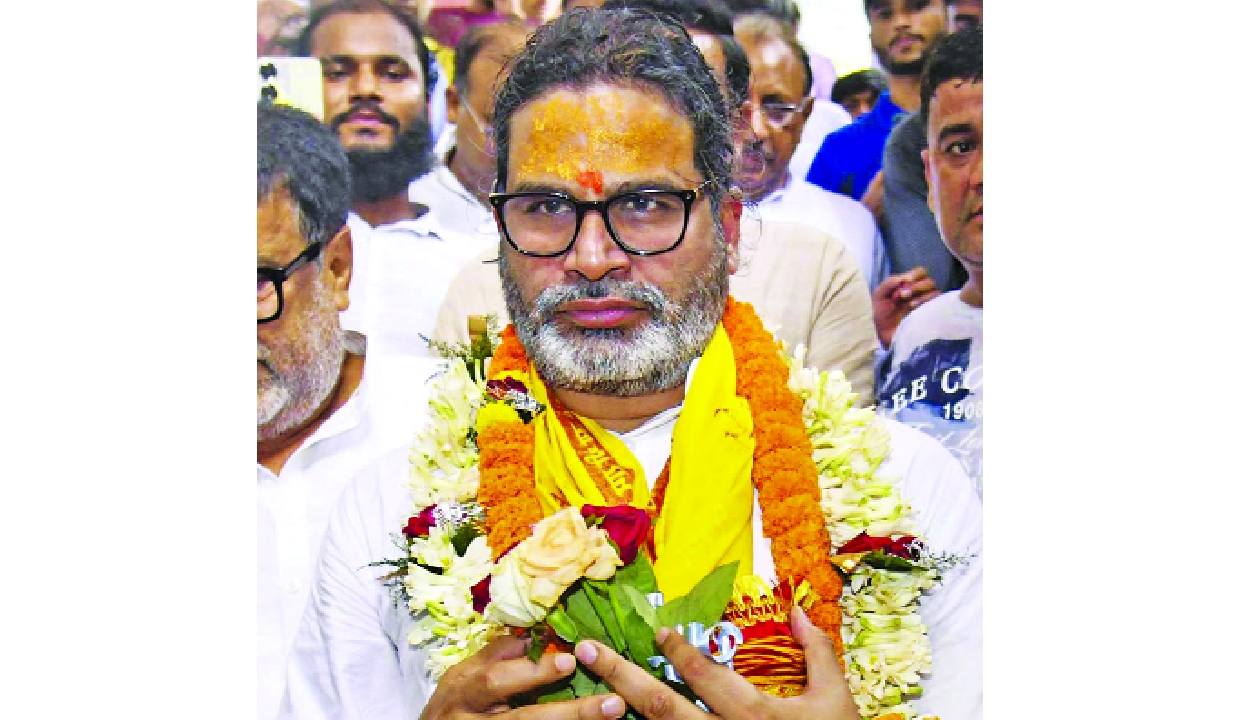
The first is the possibility that Prashant Kishor himself may contest. His candidature is yet to be formally cleared by Jan Suraaj’s working committee, but the mere prospect has already drawn heavy media attention. If Kishor does enter the fray, a significant section of voters who did not back the Jan Suraaj candidate in the 2025 assembly election could shift towards him this time. His appeal has largely been to professionals, government employees, the middle class and students-precisely the kind of urban, educated electorate that dominates Bankipur, and one likely to respond to his reformist, development-focused pitch.
The real question, however, is whether Jan Suraaj can convert this goodwill into actual votes-a difficult task given the party’s acknowledged weakness in booth-level organisation, an area where the BJP’s decades of grassroots presence give it a considerable head start. Jan Suraaj’s state president, Manoj Bharti, concedes as much: “Due to lack of skilled manpower, this has been our biggest mistake in the past. But this time around, we have rectified the mistake, strengthened the organisational power and honed up the necessary skills of booth management that could match up with those of BJP.”
The second reason is Bankipur’s status as a BJP bastion since 1990. The father-son duo of Navin Kumar Sinha and Nitin Nabin held the seat continuously from 1995 to 2025. Navin Kumar Sinha won from Patna West in 1995 and again in 2005, serving until his death in 2006. His son Nitin Nabin then won the ensuing by-election and went on to win four more consecutive terms through 2025. After the 2008 delimitation exercise, Patna West was renamed Bankipur.
The father-son duo, both Kayasthas by caste, benefited enormously from the constituency’s social composition, which is dominated by upper castes-Kayasthas alone account for roughly 23 percent of the electorate. This allowed them to build a durable personal support base over three decades. Beyond Kayasthas, the BJP has also drawn steady support from other upper-caste communities-Brahmins, Bhumihars, Rajputs, Vaishyas and Banias-making the seat nearly unassailable.
Manoj Bharti disputes this narrative of invincibility, arguing that voters are tired of the father-son duo and are actively seeking change, accusing them of doing too little for the constituency. He argues that Bankipur’s problem has not been loyalty to the BJP but apathy born of a lack of alternatives. “The people of Bankipur often used to say: What difference will it make whether I cast my vote or not? Nitin Nabin is going to win anyway,” Bharti says, adding that this time voters are showing greater willingness to turn out because they now see a genuine alternative. Bharti backs this with turnout figures: Bankipur has historically recorded voting percentages of just 34 to 39 percent, compared to 52 to 55 percent elsewhere in Bihar-evidence, he argues, of chronic voter disengagement rather than satisfaction with the incumbent. He also criticised the BJP-led state and central governments for failing to invite NITI Aayog members to Bihar to address the state’s economic troubles.
The BJP, for its part, has already begun groundwork. According to Prabhat Malakar, the party’s state media-in-charge, national president Nitin Nabin has held discussions with the president, vice-president and general secretary of each of the committees overseeing Bankipur’s ten electoral wards, to assess ground realities. This was followed by a closed-door meeting involving Nabin, state president and Chief Minister Samrat Chaudhary at the CM’s official residence. Malakar notes that since key election decisions are made in Delhi, the national president, chief minister and state president will jointly decide on the candidate once the Election Commission’s notification is issued, after which the party’s election committee will make its choice. On the likely candidate, Malakar indicated that the BJP is expected to field a Kayastha, given the constituency’s demographic profile, with names such as Ajay Alok, Sanjay Mayukh and Rituraj Sinha doing the rounds.
He expressed confidence that no rival party poses a real threat, citing the welfare schemes implemented by the father-son duo over the years, including new roads. He specifically highlighted Nitin Nabin’s role in transforming the Mandiri Nala into a covered box drain topped by a two-lane smart road-a project that eliminated foul odour, reduced flood risk in central Patna, and eased traffic congestion.
Malakar also pointed to a broader electoral pattern: the party that wins an assembly seat in a general election typically retains it in a subsequent by-election. Even so, should Prashant Kishor enter the race, retaining Nitin Nabin’s 2025 vote share of 62 percent would be no easy task for the BJP’s candidate, even in victory. Any noticeable dip in that margin would be read as a referendum on the state government’s popularity and the party’s organisational strength-making Bankipur’s outcome a matter of political prestige as much as electoral arithmetic. Unsurprisingly, the BJP is expected to spare no effort in ensuring its candidate wins by a commanding margin.
The author is a columnist; Views presented are personal.