America celebrates the 250 years of freedom
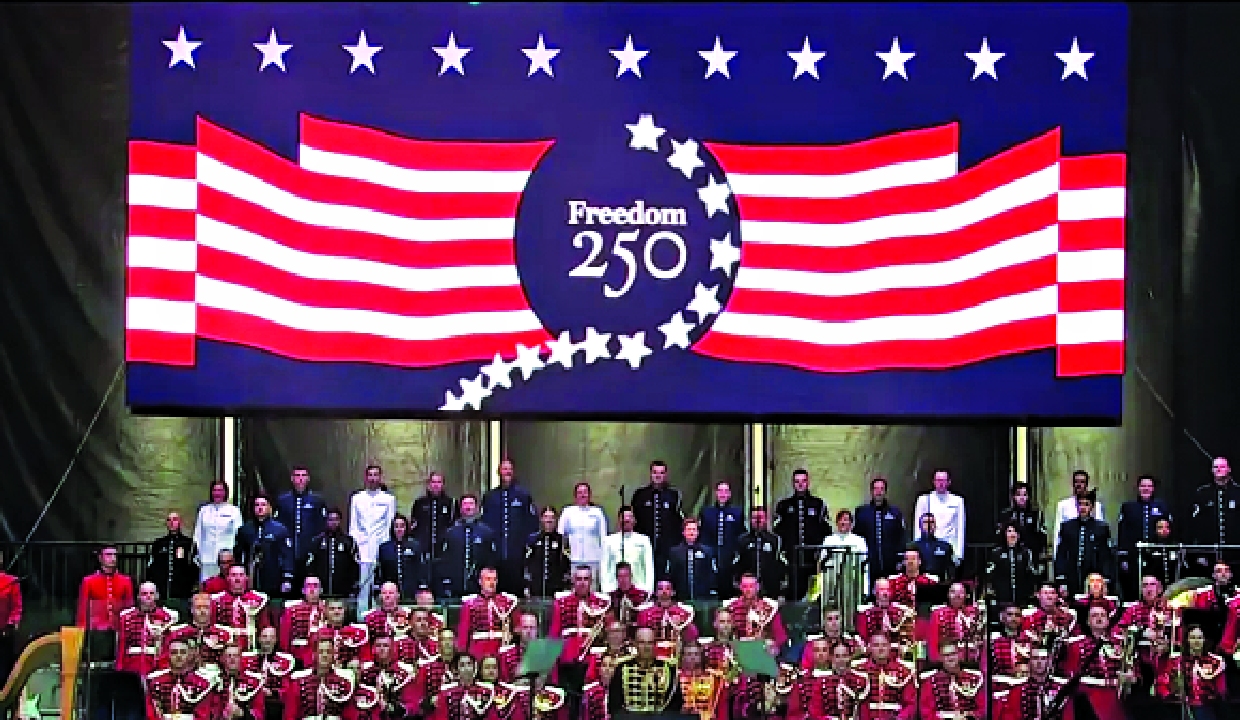
At 250 years, the United States appears less like a completed political project and more like a continuing argument that has never settled its own meaning, where universal ideals and uneven outcomes persist within the same institutional framework and shape one another over time
What has happened to Thomas Paine remains unresolved, and that uncertainty matters when trying to understand the United States at its present stage. The United States of America yesterday (July 4) marked its 250th birthday, a moment when one of the world's leading liberal democracies appeared less as a coherent model and more as a divided system, a family business struggling to awaken from its long slumber. How the United States has acted against itself in recent years raises the question of whether it is still accurate to describe it as a single coherent nation-state in the conventional sense, or whether it is better understood as an idea that repeatedly turns inward and contradicts itself. As Wang Huning, Xi Jinping's leading political theorist, wrote in 1991, "Americans accept only equality of conditions, not equality of results. Once equality of conditions is established, then comes the realm of liberty." Whether one agrees with this interpretation or not, it captures a recurring tension in the American experiment: a belief in formal equality coexisting with persistent inequality of outcome.
The United States has always been more than a set of territorial and governmental structures. It is an idea that attracts interpretation, projection and reinvention, drawing together disparate intellectual traditions into a single, contested narrative of purpose. Despite sustained criticism, it remains one of the most successful political constructions in modern history, precisely because it is not fixed. In 1783, while British troops were still being evacuated after defeat in the Revolutionary War, Ezra Stiles claimed that Americans had devised the "most perfect" principles of government anywhere, predicting that the population would exceed 300 million within "two or three hundred years". In 1804, following the Louisiana Purchase, David Ramsay argued that the republic "can never be too large" and would eventually span the continent from the Atlantic to the Pacific. In the political imagination of Thomas Paine and Thomas Jefferson, the United States was a beacon of republican government against monarchy and tyranny. Even in 1862, amid civil war, Abraham Lincoln still described it as "the last, best hope of earth". Yet from the beginning, expansion and idealism were inseparable from fracture, contradiction, and conflict between universal language and particular power.
The life and posthumous fate of Thomas Paine illustrate this tension with unusual clarity. Paine gave the revolutionary project its most accessible moral language, insisting that sovereignty belonged to citizens rather than kings, and that authority required consent rather than inheritance. Yet his later life ended in obscurity, his reputation diminished in a society increasingly suspicious of his radicalism. His remains were later disinterred by William Cobbett and transported to England, only to be lost to history, fragmented into uncertain claims and incomplete records. That physical dispersal mirrors the dispersal of the revolutionary certainty he represented. What followed Paine was not the stabilisation of a philosophical project, but its transformation into a governing system expanding across territory, economy and military capacity, constantly negotiating between founding principles and practical power.
This tension is embedded in the structure of the state itself. The United States developed as a system in which competing interpretations of the same constitutional text became engines of political struggle. Federalists and anti-Federalists, abolitionists and slaveholders, isolationists and expansionists all claimed fidelity to the founding framework while drawing incompatible conclusions from it. As territorial expansion accelerated, liberty and dispossession coexisted within the same national vocabulary. As industrialisation advanced, contractual freedom coexisted with forms of dependency that contradicted its premise. The modern state, including what later became described as the military-industrial complex, did not emerge as an external distortion of the founding idea, but as one of its internal expressions. Its strength lay not in ideological consistency, but in its capacity to absorb contradiction and remain operational across changing historical conditions. By the twentieth century, this elasticity had become both an advantage and a burden. The Cold War presented the United States as a universal model of liberty against external tyranny, yet this framing intensified internal contradictions rather than resolving them. Military interventions, proxy conflicts and intelligence operations expanded alongside declared commitments to democracy and self-determination. The result was not a simple case of hypocrisy, but a structural duality: the simultaneous production of democratic ideals and the support of undemocratic outcomes under the logic of strategic necessity. Over time, this contradiction ceased to appear exceptional and became normalised within political language itself, absorbed into the routine functioning of policy and public discourse.
Within this long historical arc, contemporary polarisation can be read less as rupture than as revelation. Donald Trump, in this context, is not an anomaly outside the American tradition but a concentrated expression of its internal contradictions. The argument that he represents either a decisive break or a total corruption of the system misses the deeper continuity of American political life, which has always oscillated between moral idealism and pragmatic force, between universal language and selective application. The increasing intensity of political conflict reflects not a sudden decline, but the difficulty of sustaining older narratives of unity under contemporary conditions.
The more fundamental question is whether the United States ever existed outside the tension it now displays so openly. Historical scholarship repeatedly returns to the same paradox: that a constitutional order capable of expanding rights also contained mechanisms of exclusion; that a political experiment inspiring global imitation was built alongside structures of inequality it struggled to overcome. The so-called hypocrisy of American liberty is not an incidental flaw, but a recurring condition of its development. It is visible in Indigenous dispossession, in the entanglement of slavery with economic growth, and in later global projections of power justified through the language of security and democracy. It is also visible in counter-traditions that repeatedly forced reinterpretation: abolitionism, civil rights movements, labour organisation and reform politics, each attempting to re-anchor founding language against the realities of practice.
To describe the United States as an idea rather than a country is therefore partially accurate, but incomplete. It is an idea that has always required institutions, enforcement and coercive capacity to exist in material form. It is also an idea that has never been stable, continuously rewritten by successive generations who inherit it under different material conditions. The military-industrial system, the administrative state, the intelligence apparatus and the electoral framework are not deviations from the founding idea, but mechanisms through which it scales itself across time and global reach. The consequence is paradoxical: a system powerful enough to preserve continuity, yet structured in such a way that disagreement over meaning becomes permanent rather than resolvable.
At 250 years, the United States appears less like a completed political project and more like a continuing argument that has never settled its own meaning, where universal ideals and uneven outcomes persist within the same institutional framework and shape one another over time. Its history shows that reform and resistance are permanently entangled, since efforts to extend equality repeatedly collide with structures designed to preserve stability, hierarchy and continuity, producing cycles in which change often arrives as adjustment rather than rupture. In modern conditions of extreme wealth concentration and intensified political polarisation, this tension becomes sharper, as formal equality coexists with highly uneven distributions of influence and power, all expressed through the same inherited language of rights and opportunity.
In this context, a 927-page financial disclosure attributed to President Donald Trump, describing extensive income streams from cryptocurrency holdings, property interests and royalty arrangements, is interpreted not simply as personal accumulation but as a symbol of a broader systemic paradox, where economic scale and political legitimacy increasingly overlap in ways that are difficult to disentangle. The result is a governing order that depends simultaneously on adaptation and preservation, where legitimacy requires change but continuity requires restraint, leaving the country defined less by resolution than by the ongoing friction between what it promises and what it produces.
To describe the United States as an idea rather than a country is therefore partially accurate, but incomplete. It is an idea that has always required institutions, enforcement and coercive capacity to exist in material form
The writer is a columnist based in Colombo; Views presented are personal.