What dropping ‘Indo’ reveals about Washington’s China bet
On June 17, 2026, the United States (US) Department of War reverted the name of US Indo-Pacific Command (USINDOPACOM) to US Pacific Command (USPACOM), established by former US President Harry S Truman to address new security dynamics in the post-Second World War order. In 2018, the word “Indo” was inserted in the name of the command, which acknowledged the growing importance of India in managing the maritime order across the Indian and Pacific Oceans. This was necessitated by growing maritime posturing and assertiveness from China, and the need to protect freedom of navigation and international law in the ocean.
The dropping of the word “Indo” by the Trump administration has become a subject of discussion in strategic circles. While Sergio Gor, the Ambassador of the US to India, clarified that a mere change on paper does not change the sum and substance of US-India relations, the reality does not seem to be as straightforward and simple.
In the first instance, placing the word “Indo” in 2018 carried strategic weight and political signalling. It established India’s centrality in the American regional and maritime strategy in the Indo-Pacific region. Reversing the same may well imply that the US is more likely to execute its Pacific strategy on its own, without letting a major power like India play any significant role.
This change in nomenclature also needs to be seen in the context of the May 2026 Beijing Summit and by closely reading the US National Security Strategy (NSS) documents of 2017, 2022 and 2025. The NSS 2017 document, during Donald Trump’s first presidency, described China as a “revisionist” power and America’s “strategic competitor”. The document further went on to state that the US was entering “a new era of strategic competition” as the ‘revisionist’ powers — China and Russia — were challenging American interests. It was in this context that the US renamed its Pacific Command the Indo-Pacific Command. Further, the NSS 2022, released during Biden’s presidency, elevated the cautionary tone as far as China was concerned. It described China as a central, generational threat to America and its interests. China was described as a power having both the intent and capabilities to reshape the global order. NSS 2022 placed the Indo-Pacific at the centre of strategy, explicitly defining China as America’s most consequential competitor.
However, the NSS 2025, released during Trump’s second term, saw a break from the tone and substance of how China was described earlier by American policymakers. There was no reference to China as being a “strategic competitor”; rather, it defined China as a “near peer”, reflecting the evolving perception among US strategic elites of China as an economic competitor and less of a strategic threat to American influence globally. This relative softening in the tone of a National Security Strategy document points not towards mere tactical manoeuvres, but towards the larger realisation in Washington that ‘managed coexistence’ with Beijing is a relatively preferable policy option.
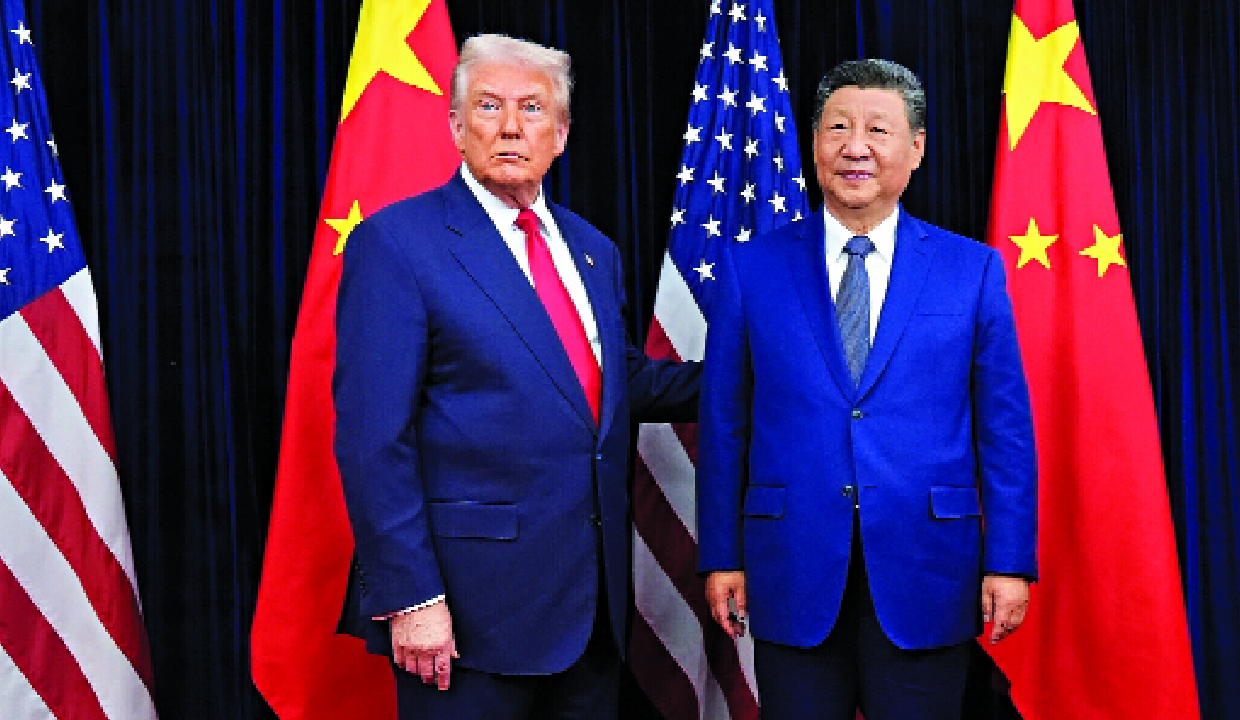
Adding to these developments, May 2026 saw Trump and Xi meeting in Beijing. The outcome seemed more transactional. America and China both emphasised “strategic stability”, implying managed competition through bilateral bargaining. While the US was focusing on practical deals in the spheres of trade and commerce, China, however, while not disagreeing with it, was intending political bargains in the context of Taiwan. Where Washington emphasised utility and outcomes, Beijing had its focus on status, hierarchy and influence. Largely, it can be inferred that the two great powers are trying to come to terms with each other; however, there are structural asymmetries also at play, inhibiting a win-win solution for both parties. The meeting reflects a simulation of a G2 condominium, where the US and China are perhaps shifting their strategic gears in order to manage the new global order in a coordinated and competitive manner.
When we read together both the evolution of language in NSS documents and the Beijing Summit outcomes, the nomenclature change does not come as a surprise, but rather as a deliberate and gradual outcome. It further suggests that Washington is steadily inching away from its strategy of managing Indian and Pacific Oceans’ affairs with India as its principal anchor. For India, any understanding of balancing between the US and China in managing the global order is not an acceptable diplomatic position. The fact that India did de-hyphenate its border issues and trade matters with China gives the impression that Indian strategic elites had kept room to manoeuvre for this day. India not only kept trade going with China but also positively participated in multilateral platforms like the SCO and BRICS. It consistently refused to reframe its China policy in a containment vocabulary. New Delhi was sure of the fact that a non-resident power cannot dictate the terms of how a territorial neighbour is to be managed. The question which now looms is: if not within the American regional framework, how will India manage its most consequential neighbour? For now, India will surely need a restructuring of its China policy in accordance with its own regional and global ambitions and its comprehensive national power, where its own economic leverage and its bilateral partnerships in the Indian and Pacific Oceans will become the pillars of its regional outlook. Finally, how New Delhi employs strategic autonomy, given the increased possibility of the G2s reaching an understanding and thus limiting India’s strategic horizon, will be something to wait and watch.
Abhishek Pratap Singh is Assistant Professor at the University of Delhi, and Kaustubh Tripathi is a Doctoral Candidate at the Department of Political Science, University of Delhi; Views presented are personal.