Limits of Parliamentary Debate
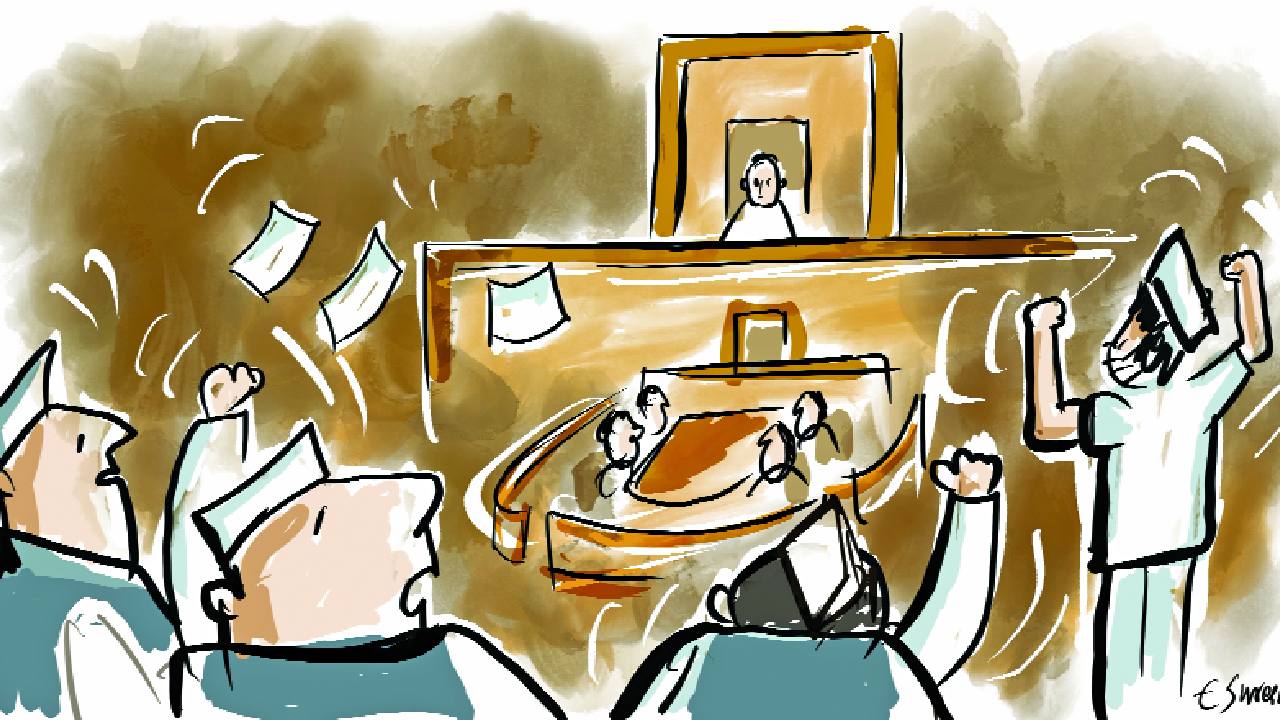
I have been asked to comment on the current situation of debate in both Houses of Parliament. Let me say at the outset that turbulence is not something new. During my 40 years in Parliament, I have observed that a certain amount of turbulence is built into the very system. In fact, my good friend, the late Arun Jaitley, once said that disruption is a legitimate form of Parliamentary activity. I strongly disagree with this. Parliament has clear rules of activity and Parliamentary procedure, and disrupting them can certainly not be looked upon as an acceptable form of activity. Indeed, it is an invitation to anarchy.
Recent events in Parliament, however, seem to have crossed all acceptable limits. It is unheard of that the Speaker would feel obliged to request the Prime Minister not to come to the Lok Sabha to reply to the debate on the Motion of Thanks to the President because, according to press reports, he felt that there was a threat of some physical attack by a section of women Parliamentarians. To begin with, I find it extremely unlikely that the concerned women Parliamentarians would go to the extent of actually physically harassing the Prime Minister. If there was such a threat, surely the security apparatus within Parliament would have been able to deal with it. The Prime Minister’s reply to the debate on the Motion of Thanks is an extremely important speech, and the fact that he was able to do so in the Rajya Sabha does not compensate for his absence in the Lok Sabha. Narendra Modi is a powerful and effective speaker, and I would have thought that it was important for him to speak in the Lok Sabha also.
I have always felt that when Parliament is disrupted, it is the Opposition that really stands to lose, because these debates are the opportunity it has to call the government to account. Unfortunately, Question Hour has been frequently disrupted. Harold Laski, in his classic Parliamentary Government in England, has said that Question Hour is really the most precious part of Parliamentary proceedings because it is the only time that backbenchers have the opportunity to question the Ministers concerned. Another unfortunate feature is that very few Bills are being referred to the relevant Standing Committees. It is my personal experience that it is in those Committees that a free debate and consensus really emerge, because there is no television coverage and Members do not need to posture to express their opinion.
Apart from these, there are Select Committees set up specially to deal with complex and controversial legislation. These are all safeguards built into Parliamentary procedure to ensure that laws are passed with maximum possible efficiency and consensus rather than rushed through, often without proper debate. The recent experience regarding the Agricultural Laws is a case in point. Had these been through the Standing Committees, it would not have been necessary for
the government to withdraw them after a year.
Another point that I would like to make is with regard to the kind of language that is being used in Parliament. Abusive words should always be avoided because millions of people view the proceedings, and such language shows the Members in a very negative light. As I said in my farewell speech after 40 years in Parliament, quoting Kabir, “Ghat Ghat Mein Tohe Piya Milenge, Katu Vachan Mat Bol Re” (The Divine is present in all beings, therefore, do not use harsh language).
Finally, let me clarify that in what I have written, I am not targeting any particular party. Having been in both Houses of Parliament, both on the Treasury Benches as well as in the Opposition, I have seen unruly behaviour cutting across party barriers.
Regarding the standard of debate, I do recall that when I first entered the Lok Sabha way back in 1967, there were outstanding parliamentarians such as Hiren Mukherjee, Somnath Chatterjee, Nath Pai, Madhu Limaye and others who, in their memorable speeches, could flay the government without using any unparliamentary language. In fact, even earlier, I used to fly down to Delhi specially to hear Pandit Jawaharlal Nehru’s reply to the debate on Foreign Affairs. It was always a classic performance covering the entire gamut of world affairs and India’s role therein. Let me say that I have interacted personally with every Prime Minister from Jawaharlal Nehru down to the current incumbent, and it is my view that each one of these has tried within their own competence to help build a new India. With Nehru and Modi getting three consecutive terms, they have had a major role in charting out the course for the future of the nation. Building India is indeed an exciting adventure, and although I am no longer in Parliament, I follow the proceedings carefully to see how we are progressing.
It is, of course, an endless process, with massive poverty still in existence, but I am confident that in due course of time we will indeed be able to overcome this barrier and finally provide to every citizen, as has been done in China, the basic facilities for a decent human existence. While China has done it under a dictatorship, we are undertaking a more challenging task of abolishing poverty while maintaining a truly democratic system as enunciated in our Constitution.
Karan Singh is an Indian politician and philosopher. He is the titular Maharaja of the princely state of Jammu and Kashmir. He was the Sadr-i-Riyasat (President) of the state of Jammu and Kashmir, served as Minister of Education and Culture, and was Ambassador to the United States of America; views are personal