Uncovering Goa’s hidden soul
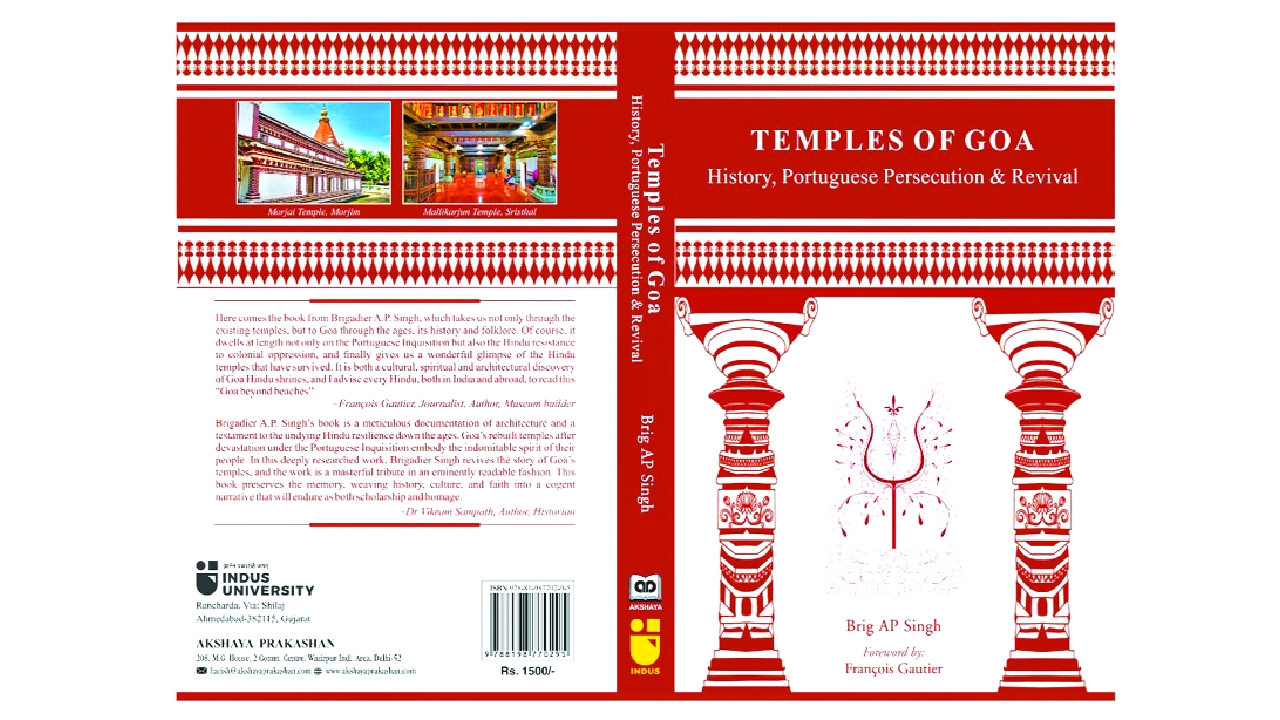
Behind Goa’s sun-drenched beaches and colonial charm lies a story of extraordinary resilience-one that has remained hidden in plain sight for centuries. Temples of Goa: History, Portuguese Persecution and Revival by Brigadier AP Singh, SM, VSM (Retd), from the Army’s Corps of Engineers and an expert on ancient temple architecture who has documented over 1,500 temples, including Hoysala dynasty sites, focusing on lathe-turned pillars, stellate designs, and construction techniques, unveils this forgotten narrative with scholarly precision and deeply moving reverence.
This is not just another history book-it is about cultural restoration after a period of persecution and attempts to destroy the old culture of the original inhabitants of Goa, known as the Gawda, Kunbi, and Velip communities, predominantly agriculturalists and fisherfolk and forming the earliest self-sufficient village communities known as Gaunkaris. Singh takes readers on a remarkable journey through Goa’s heritage, from its ancient roots documented in Sanskrit, Kannada, and Marathi inscriptions to the richness of the Sahyadrikhanda of the Skandapurana treatises. Here, we discover the stories of the Gauda Saraswat Brahmins, a distinct Hindu Konkani-speaking community originating from the ancient Saraswati River region, later settling in Goa before migrating to coastal Maharashtra, Karnataka, and Kerala; the rise and fall of the Mauryas and Kadambas; and the intricate tapestry of dynasties that shaped this sacred land.
But what makes this work truly exceptional is its unflinching examination of survival against impossible odds. Singh delves deep and is bold enough to bring out the darkest chapter of Goa’s history, tracing Portuguese persecution by way of the brutal Goa Inquisition (1560-1821)-how Goa’s Hindu temples were destroyed, communities, customs, and traditions were specifically suppressed, “new Christians” persecuted for heresy, and the Konkani language was severely restricted and eventually banned. And how, after such horrible suffering, Goans emerged with their faith intact. This is a story of cultural defiance that deserves to be told and remembered. The destruction of temples forced the people to relocate deities to hidden, simple dwellings for worshipping them before new temples were built in the 17th-18th centuries. These reconstructed temples, often in “New Conquest” areas, blend Hindu and European architecture, making them unique but less recognised as traditional, ancient Indian temples.
Richly illustrated with stunning photographs of forgotten temples, ancient settlements, and sacred groves tucked away from tourist maps, the book reveals archaeological treasures that have been overlooked for far too long. Each image tells its own story of devotion, destruction, and miraculous revival. Vikram Sampath notes in the Preface that the author’s work is not only a meticulous documentation of architecture and devotion, but also a testament to undying Hindu resilience down the ages.
Dr Sushma Ashok Arur has written an informative Introduction, bringing out some unique and not much-known aspects of Goa and complimenting the author on his insightful research.
What the author brings out is that while Goa was conquered in November 1510, it was an ancient, wealthy, and strategic region with a history dating back to the 3rd century BC. Ruled by dynasties like the Mauryas, Kadambas, and Vijayanagara, it was a major maritime trade hub known by names such as Gomant and Govapuri/Gopakapattana, a bustling port city famous for trade.
Afonso de Albuquerque, a Portuguese admiral, defeated the forces of the Sultan of Bijapur, Yusuf Adil Shah, to establish Portuguese rule, which lasted until December 19, 1961, when, after a swift 36-hour military action by the Indian Army, Navy, and Air Force, codenamed Operation Vijay, the Portuguese were forced to surrender, ending 451 years of colonial rule in Goa, Daman, and Diu. Goan temples are unique for their synthesis of Hindu traditions with Islamic and European architectural influences, resulting from rebuilding efforts in the 16th-18th centuries. Key features include distinctive deepa stambhas (lamp towers), red-tiled roofs, and serene water tanks, while retaining traditional Hindu garbhagriha (sanctum sanctorum) designs.
The oldest surviving and purely indigenous-style temple, such as the 12th-century Mahadev Temple at Tambdi Surla, is located in a dense forest, far from the tourist trail. “Tambdi” refers to the red laterite soil and “Surla” is the village/river. Other venerated temples are the Saptakoteshwar Temple, rebuilt in the 17th century by Chhatrapati Shivaji Maharaj; Mangeshi Temple, Mangeshi, one of the most famous and largest temples, dating back over 450 years with its iconic seven-storey lamp tower; Shantadurga Temple, Kavlem; Brahma Karmali Temple, Valpoi, believed to be over 1,000 years old; Chandreshwar Bhutnath Temple, Quepem; Ramnath Temple, Ramnathim; and some more.
For anyone ardent about South Asian history, religious studies, colonial legacies, or simply seeking to understand the real Goa beyond its tourist veneer, this book is indispensable. Singh challenges us to see Goa not as a vacation destination, but as a living testament to the power of cultural memory and spiritual endurance.
(The book reviewer is a VSM (Retd), a strategic affairs analyst and former spokesperson, Defence Ministry and Indian Army); views are personal