
- HOME
- INDIA
- WORLD
- BUSINESS
- STATES
- LAW & JUSTICE
- ENTERTAINMENT
- SPORTS
- VIEWPOINT
- LIFESTYLE
- TECH
In the dense forests of central and eastern India, a six-decade-long insurgency once threatened the nation’s unity. Naxalism, born in the 1967 peasant uprising at Naxalbari village in West Bengal, evolved into a Maoist armed rebellion under the banner of the Communist Party of India (Maoist), formed in 2004. At its peak in the mid-2000s, the so-called ‘Red Corridor’ stretched across nearly 200 districts in ten states, claiming thousands of lives, civilians, security personnel, and insurgents alike. It crippled development in tribal heartlands, extorted locals, and challenged the Indian state’s sovereignty. By 2014, 126 districts were officially Naxal-affected. Yet, by March 31, 2026, Union Home Minister Amit Shah stood in Parliament declaring India ‘Naxal-free’ The Politburo and Central Military Commission of the CPI(Maoist) lay dismantled. Organised left-wing extremism (LWE) had been crushed.
This was no accident. It was the result of relentless security operations, a determined political will, and an integrated strategy that combined force with development. The decline did not happen overnight. Successive governments had tried ‘Operation Green Hunt’ in the late 2000s, ‘Salwa Judum’ in Chhattisgarh but gains were patchy. Violence peaked around 2010 with over 1,000 incidents annually.

What changed after 2014 was a national policy that treated Naxalism not as a mere law-and-order issue but as India’s biggest internal security threat.
Prime Minister Narendra Modi Government’s National Policy and Action Plan on LWE, approved in 2015, laid the foundation. Central support flowed to states through funding, intelligence, and paramilitary forces. The real acceleration came under Amit Shah, who assumed charge of the Ministry of Home Affairs (MHA) in 2019 and set a clear, time-bound target: eradicate Naxalism by March 31, 2026. Shah’s approach was encapsulated in the SAMADHAN strategy, unveiled in 2017 but executed with ruthless efficiency in his tenure.
The acronym stood for Smart Leadership, Aggressive Strategy, Motivation and Training, Actionable Intelligence, Dashboard-based monitoring, Harnessing Technology, Action Plan for each theatre, and No Access to Financing. It was not rhetoric. Dashboards tracked every district’s progress in real time. Financing was choked through coordinated raids on extortion networks and hawala routes. Technology drones, satellite imagery, AI-driven intelligence, and encrypted communication transformed operations in jungles supposedly impenetrable.
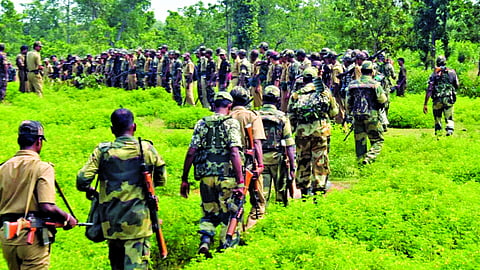
The Central Reserve Police Force (CRPF), its elite CoBRA (Commando Battalion for Resolute Action) units, state police’s District Reserve Guards (DRG) and specialised task forces formed the backbone.
Over 1 lakh personnel were deployed in multi-state operations like Operation Kagar (launched 2024) and earlier drives such as Octopus, Double Bull and Chakrabandha. Fortified police stations jumped from 66 in 2014 to 612 by 2026. New security camps, helipads and 400 bulletproof vehicles strengthened logistics.
Inter-state coordination became seamless under Shah’s oversight. Intelligence-led “Trace, Target, Neutralise” missions dismantled the Maoist hierarchy. Top leaders, including Politburo members, were eliminated or forced to surrender. MHA data speaks for itself. Between 2024 and March 2026 alone, security forces neutralised 706 Naxalites in encounters, arrested 2,218 and facilitated the surrender of 4,839. In 2025, 270 were killed, 680 arrested, and over 1,200 surrendered in a single year.
Brave jawans of the CRPF, state police and CoBRA paid with their lives in ambushes and IED blasts. Yet their sacrifice steadily reclaimed territory. Bastar division in Chhattisgarh, the epicentre of Maoist power saw Naxalism “almost eradicated,” as Shah noted. Once a no-go zone, it now hosts schools in every village, roads, and administrative outposts. The Red Corridor shrank dramatically: from 126 affected districts in 2014 to just two or three by early 2026. Most-affected districts fell from 35 to zero. States like Bihar declared themselves Naxal-free after the surrender of the last armed cadre. Jharkhand, Odisha, Maharashtra and Madhya Pradesh followed suit as violence incidents dropped over 77-89 per cent from 2010 levels. Civilian and security force deaths plummeted by over 91 per cent.
Shah repeatedly emphasised the “Clear, Hold, Develop” doctrine. Security operations cleared areas; forces held them with permanent camps and patrols; development followed swiftly. The MHA pumped resources into Left-Wing Extremism-affected regions through the Security Related Expenditure (SRE) scheme and Special Infrastructure Scheme (SIS). All-weather roads under PMGSY pierced forests, enabling markets, schools and hospitals to reach tribals. Electricity, telecom towers, banking, and postal services arrived where Maoists once blocked progress. Tribal welfare schemes such as housing, scholarships, skill training addressed root grievances of alienation and underdevelopment.
Surrender policies offered rehabilitation packages, land, jobs and security. Thousands of former Naxalites, disillusioned by the leadership’s hypocrisy and the futility of violence, laid down arms. Local communities, long caught between the gun and the state, began cooperating with forces, providing vital intelligence.
Amit Shah’s personal oversight was decisive. He held regular high-level reviews, visited affected states, and coordinated with chief ministers. In Parliament and public addresses, he blamed decades of neglect under previous regimes particularly Congress rule for allowing the insurgency to fester. Under his watch, the narrative shifted from containment to elimination.
“Naxalism in the country is now on the verge of extinction,” Shah declared in the Lok Sabha days before the deadline. The Maoist central structure was “almost completely dismantled.” On March 31, 2026, as the government’s self-imposed target was met, Shah announced that India had become Naxal-free. The formal declaration followed exhaustive verification: no major incidents, no active armed squads, and development indices rising in former hotbeds.
The victory belongs first to the men and women in uniform, the CRPF jawans who patrolled malaria-infested forests, the CoBRA commandos who survived booby-trapped trails, the state police officers who built trust in villages. It belongs to the intelligence agencies that mapped every hideout. It belongs to the tribals who chose peace over fear. And it bears the imprint of Amit Shah’s iron resolve, a Home Minister who refused to accept perpetual insurgency as India’s fate.
Today, the forests of Bastar and Dandakaranya echo not with gunfire but with the sounds of tractors, school bells, and mobile phones. Roads connect once-isolated hamlets to markets. Children study without fear. Farmers till land without extortion.
The end of Naxalism is not merely a security milestone; it is a developmental revolution. It proves that determined leadership, professional forces and an integrated approach, security plus development plus governance can heal even the deepest wounds. India’s success offers a global template: insurgencies thrive on neglect and division; they die when the state delivers both justice and opportunity. Bharat honours its security forces and salutes the political will that refused to compromise.
Naxalism in the country is now on the verge of extinction... The country will be informed once the entire process is formally completed, but I can say that we have become Naxal-free— Amit Shah, Union Home Minister
The writer is the Resident Editor of The Pioneer; views are personal