India’s delicate balancing act with the US
As Trump’s transactional approach to foreign policy reshapes Washington’s priorities, New Delhi finds itself walking a diplomatic tightrope: preserving a vital partnership with the United States while safeguarding its own strategic autonomy and regional interests
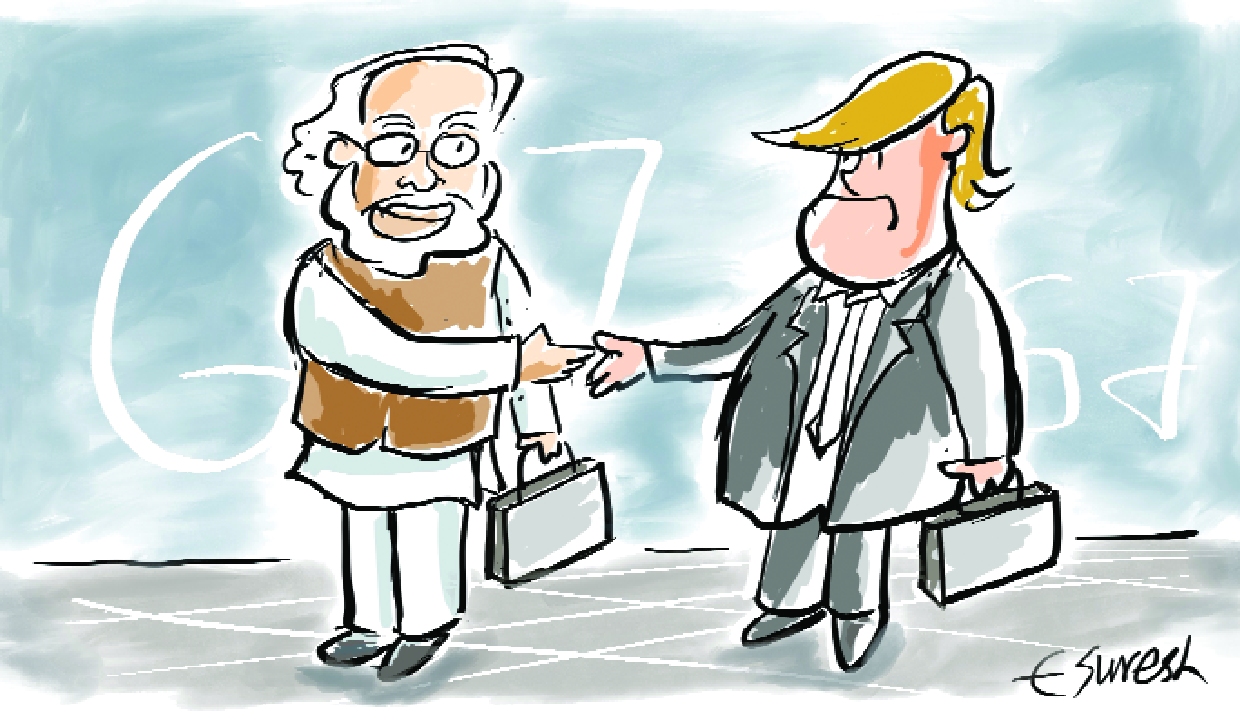
Anticipation ran high ahead of the meeting between Prime Minister Narendra Modi and President Donald Trump on the sidelines of the recent G-7 Summit in Evian-les-Bains, France. The encounter marked their first bilateral engagement since February 2025 — a 16-month hiatus that underscored the growing friction in India-US ties.
While New Delhi subsequently sought to dismiss the prolonged gap as “nothing unusual”, the reality is quite different. Following the meeting, foreign secretary Vikram Misri acknowledged the strain, noting that “relationships naturally go through ups and downs” and that both nations must actively “manage those fluctuations”. This candid admission confirms that managing bilateral friction has replaced the unabashed optimism and strategic convergence during Trump’s first term in 2017-2021.
A keyword in Misri’s statement was “manage” — a deliberate choice that reflected New Delhi’s pragmatic approach toward Trump’s unpredictable, transactional foreign policy approach. Indeed, the Trump administration’s disruptive policy shifts and rhetoric have strained bilateral relations, forcing India to recalibrate its approach to protect its own strategic interests. The Modi-Trump meeting was clearly not a “reset” in ties, nor will it automatically lead to more robust, stable relations.
In the months leading up to the meeting, the Trump administration in keeping with its mantra of ‘America First’ slapped high tariffs on Indian goods, including the imposition of punitive penalties for importing Russian oil. This has directly undermined India’s energy security, carrying serious strategic implications.
Additionally, Trump’s repeated – and, as per the Modi government, entirely unsubstantiated ones – claims about enforcing a truce between India and Pakistan following four days of cross-border hostilities under ‘Operation Sindoor’ have aggravated matters. This, combined with his administration’s restrictive immigration policies and the recent killing of three Indian seafarers in US strikes in the Hormuz Strait, have also contributed to the downward spiral in ties.
During their recent meeting, both leaders reaffirmed their commitment to strengthening the India-US Comprehensive Strategic Partnership. Yet, New Delhi knows all too well that a transactional leader like Trump can pull the carpet from under its feet any moment. This friction has eroded trust – a reality Modi implicitly referenced in his broader address to G-7 leaders, where he underscored the importance of trust-based international partnerships in an increasingly interconnected and interdependent world.
It’s precisely this trust that is currently missing from the New Delhi-Washington dynamic. Consequently, there is a delicious sense of irony in Trump’s post-meeting declaration that the two countries have “always had a great relationship”. It’s a measure of New Delhi wanting to keep the bilateral relationship stable that PM Modi also asserted that ties have gained “speed and energy” since their meeting last year.
As the two sides seek to bridge the trust deficit, deftly managing the relationship is a strategic necessity for India amid the geopolitical flux. The raging West Asia conflict, a region where India has huge stakes, also demands that New Delhi adopt a highly-calibrated approach towards Washington to safeguard its interests.
Though there is a fragile peace prevailing for now between the US and Iran after they inked a Memorandum of Understanding (MoU), the situation in the region remains volatile.
Already seriously impacted by the conflict, with its energy supplies from the region having taken a huge hit following the closure of the Hormuz Strait, India must remain engaged with all regional players.
India, however, also needs to employ some strategic pushback and plain- speaking when required. Modi, in his meeting with Trump, only indirectly raised the killing of the three Indian mariners by mentioning the general need for the safety of seafarers transiting the Hormuz Strait. The message should have been delivered much more directly. The US has expressed no regret over the killings, and President Trump himself was remarkably blasé about the deaths, dismissing them with: “It’s a rough profession.”
Meanwhile, the bilateral trade deal too has been hanging fire for far too long, though an outcome of the Modi-Trump meeting is the resolve to work out a “balanced, mutually beneficial and commercially meaningful agreement”.
What is deeply worrying for New Delhi, however, is the Trump administration’s waning interest in the Indo-Pacific framework designed to counter China. India has been unable to host the Quad Summit due to Trump’s disinclination. Equally problematic for New Delhi has been Trump’s frequent invocation of a “G-2” (US-China) framework, which positions these two nations at the absolute centre of the global order. Washington’s latest move to revert to the old nomenclature of the US Pacific Command (USPACOM) from the US Indo-Pacific Command (USINDOPACOM) also signals the diminishing importance of India and Indian Ocean in its strategic calculus.
Amid this fraught and uncertain scenario, New Delhi will have to delicately navigate its ties with Washington for as long as the mercurial Trump remains in office.
For India, an aggressive China remains its foremost strategic challenge. Balancing the threat with the help of the US, and to some extent other Indo-Pacific powers like Japan, Australia and South Korea, is pivotal.
What is deeply worrying for New Delhi, however, is the Trump administration’s waning interest in the Indo-Pacific framework designed to counter China. India has been unable to host the Quad Summit due to Trump’s disinclination
The writer is a senior journalist; Views presented are personal.