ECI: A Republic’s silent sentinel
On January 25, 1950, just two days before India formally became a republic, a modest yet momentous institution came into being: the Election Commission of India (ECI). Conceived in the aftermath of colonial rule and amid the uncertainties of a newly independent nation, the Commission was entrusted with a responsibility few countries had ever attempted on such a scale - conducting free and fair elections in a land of vast geography, staggering diversity, deep poverty, and widespread illiteracy. Seventy-seven years later, the very survival, let alone the success, of Indian democracy stands as a quiet rebuke to the many sceptics who once dismissed this experiment as doomed from the start. At its inception, the Election Commission was a one-member body, operating in an India still scarred by Partition and communal violence, with fragile institutions and a largely agrarian economy. The odds were formidable. Many in the so-called developed world confidently predicted that democracy could not endure in a poor, ‘backward’ country, arguing that universal adult franchise was a luxury India could ill afford.
History, however, has proved them profoundly wrong. What has unfolded since 1950 is not merely a story of elections, but of institutional resilience, administrative imagination, and a deep faith in the constitutional promise of popular sovereignty.
From supervising the first general elections in 1951-52 — an exercise involving over 173 million voters, most of whom were voting for the first time — to managing today’s polls for nearly a billion electors, the Election Commission’s journey mirrors the growth of Indian democracy itself.
With each passing decade, the scale has become more daunting, the logistics more complex, and the stakes higher. Yet the Commission has repeatedly risen to the challenge, often under conditions that would test even the most sophisticated state machinery.
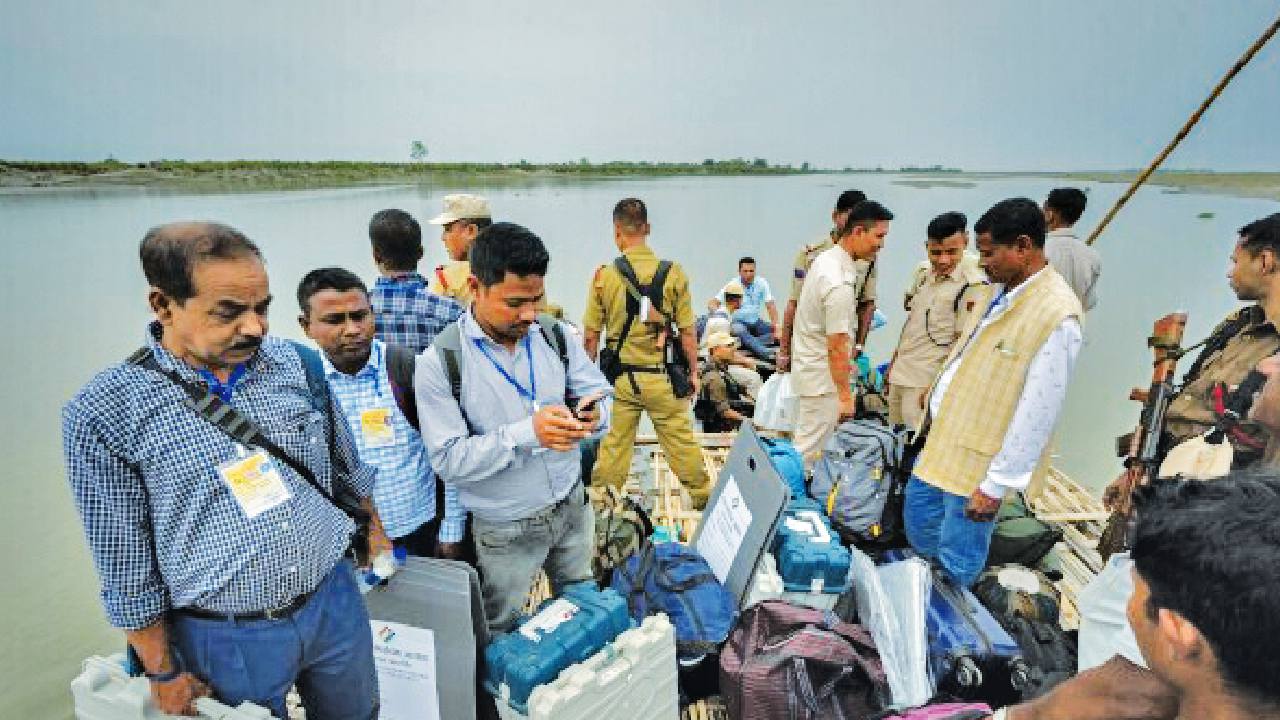
Few anecdotes capture this commitment more vividly than the now — iconic story from Gujarat’s Gir forest. To ensure that not a single citizen was denied the right to vote, polling officials in the 2024 Lok Sabha elections trekked through the last remaining natural habitat of the endangered Asiatic lion to set up a booth at Banej. The purpose was not symbolic; it was practical and principled. Mahant Haridas Udaseen, the sole resident — and therefore the sole voter — of the area, was entitled to exercise his franchise. The Election Commission deemed that entitlement non-negotiable. In that solitary ballot lay the essence of Indian democracy: one person, one vote, regardless of remoteness or inconvenience.
Such stories are not aberrations but expressions of an institutional ethos that has taken root over decades. Whether in the icy heights of Ladakh, the dense forests of central India, or the oceanic territories of Andaman and Nicobar and Lakshadweep, the Commission has insisted that the Indian voter must never be too distant to matter. The result is the most gargantuan democratic exercise anywhere in the world, conducted with a regularity and credibility that many older democracies struggle to match. This is not to suggest that the Election Commission’s history has been unblemished.
Like all constitutional bodies, it has operated within the political currents of its time, sometimes buoyed by public trust, at other times buffeted by criticism. The darkest chapter remains the Emergency of 1975-77, when democratic rights were suspended and institutional independence severely tested. The Commission, constrained by the prevailing political climate, could not escape the shadow of that period. Yet the restoration of democracy and the conduct of free elections in 1977 marked not only a national political reset but also a moment of institutional redemption.
In the decades that followed, the Election Commission steadily asserted its autonomy and authority, particularly through strong leadership. The tenure of the late TN Seshan in the early 1990s stands out as a watershed. With an uncompromising interpretation of the Constitution and election laws, Seshan transformed the Commission from a largely procedural body into a formidable constitutional guardian. He enforced the Model Code of Conduct with unprecedented rigour, curbed electoral malpractices, and injected a sense of accountability into a political class long accustomed to bending the rules. While his style was often controversial, his impact was undeniable: elections were no longer a formality, but a process to be respected and feared in equal measure.
Since then, the Commission has continued to evolve, adopting new technologies and administrative innovations to keep pace with India’s changing electorate. The introduction of Electronic Voting Machines, voter-verified paper audit trails, and extensive voter education campaigns reflect an institution that recognises the need to balance tradition with modernisation.
At the same time, it has had to navigate growing polarisation, the influence of money and media, and heightened public scrutiny —challenges that confront election authorities worldwide. Today, housed at Nirvachan Sadan in New Delhi, the Election Commission of India presides over elections across 29 states and multiple Union Territories, coordinating millions of polling personnel and security staff. It does so in a polity that represents nearly one-seventh of humanity, where political choices are shaped by generational shifts, social transformations, and evolving aspirations. That such a vast and varied electorate continues to place its faith in the ballot is, in no small measure, a testament to the Commission’s credibility.
Critics rightly point out that the ECI is not beyond reproach. Allegations of institutional pliancy, debates over its independence, and concerns about enforcement gaps persist. These critiques deserve serious engagement, for the strength of democracy lies as much in questioning its institutions as in celebrating them. Yet even these criticisms underscore a deeper truth: the Election Commission matters. It commands attention, scrutiny, and expectations precisely because it has become central to India’s democratic life.
At 77, the Election Commission of India stands as one of the republic’s most consequential yet understated achievements. It has overseen the peaceful transfer of power countless times, accommodated the will of an electorate larger than that of entire continents, and demonstrated that democracy need not be the preserve of the wealthy or the homogeneous. For all its flaws and shortcomings, it remains a model from which even established democracies can learn — about scale, inclusion, and institutional perseverance.
In an era when democratic norms are under strain globally, India’s Election Commission offers a reminder that faith in the voter, backed by a robust constitutional framework, can yield extraordinary results. What began in 1950 as a tentative experiment has matured into a living institution — one that continues to safeguard the simple yet radical idea that every Indian counts.
The writer is formar member of Payliament, Rajya Sabha and popular coloumnist; views are personal
Managing Indian Elections
Over more than 75 years, the ECI has conducted numerous general and state elections, overseeing the world’s largest democratic exercise, expanding voter registration to over 100 crore electors, and continuously reforming processes to uphold free and fair elections. Its journey mirrors the evolution and deepening of democratic governance in India — from paper ballots to digital systems, from foundational laws to voter empowerment initiatives.
1950 – Establishment
The Election Commission of India was established on January 25, 1950, as a permanent constitutional body under Article 324 of the Constitution of India, empowered to conduct all elections.
1951-52 - Presidential Elections
The ECI conducted India’s first general elections (1951-52), a massive democratic exercise in a newly independent nation. It also organised the first presidential election in 1952.
1950s-60s - Electoral Law
Over the following decades, the electoral framework was strengthened through laws such as the Representation of the People Act, 1951, which guided voter registration, conduct, etc.
1989-1990 - Multi-Member Commission
Initially comprising only a Chief Election Commissioner, the ECI was briefly expanded in 1989, and then formally made a multi-member commission in 1990, enabling collective decision
1990s - Reforms Under TN Seshan
Under CEC TN Seshan (1990-1996), the ECI asserted its authority through strict enforcement of the Model Code of Conduct, curbing misuse of official machinery and heightening accountability
1993 - Photo Identity Cards
EPICs (voter ID cards) were introduced to improve voter identification and curb electoral fraud; they have since become a cornerstone of the voting process.
1990 - EVMs introduced
After experimental use in the 1980s, Electronic Voting Machines (EVMs) were progressively introduced and nationwide deployment was completed by the 2004 general elections.
1998 - Digital era and Transparency
The Election Commission of India launched its official website (1998) and adopted computerised electoral rolls, increasing accessibility and transparency.
2011 - National Voters’ Day
25 January was designated as National Voters’ Day to encourage voter enrolment and participation, especially among young eligible voters across the country.
2010 - Inclusivity and Voter Education
Initiatives like SVEEP (Systematic Voters’ Education and Electoral Participation) introduced, apps to assist voters with disabilities, and gender-ratio improvements in rolls also introduced.
2020s - Digital and Roll Revision
The ECI continues large-scale digitisation of electoral rolls, automation of functions to improve transparency, and periodic Special Intensive Revisions (SIR) to ensure accurate voter lists.
Indian Elections
Logistical Challenge: To ensure every eligible citizen has access to a booth, Indian electoral rules mandate a polling station within 2 km of every habitation.
Infrastructure: Over 1 million polling stations are established, including booths set up for a single voter in remote locations.
Personnel: Roughly 15 million government officials and security personnel are deployed, using modes of transport ranging from helicopters and special trains to elephants, boats, and camels.
Technology: The exercise utilized approximately 5.5 million Electronic Voting Machines (EVMs) and nearly 1.8 million Voter-Verifiable Paper Audit Trail (VVPAT) systems to ensure transparency.