Dense fog envelops city
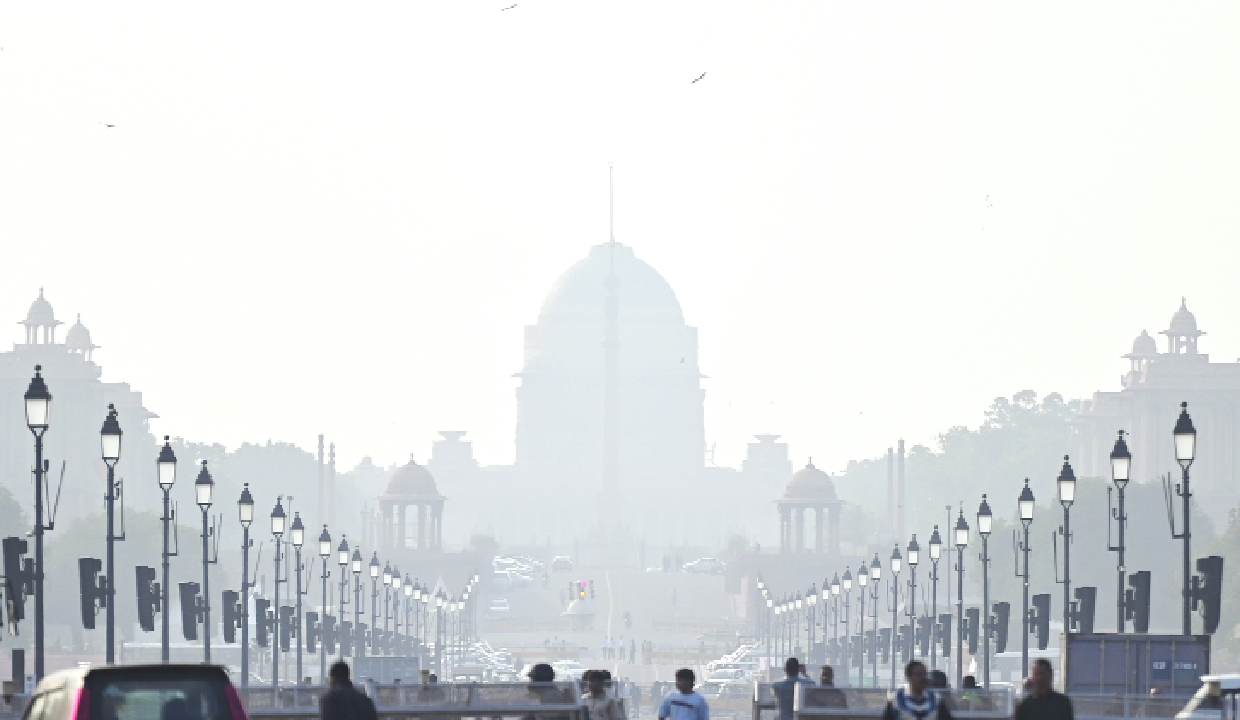
A thick blanket of fog enveloped Delhi on Tuesday morning, blurring skylines, slowing traffic and sharply reducing visibility across several areas. According to the India Meteorological Department (IMD), Delhi recorded a maximum temperature of 22.5 degrees Celsius. The air quality remained in the poor category.
The maximum temperature at the city’s base station was 0.2 notches above normal, while the minimum settled at 9.4 degrees Celsius, the India Meteorological Department (IMD) said.
Station-wise data showed that Palam recorded a maximum temperature of 19.5 degrees Celsius, below normal, with the minimum at 8.6 degrees Celsius. Lodi Road registered a maximum of 21.8 degrees Celsius and a minimum of 9.6 degrees Celsius, while the Ridge station logged a maximum of 21.7 degrees Celsius and a minimum of 11.0 degrees Celsius.
At Ayanagar, the maximum temperature stood at 21.8 degrees Celsius, while the minimum dropped to 10.3 degrees. No rainfall was recorded at any station during the past 24 hours, officials said.
During the morning hours, visibility dropped sharply to 100 metres at both Palam and Safdarjung, the weather office said. For Wednesday, the IMD has forecast a minimum temperature of 9 degrees Celsius and a maximum of 22 degrees Celsius, with dense fog conditions likely under a yellow alert. On the air quality front, Delhi’s 24-hour average Air Quality Index (AQI) stood at 272 on Tuesday, placing it in the ‘poor’ category, according to the Central Pollution Control Board (CPCB).
Station-wise data showed uneven air quality across the capital, with 16 monitoring stations reporting ‘poor’ air quality, another 16 in the ‘very poor’ category and seven stations recording ‘moderate’ levels during the evening hours, according to data from the Sameer app.
Data from the Decision Support System (DSS) showed that Delhi’s transport sector contributed up to 13.1 per cent to the city’s pollution load, followed by Delhi and peripheral industries at 11.3 per cent. Waste burning accounted for 1.3 per cent, construction activities 2.3 per cent, road dust 1.1 per cent and residential sources 3.3 per cent.
The air quality is likely to remain in the ‘poor’ category on Wednesday and is expected to improve to the ‘moderate’ category from February 5 to February 6, according to the Air Quality Management System.
The city’s AQI was recorded at 256 at 9 am on Tuesday, remaining in the ‘poor’ category. Station-wise CPCB data showed air quality at 19 stations in the ‘poor’ category, 10 in ‘very poor’ and 10 in ‘moderate.’