Kautilya’s tax wisdom still relevant, says ex-IMF economist
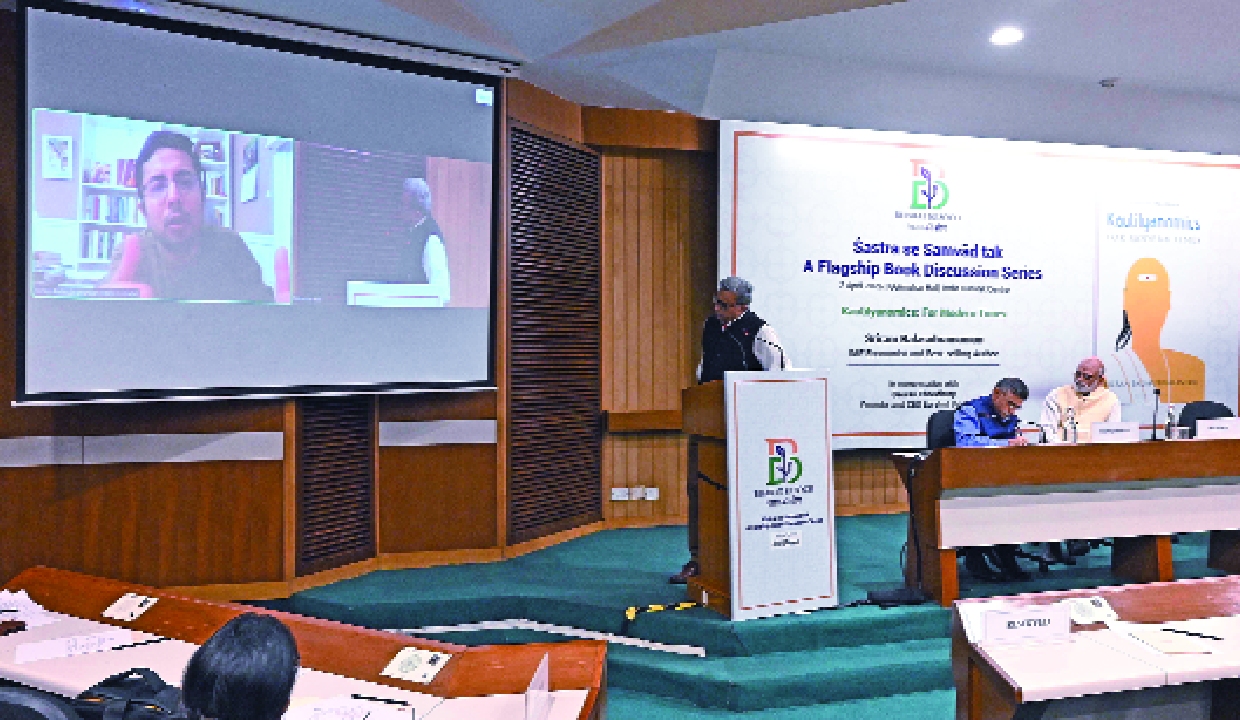
“This prosperity did not happen as a one-off. There had to be a philosophical principle behind it.” Those words, spoken without theatre or flourish at Gulmohar Hall of the India Habitat Centre in New Delhi on Thursday, landed with the quiet weight of a provocation.
Behind them sits a question that former IMF economist Sriram Balasubramanian has spent nearly a decade trying to answer seriously: if India dominated global GDP for 17 unbroken centuries, what exactly was the architecture that held it up? And why has no one in mainstream economics bothered to find out?
The occasion was the inaugural session of Bharat Ki Soch’s flagship book discussion series, titled “Shastra se Samvad tak,” a journey, as the organisers put it, from inheritance to wisdom. Leading national daily, The Pioneer, with a legacy of over 160 years, was the media partner of the event chaired by foundation chairman Anil Rajput, where intellectuals from various fields, including academics, bureaucracy, and media, participated.
Balasubramanian was there to discuss his book, “Kautilyanomics: For Modern Times.” Gaurav Choudhury, an economist, media entrepreneur, and alumnus of the Delhi School of Economics, as well as the founder of Earshot DigiMedia, led the discussion.
Balasubramanian, who joined virtually from the United States, opened with a graph. It was drawn from the work of British economic historian Angus Maddison, who spent decades reconstructing GDP and GDP per capita data going back thousands of years. The conclusion is striking: India and China were the world’s two largest economies from the early centuries of the common era through to the 17th century.
“Maddison’s data is probably an underestimate,” Balasubramanian said. “But it gives us the trend. And the trend triggered a thought that this wasn’t the population. This was sustained over centuries. There had to be a philosophical principle behind it.” That principle, he argues, lives in the Arthashastra. Not Machiavelli. Not Marx. Kautilya.
The afternoon’s most pointed argument was about a comparison that Balasubramanian finds deeply misleading: the habit of calling Kautilya “India’s Machiavelli.” He pushed back firmly. “Kautilya predates Machiavelli by nearly 1,800 years,” he said. “And the Arthashastra is fundamentally an economic text, not a political one. The idea of Dharma of ethical conduct is central to it.”
His framework, which he calls Dharmic Capitalism, rests on three pillars: a rule-based but non-intrusive state; wealth creation through sustained global engagement; and sustainable, inclusive growth. He was careful not to make it sound like soft nationalism dressed in economic language. The framework, he insisted, is grounded in data, primary inscriptions, and the accounts of third-party travellers who visited India precisely because of the prosperity they witnessed.
The discussion grew most animated around taxation. Choudhury raised Kautilya’s famous metaphor that a king should extract taxes the way a bee draws honey, without destroying the flower.
Balasubramanian put a precise number to it. Kautilya’s effective tax range, he said, ran from roughly 15 to 25 per cent, varying by category of goods. He taxed agriculture at a time when it formed the backbone of the economy. But the principle was clear: taxation beyond a threshold is self-defeating.
“People find ways around it. Businesses find it complex to function. Compliance falls,” Balasubramanian said. “What Kautilya understood and what we are relearning today is that the premium for paying taxes must be visible. The state must offer the rule of law in return. It is a contract.”
The sharpest exchange of the afternoon came near the end. Choudhury pressed on why Kautilya remains under-researched. Balasubramanian’s answer was blunt. “Take the stock of historians in post-independent India. My view is that 99 per cent of them would not have even a basic understanding of Sanskrit. Yet 99 per cent of our ancient texts are in Sanskrit,” the noted former IMF economist said.
India’s intellectual history, he argued, was largely translated and interpreted by Europeans for Indians who had been cut off from their own textual inheritance through a long period of mental and institutional displacement. “I am not saying our past was perfect,” he said, wrapping up. “I am saying we have not yet seriously tried to understand it. And until we do on our own terms, with our own tools, we will keep borrowing frameworks that were never built for us.” The applause, when it came, felt less like politeness and more like recognition.
The session was organised by Bharat Ki Soch, a research organisation that describes its mission as drawing on India’s civilisational wisdom to address contemporary challenges in governance, economy, and public policy. Bharat Ki Soch Foundation Director R.K. Pachnanda and Advisory Council member Raghvendra Singh were amongst the present.