
- HOME
- INDIA
- WORLD
- BUSINESS
- STATES
- LAW & JUSTICE
- ENTERTAINMENT
- SPORTS
- VIEWPOINT
- LIFESTYLE
- TECH
Another Delhi fire tragedy highlights the cost of negligence, where profit took precedence over safety and enforcement failed
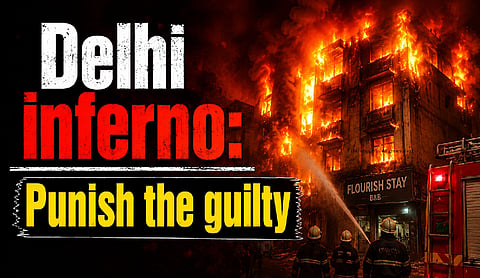
What we learn from mishaps is that we do not learn anything from them. Moreover, the cost of human life does not matter when it comes to making profits. Delhi has seen several fire disasters - the Uphaar Cinema fire (1997), the Anaj Mandi factory fire (2019), the Mundka building fire (2022), the Alipur paint factory fire (2024), the recent Dwarka fire (2026), to name a few, and now the latest Malviya Nagar hotel fire that killed at least 21 people. Despite the recurrence of these incidents, the rules remain lax and enforcement even poorer.
The facts emerging from the ashes of Hauz Rani are damning. The hotel held a Bed & Breakfast licence for a maximum of six rooms. It was running 25. It had no valid Fire Safety No Objection Certificate - a legal requirement for every commercial hospitality establishment in India. There was a single exit from the building, and even that outer gate was reportedly locked. Most of the foreign victims were from Nigeria, Mozambique, Somalia, Liberia, Bangladesh and Afghanistan — families of patients undergoing treatment at the nearby Max Hospital. Who is responsible? The answer is not one person but an entire ecosystem of failure.
First and most directly, the hotel owner, who illegally expanded the premises fourfold, operated without mandatory fire clearances, sealed windows and blocked exits. The absconding owner must be arrested, tried and punished to the fullest extent of the law.
But the owner did not act in a vacuum. Budget hotels and B&Bs across Delhi routinely flout fire norms with near-total impunity. Inspectors who were meant to verify compliance either never visited or certified compliance they never checked. Municipal and licensing authorities who permitted a six-room operation to quietly balloon into a 25-room commercial complex over months or years are equally culpable. Complicity through inaction is still complicity. They too must face accountability. Why does Delhi burn every summer? The answers are structural. The city’s older residential neighbourhoods - Malviya Nagar, Karol Bagh and Paharganj - are dense, with narrow lanes that delay fire engines and buildings with no separation between structures. As temperatures breach 45°C, electrical loads spike, air conditioners run continuously, and ageing wiring sparks under the strain. Illegal construction, mixed-use buildings with restaurants below and hotels above, and virtually no culture of fire drills or safety training make every summer a disaster waiting to happen. The way forward demands more than condolences. Delhi needs a time-bound, ward-by-ward fire-safety audit of every hotel, B&B, hostel and lodge, with the results made public. Licences must be physically verified, not rubber-stamped. Building plans must match reality on the ground. Fire exits, sprinklers and smoke alarms must be non-negotiable conditions of operation, not optional upgrades. Those who fail inspections must be shut down immediately, not fined and forgotten. Above all, this cannot be another tragedy that fades from the news cycle.