Andhra Pradesh: From faith to flame, tracing history through taste
Along India’s eastern coast lies Andhra Pradesh, where the emerald ocean meets the quiet strength of the hills. The Bay of Bengal laps against its shores while the Eastern Ghats rise gently in the west, and between them stretch the wide deltas of the Krishna and Godavari rivers, lifelines that have nourished civilizations, crops, and cultures for more than two millennia. The beauty of the land is mesmerizing. Coconut palms fringe fields of lush green paddies, and the red earth blushes with ripening chilies in the bright sunlight. The terrain’s contrasts, fertile plains, arid highlands, and forested hills, have shaped a people of resilience and invention, whose history, faith, and cuisine mirror the beauty and bounties of their land.
Long before Andhra Pradesh as we know it today took shape (following the creation of Telangana on June 2, 2014), its story began in legend. The Aitareya Brahmana of the Rig Veda speaks of the Andhras as a southern tribe migrating from the north, and by the 6th century BCE the Assaka Mahajanapada had arisen between the Godavari and Krishna, its people known for trade and grain. When Chandragupta Maurya’s empire expanded southward around 321 BCE, these plains became part of a larger imperial framework, only to give rise, a century later, to the Satavahanas, one of India’s earliest enduring dynasties. Founded around 230 BCE, their rule from Pratishthana (Paithan) and Dharanikota near Amaravati lasted nearly four centuries, giving shape to Andhra’s first political identity. They issued coins bearing the names of their kings in Prakrit, encouraged inland trade along the Krishna, and sent ships from ports such as Ghantasala and Motupalli toward Rome and Southeast Asia. Under Gautamiputra Satakarni (around 80 CE), they consolidated the Deccan, patronized both Buddhism and Vedic rites, and built the famed Amaravati Stupa; its carved limestone railings depicting scenes from the Buddha’s life are among the most intricate of the ancient world.
Following the decline of the Satavahanas in the 3rd century CE, the Ikshvakus rose at Nagarjunakonda, and were known to patronize monasteries and stupas that came up along the river banks. The Vishnukundins followed in the 5th century, extending their realm deep into the eastern Deccan, and there is evidence of a polity that encouraged irrigation and the construction of Hindu temples. By the 7th century, the Pallavas of Kanchipuram and the Eastern Chalukyas of Vengi were contending for the same fertile delta that was renowned for its fertility and prosperity. Pulakesin II’s conquest of Vengi in 624 CE heralded an era of Telugu-Kannada influence that would define the unique language, script, and art of the region. Inscriptions from this time show Telugu emerging as a literary tongue alongside Sanskrit, and temples at Draksharamam and Chebrolu began to feature both Nagari and Telugu inscriptions side by side. The Cholas had a significant role in Andhra’s history in the 11th century. Rajaraja I’s campaigns in 1002 CE and Rajendra I’s in 1022 CE brought the delta under Chola suzerainty for two centuries, introducing stone temples, bronze icons, and new irrigation tanks. Yet even under Chola rule, local chiefs like the Velanatis, the Chodas of Nellore (a branch of the Telugu Chola family), and others retained regional identity. It was during this time that Rajaraja Narendra commissioned Nannayya Bhattaraka, one of the earliest poets of the Telugu language, to translate the Mahabharata into Telugu to popularize it among the locals. The rise of the Kakatiyas in the 12th century marked a new epoch for the Telugu-speaking lands.
From strongholds that extended into what is now Andhra Pradesh, rulers like Rudradeva and Rani Rudrama Devi fostered fortifications, codified local administration, and sponsored trade across the eastern Deccan. Their legacy inspired a flowering of Telugu art and architecture across present-day Andhra. The Kakatiyas’ decline in the early 14th century fragmented the region once again, but even in loss, their reign seeded a golden age of Telugu literature and temple building. In the wake of their decline, smaller Hindu principalities briefly reemerged under the Musunuri Nayakas and Reddi kings before the Vijayanagara Empire brought stability in the 14th century. Under Krishnadevaraya (reigned from 1509-1529), Andhra flourished as part of a vast network of temples, irrigation tanks, and markets extending from Hampi to the coast. Ports such as Machilipatnam and Nellore hummed with the export of textiles, rice, and spices. Telugu literature achieved classical refinement; Krishnadevaraya himself wrote in the language he called “the sweetest of the Dravidian tongues.” But after the Battle of Talikota in 1565 CE, Vijayanagara power waned, and local Nayakas and regional chieftains took the mantle, fostering crafts and architecture that continue in Rayalaseema to this day.
With the passing of time, by the 18th century, as Mughal authority faded, European traders edged in along the coast. The French briefly occupied Yanam, but the British East India Company soon prevailed, acquiring the Northern Circars in 1765 and integrating coastal Andhra into the Madras Presidency. British engineers built the Dowlaiswaram Anicut (1852) across the Godavari and the Prakasam Barrage (1855) on the Krishna, transforming Andhra into the “Rice Bowl of India.” The colonial period also saw the rise of education and reform: Kandukuri Veeresalingam championed widow remarriage in the 19th century, and Tanguturi Prakasam led nationalist movements in the 20th. By 1921, the Andhra Mahasabha had emerged as a platform for linguistic identity, paving the way for the creation of Andhra State in 1953, the first state formed on a linguistic basis. In 1956, Andhra merged with the Telugu-speaking districts of Hyderabad State to form Andhra Pradesh, uniting the coastal and Rayalaseema regions under one state. In 2014, Telangana was carved away, and Amaravati on the Krishna River became the new seat of governance, closing yet another historical circle.
Religion in Andhra Pradesh flows like its rivers, wide, nourishing, and layered with time. The Godavari and Krishna valleys once echoed with Buddhist chants; monks at Amaravati, Thotlakonda, and Salihundam carved monasteries into hillsides that overlooked ancient trade routes. Stupas rose, stone relics were set, and merchants carried not only spices and textiles but teachings that reached as far as Southeast Asia. Even as Buddhism waned by the 7th century, its ethos lingered in Andhra’s simplicity of worship and vegetarian traditions. Hinduism, meanwhile, found monumental expression in the temples of Srisailam (on the border of Andhra Pradesh) and Draksharamam and Tirupati. The Srisailam complex, dedicated to Lord Mallikarjuna and Goddess Bhramaramba, is one of the twelve Jyotirlingas and eighteen Shakti Peethas, a convergence rare in Indian sacred geography. Tirumala’s temple to Lord Venkateswara, rising on the Seshachalam Hills, continues to attract millions of devotees yearly. Its kitchens, among the largest in the world, prepare prasadam for thousands daily, with offerings like the famous Tirupati Laddu and pulihora served as divine blessings.
The region also absorbed Islamic, Jain, and tribal spiritualities. Rayalaseema’s towns house Sufi dargahs where Qawwali echoes beside temple bells, and Jain caves near Undavalli preserve sculpted meditations in stone. In the coastal plains, village goddesses, Poleramma, Gangamma, and Yellamma, are still invoked before every harvest. Farmers begin sowing by offering new rice to the deity and cook pongali (sweet rice with jaggery and ghee) as the first food of the season. Festivals like Ugadi, Sankranti, and Karthika Deepam transform harvesting rituals into communal feasts, offering thanksgiving and gratitude through shared cooking and sharing.
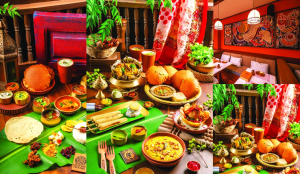
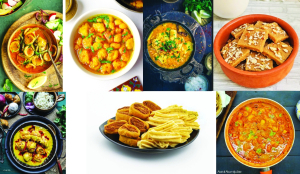
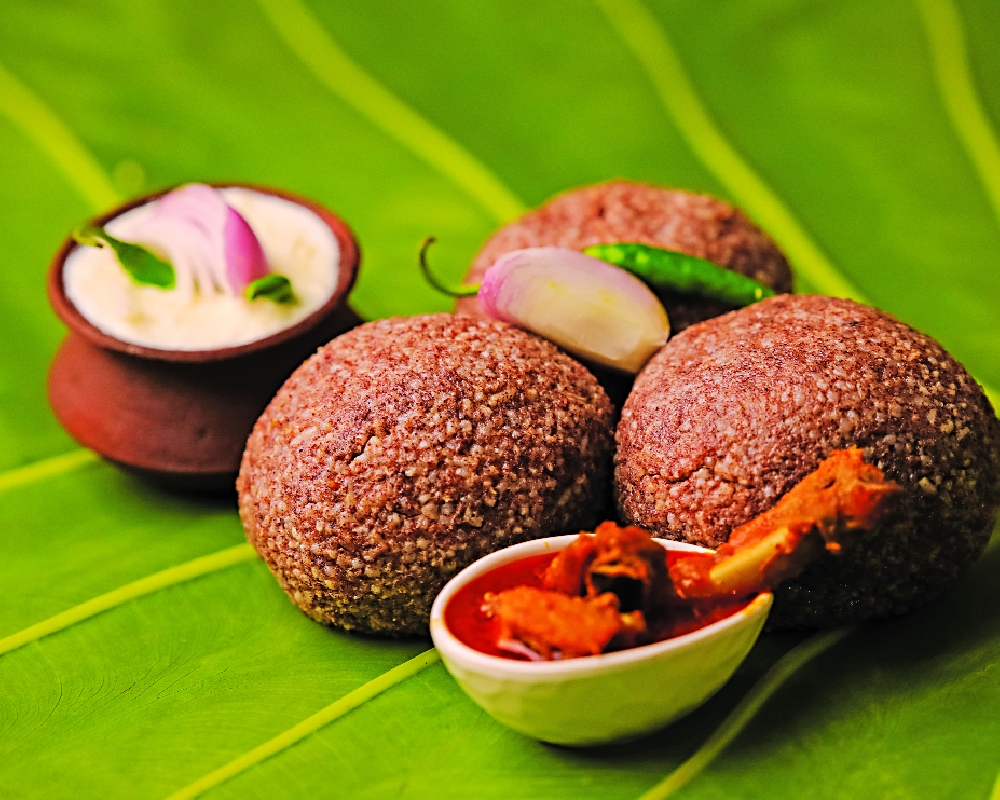
From this fusion of geography, faith, and survival emerges Andhra Pradesh’s extraordinary cuisine, a palette that captures both the heat of its sun and the generosity of its rivers. Broadly, three regional cuisines define the region: Coastal Andhra, Rayalaseema, and Uttarandhra. In Coastal Andhra, where paddy fields sway with the gentle breeze, rice reigns supreme. Meals often begin with steamed rice, dal, and a tangy Pachi Pulusu (a raw heated tamarind soup), followed by dry curries and pachadis (chutneys). Pulihora, the temple rice of tamarind and turmeric, is more than food; it is an offering. The rice is mixed with tamarind pulp, tempered with mustard seeds, curry leaves, dry chilies, and peanuts, and left to rest until each grain is flavoured sour-sweet. Gongura Pappu (lentil made with Sorrel leaves) features toor dal (pigeon pea) and is simmered to a smooth broth, while Chepala Pulusu transforms river fish into tender fillets steeped in tamarind, chili, and garlic. In Rayalaseema, the land of red earth and hotter skies, the palate grows fiercer. Here, ragi (finger millet) replaces rice, and every meal is an event in itself. Ragi Sangati is prepared by boiling water, stirring in ragi flour until thick, then shaping the mixture into smooth balls and serving it with Ulavacharu (horse gram stew) and Naatu Kodi Pulusu (country chicken curry). Ulavacharu is slow-cooked over wood for hours: horse gram is soaked, boiled, and strained; the broth is then simmered with tamarind, garlic, and a dash of ghee to yield a dark, silky soup brimming with warmth. Mirapakaya Bajji (chili fritters) and Uggani (spiced puffed rice) accompany breakfasts, while Gutti Vankaya Kura (stuffed brinjal curry) appears at festive dinners. Food here speaks in spice and curry, but its simplicity is overwhelming.
Further north, in Uttarandhra, the cuisine softens into gentler flavors. Coconut, jaggery, and mustard balance sour tamarind, and even dals carry a faint sweetness. Bellam Pappu (sweetened lentils with jaggery) is served with rice, while Sunti Pappu (moong dal with ginger and tamarind) refreshes after long days in the fields. Pullakura Kura (spinach stew) and Sajja Roti (millet flatbread) are eaten with pickles, and jaggery often finishes the meal. Yet the signature dish of this region remains Pesarattu, a crepe made from soaked and ground green gram, spread thin on a hot griddle, brushed with oil, and served crisp with ginger chutney.
Across Andhra, dining itself follows ritual order: rice at the center, flanked by lentils, greens, pickles, fry curries, and curd, always served on a banana leaf. Meals end with sweets that make a dessert following a nourishing and spicy meal. Ariselu, made of rice flour dough sweetened with jaggery and deep-fried in ghee, symbolizes abundance and is a favourite. Bobbatlu (stuffed with lentil and jaggery paste) are festival delicacies, while Pootharekulu, delicate rice paper rolls filled with jaggery and coconut, remain culinary marvels of craftsmanship. Even humble snacks such as Garelu (urad dal fritters) or Punugulu (fermented batter dumplings) demonstrate the balance of fermentation, spice, and texture that defines Telugu cooking and gives it a unique character.
Beyond its homes and temples, Andhra’s culinary identity has become a bridge between tradition and innovation. Its pickles travel in jars to every corner of India and abroad, its red chilies carry the Guntur name to world markets, and its millets find new life in health-conscious kitchens. Food festivals in Visakhapatnam, Vijayawada, and Anantapur showcase traditional recipes adapted for modern plates. Chefs reinterpret age-old dishes with subtlety, but the spirit remains the same: preserve the heat, honor the earth, and balance every flavour. Andhra Pradesh’s cuisine is therefore more than sustenance; it is a reflection of its beauty, fragrance, culture and faith. Each meal tells of kingdoms and farmers, of ports and pilgrims, of survival and celebration. In every grain of rice and every drop of ghee lies the story of a people who turned necessity into art. It is now upon us to keep this story alive, not as a nostalgic memory, but as a living practice. Let us teach the next generation not only how these dishes are made, but why they endure: for their balance, their nourishment, and their quiet wisdom. For in every pot of Pulihora (tamarind rice) and every spoonful of Chepa Pulusu (fish curry) lies the same truth that has fed Andhra through centuries, that food, when made with care and gratitude, is both heritage and devotion. To preserve it is to preserve the soul of a civilization carved by rivers, sanctified by faith, and forever flavoured by fire and grace.
(The writer is Secretary, Cuisine India Society)