Ancient Wisdom Through an Ancient Language in Modern Times
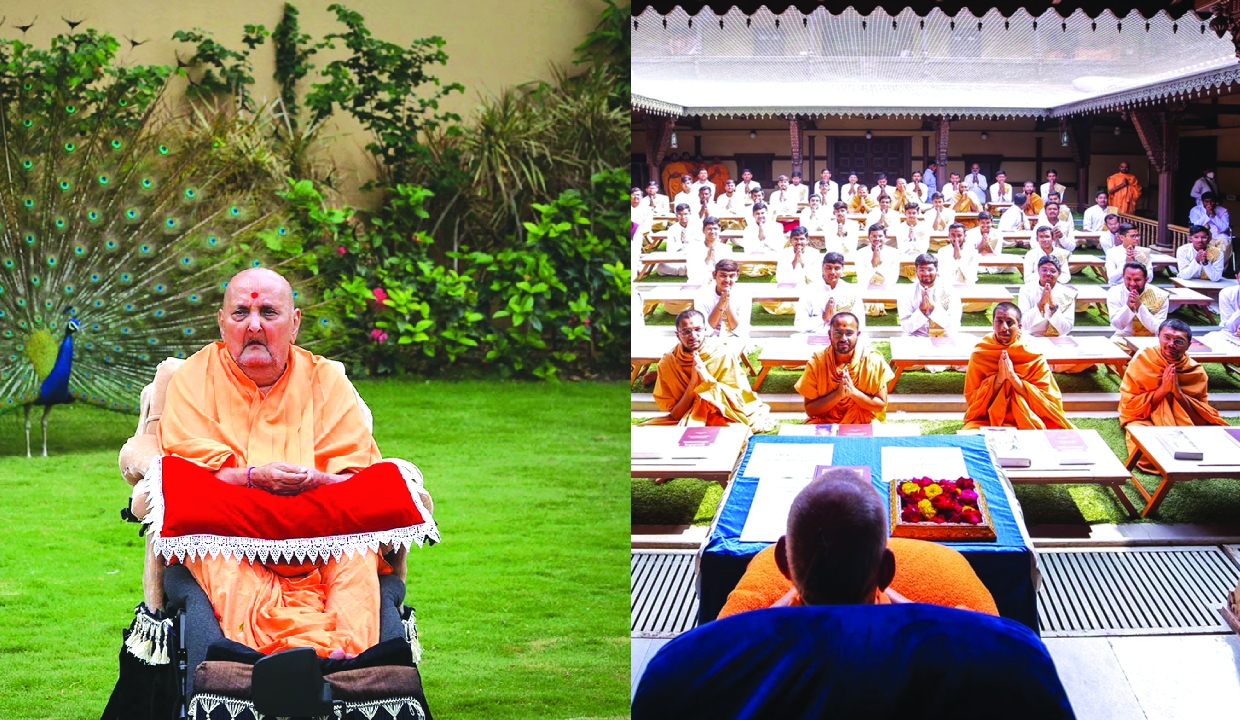
The fragrance of flowers, the call of peacocks, the glow of sacred fires, and the sound of Sanskrit mantras at dawn, Sarangpur feels less like a place and more like a forgotten chapter of India’s spiritual past brought to life. Here, amidst a living gurukul tradition envisioned by Pramukh Swami Maharaj, ancient wisdom continues to inspire modern minds
The road to Sarangpur winds through the quiet countryside of Gujarat. At first glance, Sarangpur appears to be just another small Indian village, unassuming and far removed from the bustle of modern cities. Yet, as one enters the vast campus of the BAPS Swaminarayan Mandir, the atmosphere changes dramatically. A sense of serenity descends. The air seems calmer, the pace slower, and the surroundings imbued with a timeless grace.
My visit to the BAPS Swaminarayan Sanskrit Mahavidyalay felt less like entering an educational institution and more like stepping into a living chapter of India’s ancient heritage. Towering trees lined the pathways. Colorful flowers bloomed in carefully tended gardens. Peacocks, the national bird of India and affectionately known in Sanskrit as saranga, from which Sarangpur derives its name, wandered freely across the campus, their calls mingling with the chants of sacred verses. Sadhus in saffron robes, devotees engaged in seva, and young students dressed in traditional attire moved purposefully through the grounds, creating a scene that seemed transported from the era of the ancient gurukuls.
There was something profoundly moving about witnessing Sanskrit, not as a subject preserved in books, but as a living language spoken, studied, discussed, and cherished. The environment evoked the spirit of the Vedic age, where learning was not merely the accumulation of information but a holistic process of intellectual, moral, and spiritual refinement. In a world increasingly shaped by screens and algorithms, the experience was both refreshing and inspiring.
At the heart of this unique environment stands the BAPS Swaminarayan Sanskrit Mahavidyalay, an institution dedicated to preserving and advancing India’s classical knowledge traditions. Established in 1973 as the Yajñapurusa Sanskrit Vidyalay, the Mahavidyalay has grown into a respected center for Sanskrit scholarship, attracting students from across India and around the world. Here, ancient wisdom is not treated as a relic of the past but as a living source of insight capable of enriching contemporary life.
The Mahavidyalay offers rigorous training in Sanskrit scriptures, philosophy, literature, linguistics, and traditional knowledge systems. Its purpose is not merely to produce scholars who can interpret ancient texts, but individuals capable of communicating their timeless relevance to modern society. Students immerse themselves in the study of sacred works while developing the analytical, linguistic, and research skills required for academic excellence.
A distinctive strength of the Mahavidyalay lies in its comprehensive language programme. Alongside Sanskrit, students receive training in Gujarati, Hindi, and English, enabling them to engage with a broad range of scholarly resources and communicate effectively across cultural and academic contexts. The curriculum emphasises all dimensions of language learning: reading, writing, listening, speaking, and critical interpretation, under the guidance of experienced instructors.
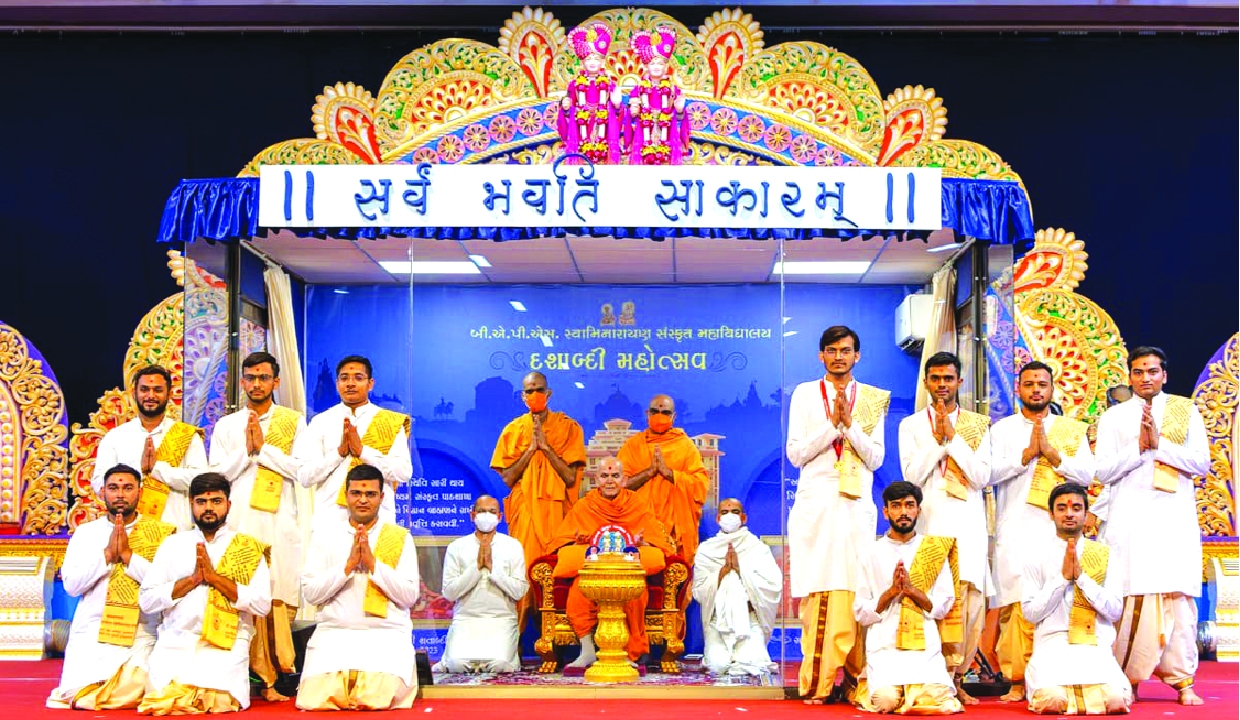
The institution’s affiliation with Shree Somnath Sanskrit University enables qualified students to pursue undergraduate, postgraduate, doctoral, and diploma programs. Through its online learning initiatives, students from around the world can also access structured Sanskrit education, extending the reach of this ancient language far beyond the boundaries of Sarangpur.
Research and academic engagement form an integral part of life at the Mahavidyalay. Regular Sambhasana seminars provide students and researchers with opportunities to present their ideas, participate in debates, engage in scholarly discussions, and refine their communication skills. These forums cultivate critical thinking while preparing students for the demands of academic research and public presentation.
Many students go on to present papers at national and international conferences, where they interact with leading scholars and contribute to contemporary discussions in Sanskrit studies and related disciplines. Such experiences strengthen their research abilities, broaden their intellectual horizons, and prepare them to participate confidently in global academic discourse.
The Mahavidyalay also welcomes visiting researchers, professors, and scholars from universities and research institutions across the world. Their presence enriches the academic environment and exposes students to diverse perspectives and emerging opportunities in Sanskrit studies internationally. For many young scholars, these interactions become windows into a global network of research, collaboration, and lifelong learning.
Yet, what leaves the deepest impression on a visitor is not simply the Mahavidyalay’s academic excellence, but the divine atmosphere that envelops the entire campus. At dawn, some students gather to perform yajna or mahapuja, their resonant chanting of Vedic mantras filling the air with a sacred energy. As evening descends over Sarangpur, the echoes of dhun, stuti and aarti linger in the air. Watching young students perform seva with remarkable devotion, one feels transported centuries back to the ancient gurukul.
Thus, the Mahavidyalay emerges as a remarkable embodiment of Pramukh Swami Maharaj’s vision: a sacred bridge connecting the wisdom of ancient India with the needs of the modern world, ensuring that the light of Sanatan values continues to illuminate generations to come.
The writer, Dr Swami Gyanananddas, is a dedicated follower of the Swaminarayan tradition and has earned a PhD from MS University; Views presented are personal.