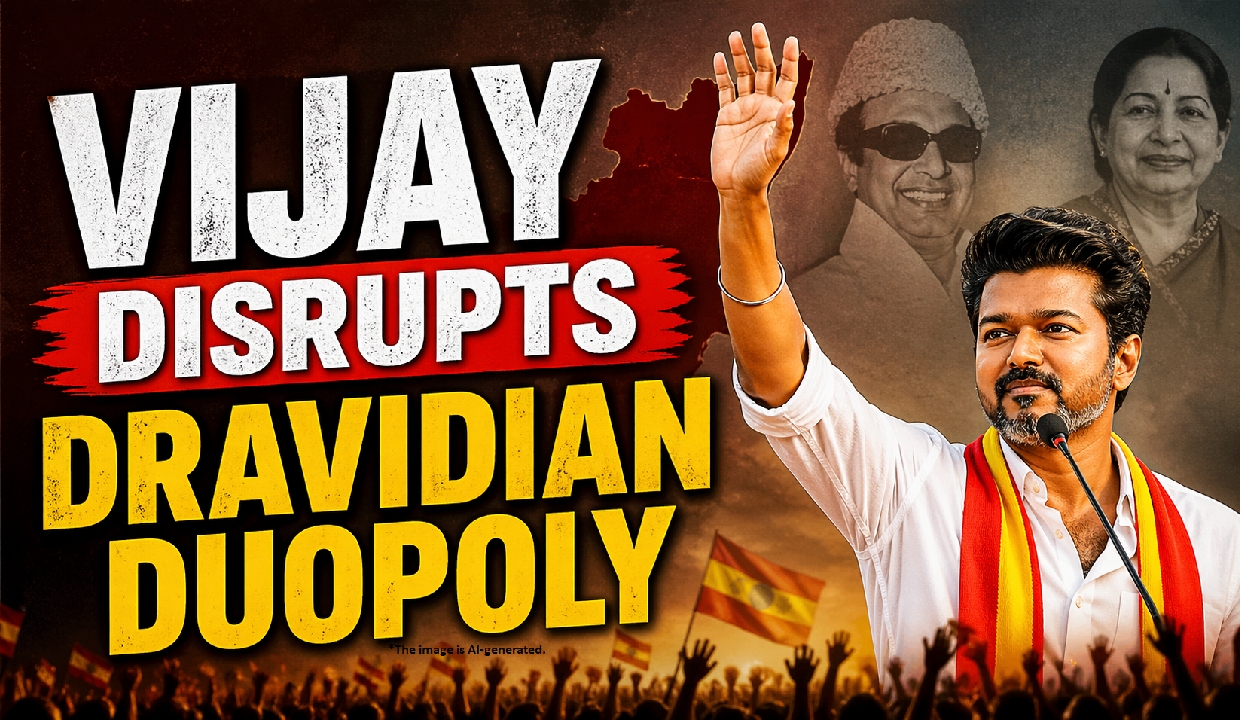
Vijay disrupts Dravidian duopoly
The 2026 Assembly election may not immediately dethrone the Dravidian majors, but it signals the beginning of a more fragmented and competitive era
Tamil Nadu voted to choose its next Assembly on April 23, 2026, and the results would be out on May 4, with the rest of the States that went to polls in the recently held Assembly election. However, the southern politics is way different from what it is in the North. The biggest difference is the absence of the largest ruling party at the centre — the Bharatiya Janata Party, which has sway over most of the northern states, yet still needs to make its presence felt in the southern states.
For long, the Dravadian politics has been dominated by cult figures like MGR, Jayalalitha and has its own dynamics. The chessboard of Tamil Nadu politics has only two players — a bipolar axis dominated by M. K. Stalin’s Dravida Munnetra Kazhagam and the All India Anna Dravida Munnetra Kazhagam, which was headed by charismatic J Jayalalitha. The 2026 election, however, marks a decisive break from that tradition. This time, a new entrant, equally charismatic and sharp, actor-turned-politician Vijay, might well be the third vertex of Tamil Nadu’s politics.
Vijay’s Tamilaga Vettri Kazhagam has transformed the electoral battlefield into a triangular contest. Vijay represents a generational and structural shift. With a projected vote share of 15-20 per cent, TVK may become a serious contender with its leader’s charisma, whose messaging and organisational groundwork may disrupt the well-entrenched political parties. Having said that, it is not to suggest that Vijay is the top runner; he is not, at least for now, but his presence would be felt by all. Ironically, TVK may hurt the Opposition party more than the ruling one. The AIADMK, still recovering from the leadership vacuum left after J. Jayalalithaa, relies heavily on consolidating anti-incumbency sentiment and would have secured all the disgruntled voters, but with Vijay present as a counter force competing in the same space, that vote might get divided as Vijay’s appeal among young, urban, and first-time voters is immense. For Stalin and the DMK, Vijay is good news.
The DMK party continues to benefit from a strong governance narrative, welfare schemes, and a stable social coalition. TVK’s focus on youth, employment, and anti-corruption messaging could erode the DMK’s urban and aspirational voter base, but it would be marginal and impact the fence-sitters. As for the Bharatiya Janata Party, its role in Tamil Nadu remains limited. Unlike in northern states, the BJP has struggled to establish a deep social and cultural foothold in the South. The deeper question is why Tamil Nadu’s politics differs so sharply from that of northern India. The answer lies in history and identity. Welfare politics here is part of a broader social contract. Leaders are judged as much by their ability to deliver governance as by their ideological commitments. This contrasts with the North, where caste alignments, religious polarisation, and national narratives often play a more dominant role. Moreover, Tamil Nadu’s electorates have traditionally favoured regional leadership over national parties. In all likelihood, Vijay would be a serious contender in the next assembly election, and the era of bipolarity may become a relic of the past!