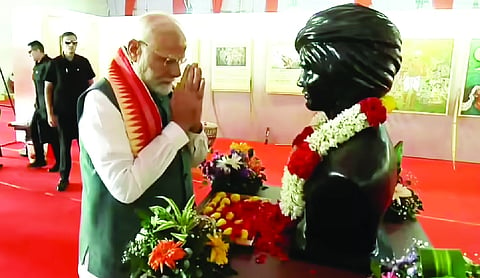

More than a century after he led a courageous resistance against colonial oppression, Bhagwan Birsa Munda continues to inspire India’s march toward justice, dignity, and inclusive development
When India recalls its great freedom fighters, one name rises from the forests of Chotanagpur with enduring moral force - Bhagwan Birsa Munda, revered as Dharti Aaba, the Protector of the Land. More than a historical figure, he remains a living symbol of dignity, resistance, and tribal self-respect. His vision - that tribal identity must be protected, equality must be meaningful, and development must reach ordinary people with justice - continues to guide India’s journey towards Viksit Bharat. Today, after twelve years of renewed national emphasis on inclusive development, those ideals are shaping policy, governance, and the aspirations of a new India.
Giving the legacy its rightful place
Bhagwan Birsa Munda’s legacy has long lived in the songs, stories, and collective memory of tribal communities across India. In 2021, the Hon’ble Prime Minister accorded this legacy national recognition by declaring 15th November, Birsa Munda’s birth anniversary - as Janjatiya Gaurav Diwas. The recognition deepened further with the observance of Janjatiya Gaurav Varsh from November 15, 2024, to November 15, 2025, to mark his 150th birth anniversary. During this period, more than 2 lakh events were organised, reaching over three crore citizens in a nationwide celebration of tribal pride, heritage.
Across the country, these celebrations reflected the richness and diversity of tribal life. From the Hornbill Festival in Nagaland and the Tribal Literary Festival in Kerala to the National Tribal Film Festival in Jharkhand and the Canoe Sprint Championship in Telangana, the events brought tribal culture, creativity, sport, and storytelling into the national spotlight. Together, they saw participation from more than 11 lakh tribal citizens representing distinct cultures and communities. They were declarations - that tribal heritage is a living, breathing force in shaping modern India. Building upon twelve years of sustained and focused national efforts towards tribal empowerment and inclusion, Janjatiya Garima Utsav 2026 carries this momentum forward through four thematic weeks that together reflect the full spectrum of tribal development. The third week, in particular, focuses on a question central to India’s future: how do we recognise the individuals and communities that shaped this nation, and how do we empower the next generation to carry that legacy forward?
Restoring the Names
Answering that question begins with recognising the many tribal heroes whose contributions remained absent from mainstream historical narratives for far too long. Across tribal regions, generations of educators, artists, healers, and reformers have sustained communities and preserved cultural identity. Their stories deserve a rightful place in India’s national memory, and sustained efforts are now underway to document and celebrate these contributions.
Tribal Research Institutes (TRIs) across the country are playing a central role in this effort by documenting oral histories, recording indigenous knowledge systems, and preserving tribal languages and cultural traditions. At present, 29 TRIs across 26 States and 3 Union Territories are engaged in this work, with 355 primers documented in 222 tribal languages. These efforts are helping preserve invaluable cultural knowledge for future generations.
The effort to restore tribal voices to the national narrative is also taking shape through Tribal Freedom Fighters Museums, envisioned as spaces of memory and recognition. Ministry of Tribal Affairs has sanctioned 11 such museums across 10 states to honour the role of tribal communities in India’s freedom movement. Four museums have already been inaugurated, including those dedicated to Bhagwan Birsa Munda in Ranchi and Shaheed Veer Narayan Singh in Nava Raipur. Through these institutions, the stories of tribal heroes are being documented, celebrated and permanently woven into India’s collective historical memory.
Empowering the torch bearers
From honouring the past, the journey naturally moves towards empowering the present generation. This is most visible in the growing number of tribal students benefiting from the Ministry’s scholarship programmes. In the current year alone, 26,01,979 tribal students have been supported under five scholarship schemes, with a total outlay of `3825.54 crores. Many are the first in their families to access higher education, carrying not only personal aspirations but the hopes of entire communities. Of this, over 56 per cent of the current scholarship beneficiaries are women. The expansion of Eklavya Model Residential Schools (EMRS) reflects the same commitment to educational access and opportunity. The number of sanctioned EMRS institutions has increased from 167 in 2013-14 to 723 in 2025-26, a rise of over 330 per cent - while functional schools grew from 123 to 499 during the same period. Student enrolment has also risen significantly, from 0.34 lakh to 1.56 lakh students. By providing quality residential education in tribal regions, EMRS institutions are helping build stronger educational foundations and expanding opportunities for tribal youth across the country.
These numbers reflect more than the expansion of schemes; they represent a larger structural shift. Scholarships and fellowships are investments in confidence, representation, and leadership. Our commitment is unwavering: no tribal student should be denied opportunity because of geography, background, or limited access to institutions of learning.
Alongside this educational transformation is a significant shift in grassroots leadership led by tribal women. For generations, tribal women have been the quiet keepers of culture, natural resources, and community life - sustaining families and traditions. India is home to 5.20 crore tribal women, accounting for almost half of the total tribal population, and their leadership is becoming central to inclusive development. At present, 4,712 VDVKs have been sanctioned, of which 3,365 are operational, benefiting over 12.9 lakh people, with women constituting more than half of the beneficiaries. These efforts are strengthening grassroots democracy.
The legacy that walks forward
Celebration, remembrance, education, and women’s leadership together form part of a larger and continuing story, one in which tribal communities are increasingly shaping India’s future with confidence and dignity. Through initiatives such as Dharti Aaba Janjatiya Gram Utkarsh Abhiyan (DA-JGUA) and Pradhan Mantri Janjati Adiwasi Nyaya Maha Abhiyan (PM JANMAN), transformative change is reaching the ground through a new paradigm of convergence and collaboration. The rise of tribal scholars, the recognition of unsung heroes, and the growing leadership of tribal women together reflect how the legacy of Bhagwan Birsa Munda continues to live in contemporary India. Today, India’s more than 10.5 crore tribal citizens are forward-looking chapters in the national story. They are not at the margins of national progress, but among the strongest contributors to the vision of Viksit Bharat - scholars breaking new ground, women redefining leadership and unsung heroes finally receiving recognition. In this journey, the legacy of Dharti Aaba walks forward.
The effort to restore tribal voices to the national narrative is also taking shape through Tribal Freedom Fighters Museums, envisioned as spaces of memory and recognition
The writer is Secretary, Ministry of Tribal Affairs, GoI; Views presented are personal.