Turning gas crisis into an opportunity
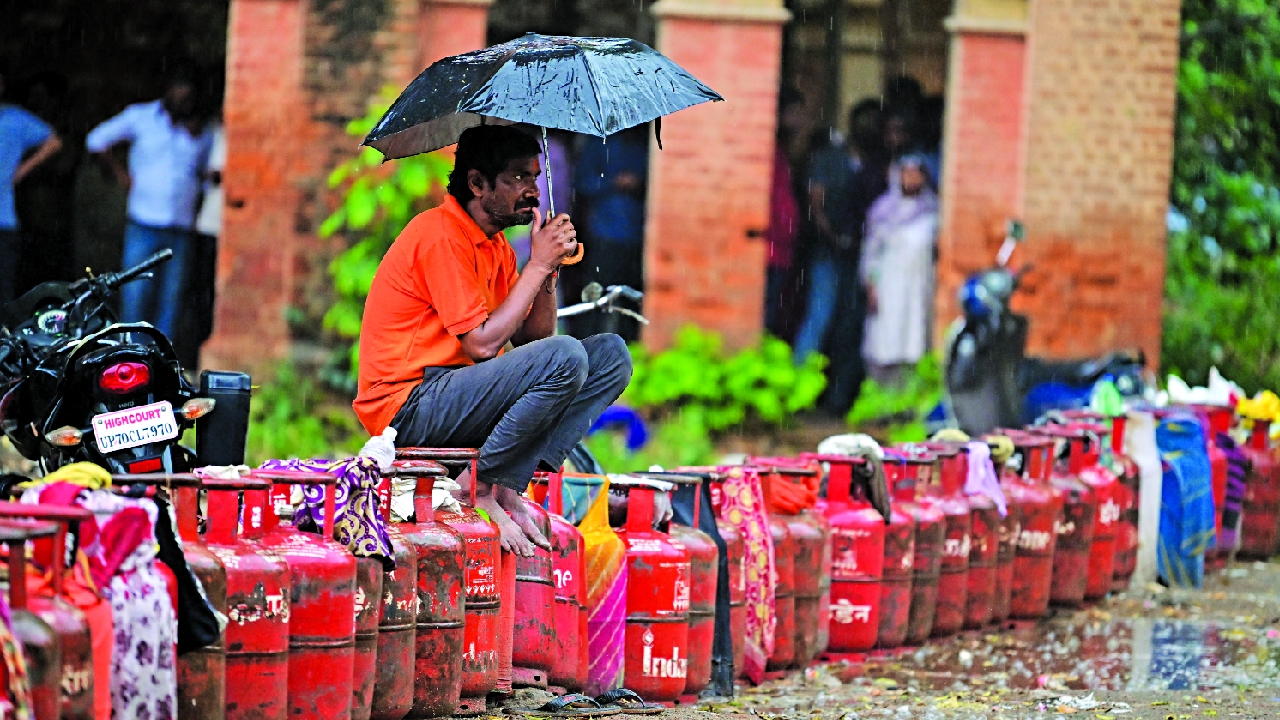
In neighbourhoods from Delhi to the Deccan, a grimly familiar tableau has emerged. Lines of anxious families snake around gas agencies, where heavy steel cylinders roll slowly along the pavement like reluctant passengers in an endless queue. The crisis is hitting the heart of the home and the heat of the kitchen. In restaurants, chefs trade worried whispers while glancing at their final reserves. Meanwhile, small roadside eateries that fuel India’s workforce are being forced into a corner-trimming menus, delaying service, or quietly raising prices just to keep the blue flame alive. Driving this unease is a global tremor.
The ongoing tensions in West Asia have disrupted energy flows and pushed liquefied petroleum gas (LPG) prices sharply upward-by some estimates nearly 77 per cent earlier this month. As India imports a large share of its cooking gas, the effects ripple quickly into everyday life. Shortages appear, delivery dates stretch, and the familiar spectre of black marketing lurks in the background. It is another reminder of how deeply daily life depends on energy that travels thousands of kilometres before reaching an Indian kitchen.
There are two ways to read such an event. One is the familiar way: wait patiently until global tensions ease, prices fall again, and the old routine resumes-until the next geopolitical storm arrives. There is another way to read this crisis. Sometimes, a disruption is not merely an inconvenience; it is an invitation.
A moment when a country can convert vulnerability into strength; when a country can convert a crisis into an opportunity. India could well be at the cusp of such a transformation, depending upon how the situation is seized. To convert this crisis into an opportunity does not require waiting for futuristic technologies.
The elegance of the idea lies in its simplicity. Technologically, the pieces already exist. Firstly, India today possesses a remarkable advantage that did not exist previously: abundant solar power. From the sun-drenched plains of Rajasthan to the vast solar parks of Gujarat, India’s solar capacity has grown immensely. It already has an installed capacity of 85 gigawatts, producing electricity cheaper than most fossil fuels, i.e. at INR 2-2.5 per kWh (kilowatt-hour). Secondly, imagine a familiar object in an unfamiliar form: a cooking cylinder, but instead of gas, it contains stored solar energy.
These “solar cylinders” could be modular battery packs charged at solar-powered hubs. Each pack, storing about 5-6 kWh of energy, could power an induction stove for two or three days of ordinary household cooking. When depleted, it would simply be exchanged for a freshly charged unit.
Thirdly, each 5-6 kWh lithium iron phosphate battery pack-safe and durable-could store enough energy for two to three days of household cooking, plugging straight into induction cooktops that convert electricity to heat far more efficiently than gas burners, i.e. at around 85-90 per cent efficiency, far surpassing that of gas stoves.
Fourthly, India has one of the world’s largest cooking fuel distribution systems. Over 25,000 LPG distributors, fleets of delivery trucks, and established supply routes already serve more than 330 million households. These networks that transport gas could just as well transport charged batteries. The kitchen experience remains familiar: a cylinder arrives, and cooking continues.
Fifthly, battery swapping-already common in electric vehicle ecosystems-allows quick exchanges in minutes rather than long charging waits at centralised stations.
As such, the need is to create a seamless loop: from battery manufacturing, to solar-charged batteries, induction appliances, delivery by agents, and the return of empty units for recharge. The national implication of this is stark: India spends around INR 70,000 to INR 72,000 crore annually on importing LPG. Every meal cooked with domestically generated solar power is one step towards reducing that dependence. Cleaner kitchens, reduced pollution, and greater energy security would follow naturally.
Doubtless, challenges remain. Batteries would need more frequent replacement cycles than gas cylinders, requiring efficient logistics or enhanced capacity over time. Early deployment might focus on solar-rich states such as Rajasthan, Gujarat, or Tamil Nadu before expanding nationwide.
Yet every transformative system begins somewhere-with a pilot, a partnership, a policy push. Government programmes could provide the launchpad. The Pradhan Mantri Surya Ghar Muft Bijli Yojana may subsidise solar setups and could fund charging hubs. The Production Linked Incentive for Advanced Chemistry Cells (PLI-ACC) may drive affordable battery production. Viability Gap Funding for Battery Energy Storage Systems (BESS) may support large-scale solar-linked storage. The Bureau of Energy Efficiency’s Energy Service Companies (ESCOs) framework may enable performance-based swaps.
To accelerate this, NITI Aayog or relevant ministries could convene a meeting among solar farm operators, battery manufacturers, induction stove producers, swapping firms, and gas distributors-leading to collaborations that turn concepts into reality.
Now, we could simply wait for the global gas market to calm down, or we could seize the opportunity to build something quietly revolutionary: a cooking system powered not by distant oilfields, but by the ‘Indian sun’-an Atmanirbhar energy future.
The writer is a former Additional Secretary/ Member (HRD), Postal Services Board, Ministry of Communications; views are personal